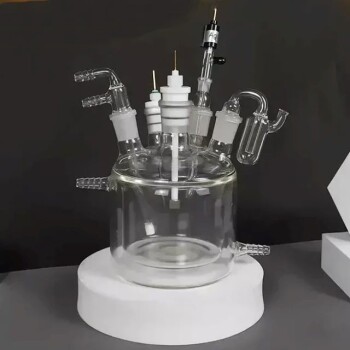
External heating jackets and temperature controllers function as a precision thermal stabilization system, maintaining the electrolyte sample at a constant temperature (typically 298 K) throughout the entire testing process. This isothermal environment is critical because it removes temperature-driven variables, ensuring that any fluctuations in ionic conductivity are strictly the result of applied pressure and its effect on the material's atomic structure.
The primary role of these components is to enforce a strictly isothermal environment, isolating external pressure as the sole independent variable affecting the electrolyte's performance and ion migration characteristics.
Achieving Isothermal Stability
Constant Temperature Maintenance
External heating jackets provide the physical heat source, while temperature controllers provide the logic to maintain a specific set point, such as 298 K.
This stability must be maintained throughout the entire compression and decompression cycle, preventing the system from reacting to ambient lab conditions.
Eliminating Thermal Noise
Ion migration is naturally sensitive to heat; without active control, small temperature shifts could be mistaken for pressure-induced changes.
By locking the temperature, the system eliminates the impact of temperature fluctuations on the movement of ions within the electrolyte.
Isolating Pressure-Induced Effects
Focusing on Atomic Structure
The core goal of electrolyte pressure testing is to understand how external pressure physically alters the atomic structure of a material.
With a constant temperature baseline, researchers can confidently attribute changes in ionic conductivity to the mechanical compaction or expansion of the sample.
Ensuring Data Integrity
Precise environmental control transforms the testing unit from a simple press into a high-fidelity analytical instrument.
It ensures that the resulting data reflects a pure pressure-conductivity relationship, which is essential for developing next-generation battery materials.
Understanding the Trade-offs
Calibration and Thermal Gradients
The effectiveness of these units depends heavily on the placement of the thermal sensors.
If the sensor is not positioned correctly relative to the sample, thermal gradients may develop, leading to internal temperature differences that the controller cannot see.
Managing System Lag
Controllers must be finely tuned to handle the thermal lag inherent in heating jackets and the thick walls of pressure vessels.
Slow response times can lead to "overshooting" the target temperature, briefly compromising the isothermal nature of the experiment during rapid pressure changes.
Applying This to Your Research
Making the Right Choice for Your Goal
To maximize the utility of your electrolyte pressure testing unit, consider your primary experimental objectives:
- If your primary focus is high-precision material characterization: Prioritize a controller with PID (Proportional-Integral-Derivative) logic to minimize temperature oscillations during the cycle.
- If your primary focus is high-throughput testing: Invest in high-wattage heating jackets that can reach the target baseline temperature quickly after sample loading.
- If your primary focus is investigating extreme environments: Ensure the heating jacket is rated for temperatures well above standard room-temp (298 K) to explore the interplay between high heat and high pressure.
By strictly controlling the thermal environment, you turn environmental variables into constants, allowing the true relationship between pressure and conductivity to emerge.
Summary Table:
| Component | Role in Testing | Key Benefit |
|---|---|---|
| External Heating Jacket | Provides physical heat source | Maintains a stable 298 K baseline throughout cycles |
| Temperature Controller | Executes logic (e.g., PID control) | Eliminates thermal noise and prevents fluctuations |
| Thermal Sensors | Monitors internal temperature | Critical for detecting and managing thermal gradients |
| Isothermal Environment | System-wide thermal stability | Isolates pressure as the sole independent variable |
Elevate Your Battery Research with KINTEK Precision
Achieving high-fidelity data in electrolyte pressure testing requires more than just a press—it demands a perfectly controlled environment. KINTEK specializes in advanced laboratory equipment designed for the most rigorous material characterization workflows.
Our extensive portfolio includes high-temperature high-pressure reactors and autoclaves, high-performance hydraulic presses (pellet, hot, isostatic), and precision battery research tools tailored to isolate variables and ensure data integrity. Whether you need PID-controlled heating systems to eliminate thermal noise or specialized consumables like PTFE products and ceramics, we provide the reliable solutions your lab needs to innovate.
Ready to optimize your experimental setup? Contact our technical experts today to discuss how our custom heating solutions and pressure systems can accelerate your research.
References
- Vasiliki Faka, Wolfgang G. Zeier. Pressure dependence of ionic conductivity in site disordered lithium superionic argyrodite Li<sub>6</sub>PS<sub>5</sub>Br. DOI: 10.1039/d3ya00424d
This article is also based on technical information from Kintek Solution Knowledge Base .
Related Products
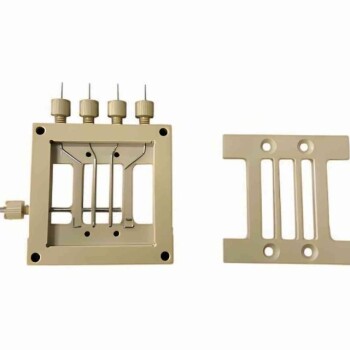
- Custom Ion Conductivity Test Fixtures for Fuel Cell Research
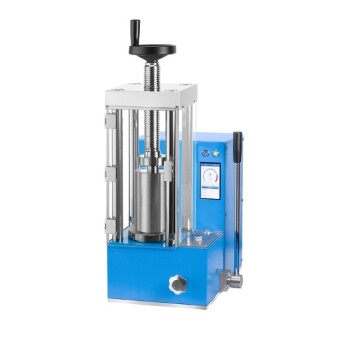
- Electric Lab Cold Isostatic Press CIP Machine for Cold Isostatic Pressing
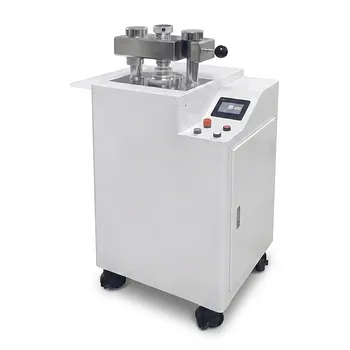
- Automatic Laboratory Hydraulic Press for XRF & KBR Pellet Press
- Laboratory Hydraulic Press Split Electric Lab Pellet Press
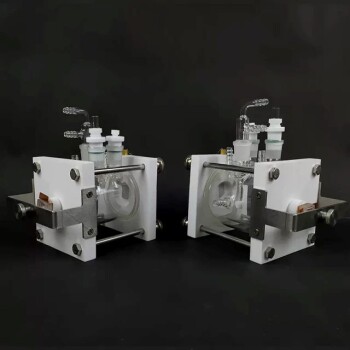
- Electrolytic Electrochemical Cell for Coating Evaluation
People Also Ask
- What is the purpose of using a high-precision capacitance manometer to monitor pressure during cathodic cage nitriding?
- What is the function of a battery test fixture? Essential Mechanical Stabilization for All-Solid-State Battery Testing
- Why is a capacitance manometer preferred for RF plasma systems? Ensure Precise Gas-Independent Pressure Monitoring
- Which thing is determined in ash content? Measure Inorganic Material for Quality Control
- Does strain hardening affect conductivity? Understanding the Strength vs. Conductivity Trade-Off