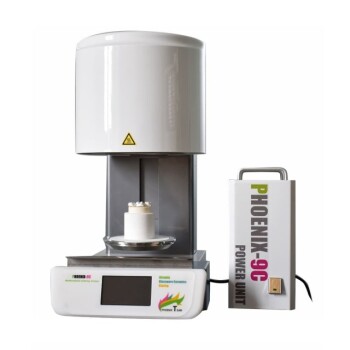
The maturation of dental porcelain is determined by the total heat work applied to the material. This process is a function of two inseparable variables: the time of exposure and the temperature maintained during the firing cycle, rather than the final temperature alone.
True porcelain maturation is not an instant event triggered by hitting a specific degree; it is the cumulative result of heat energy absorbed over time.
The Components of Maturation
The Misconception of Temperature
It is common to assume that the final temperature reached during a firing cycle is the sole determinant of success.
However, reaching a specific peak temperature does not automatically guarantee that the porcelain has fully matured.
Reliance on temperature alone often overlooks the kinetic nature of the sintering process.
The Critical Role of Time
Time is the second, equally important variable in the equation.
For the material to fuse and mature correctly, it must be exposed to heat for a sufficient duration.
This duration allows the heat to penetrate the material uniformly, ensuring consistent physical properties throughout the restoration.
Heat as a Function
In dental ceramics, "heat" should be understood as the integration of time plus temperature.
These two factors work in tandem; a slightly lower temperature held for a longer time can often achieve the same maturation as a higher temperature held for a shorter time.
Operational Considerations
Material-Specific Requirements
The specific settings for a firing cycle are dictated by the material being fired.
Different porcelains have unique chemical compositions that react differently to heat work.
Operators must select parameters that align with the manufacturer’s specifications for that exact product.
Procedural Context
The firing cycle must also be adjusted based on the specific procedure being performed.
A bake for an opaque layer, for example, requires different heat parameters than a glaze firing.
Modern furnaces utilize pre-set, standardized, or custom-programmed cycles to manage these variables automatically.
Understanding the Trade-offs
The Risk of Imbalance
Failing to balance time and temperature can lead to significant quality issues.
If the temperature is high but the time is too short, the porcelain may appear mature on the surface but remain under-fired internally.
Conversely, excessive time at high temperatures can lead to "over-firing," resulting in loss of contour or vitality.
Blind Reliance on Pre-sets
While standardized parameters are useful, they are not infallible.
Variations in furnace calibration or power supply can alter how heat is delivered.
Trusting a pre-set cycle without visually verifying the maturation quality can lead to inconsistent results.
Making the Right Choice for Your Goal
To achieve optimal results, you must manipulate the variables based on your specific objective.
- If your primary focus is Material Integrity: Adhere strictly to the manufacturer's recommended combination of time and temperature to ensure the physical properties are not compromised.
- If your primary focus is Aesthetic Correction: detailed adjustments to the "hold time" (soak) at the final temperature are often more effective than simply raising the temperature.
Mastering the interplay between time and temperature is the only way to ensure predictable, high-quality dental restorations.
Summary Table:
| Factor | Description | Impact on Maturation |
|---|---|---|
| Temperature | The peak heat intensity reached during the firing cycle. | High heat triggers sintering; must be precisely controlled to avoid over-firing. |
| Time | The duration of exposure to the required temperature (soak time). | Ensures uniform heat penetration and consistent physical properties. |
| Material Type | The specific chemical composition of the porcelain. | Dictates unique firing parameters based on manufacturer specifications. |
| Procedure | The specific stage (e.g., opaque layer vs. glaze firing). | Influences whether a short, high-heat or long, low-heat cycle is required. |
Achieve Perfect Porcelain Maturation with KINTEK
Precision in the firing cycle is the difference between a successful restoration and a failed one. KINTEK specializes in high-performance dental furnaces and lab equipment designed to give you absolute control over the time-temperature equation. From advanced dental furnaces and vacuum sintering solutions to high-quality ceramics and crucibles, we provide the tools you need for consistent, aesthetic results.
Ready to elevate your lab's precision? Contact our experts today to find the perfect equipment solution for your dental practice or research facility.
Related Products
- Dental Porcelain Zirconia Sintering Ceramic Vacuum Press Furnace
- Dental Porcelain Zirconia Sintering Ceramic Furnace Chairside with Transformer
- Vacuum Dental Porcelain Sintering Furnace
- High Temperature Muffle Oven Furnace for Laboratory Debinding and Pre Sintering
- Vertical High Temperature Graphite Vacuum Graphitization Furnace
People Also Ask
- What does sintering do to zirconia? Unlock Its Full Strength and Aesthetic Potential
- What is the shrinkage of zirconia during sintering? Mastering the 20-25% Dimensional Change
- What is the sintering temperature of zirconia ceramic? Mastering the 1400°C-1600°C Thermal Profile
- What is the price of zirconia sintering furnace? Invest in Precision, Not Just a Price Tag
- What factors are important to consider when choosing a dental sintering furnace? Match Your Workflow for Optimal Results