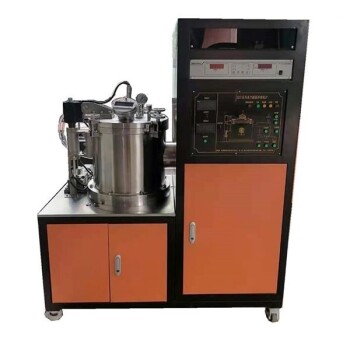
Knowledge What function does a laboratory vacuum furnace serve during the 150°C post-treatment of fluorinated carbon aerogels?
Author avatar

Tech Team · Kintek Solution

Updated 1 day ago

What function does a laboratory vacuum furnace serve during the 150°C post-treatment of fluorinated carbon aerogels?


The primary function of a laboratory vacuum furnace during this specific post-treatment is to act as a purification and stabilization chamber for fluorinated carbon aerogels. By maintaining a temperature of 150°C for two hours under vacuum, the equipment facilitates the thermal decomposition of unstable chemical linkages and the evacuation of hazardous residuals.

The core objective of this process is to transform the aerogel from a volatile state into a chemically stable material by eliminating weak carbon-fluorine bonds and stripping away corrosive byproducts.

The Mechanism of Stabilization

Eliminating Weak Chemical Bonds

The fluorination process introduces various Carbon-Fluorine (C–F) bonds into the aerogel structure.

Not all of these bonds are created equal; some are inherently unstable and weak.

The 150°C thermal treatment provides the precise energy required to break these weak C–F bonds, leaving behind a more robust and uniform molecular structure.

Removal of Residual Byproducts

The synthesis of fluorinated aerogels generates several volatile and potentially dangerous byproducts.

The vacuum furnace plays a critical role in removing trapped residuals such as Fluorine (F2), Hydrogen Fluoride (HF), Nitrogen Trifluoride (NF3), and Tetrafluoromethane (CF4).

The vacuum environment lowers the boiling point of these volatiles and provides a pressure gradient that draws them out of the porous aerogel structure.

The Impact on Material Performance

Enhancing Chemical Stability

By purging the material of unstable bonds, the post-treatment ensures the final product is chemically inert.

This significantly improves the chemical stability of the fluorinated carbon aerogels, making them reliable for long-term use.

Preventing Corrosive Outgassing

Without this treatment, the aerogels would retain trapped gases.

The vacuum furnace ensures that the material does not release corrosive gases during future applications.

This protects both the aerogel itself and any surrounding components from chemical degradation.

Understanding the Trade-offs

The Risk of Inadequate Duration

The two-hour duration is not arbitrary; it is the minimum time required for thorough diffusion.

Shortening this cycle risks leaving residual byproducts deep within the aerogel pores.

This leads to "latent" degradation, where the material appears stable initially but fails later due to slow outgassing.

Temperature Precision vs. Aggression

While some vacuum furnaces can reach extreme temperatures (up to 1600°C), this specific process requires a moderate 150°C.

Exceeding this temperature could damage the desired carbon structure or alter the beneficial properties of the fluorination.

Conversely, temperatures below 150°C may fail to provide enough energy to break the targeted weak C–F bonds.

Making the Right Choice for Your Goal

If your primary focus is Material Longevity: Prioritize the removal of unstable C–F bonds to prevent internal chemical breakdown over time.

If your primary focus is Operational Safety: Ensure the vacuum system is operating at peak efficiency to fully capture and exhaust hazardous byproducts like HF and F2.

By strictly adhering to this thermal vacuum protocol, you convert a volatile raw sample into a robust, chemically inert carbon aerogel ready for advanced applications.

Summary Table:

Process Parameter Action/Mechanism Purpose/Result
Temperature (150°C) Thermal decomposition of weak C–F bonds Enhanced chemical stability and structural robustness
Vacuum Environment Pressure gradient & boiling point reduction Efficient evacuation of volatile residuals (HF, F2, CF4)
Treatment Duration 2-hour consistent thermal soak Ensures thorough diffusion and prevents latent outgassing
Safety Focus Removal of corrosive byproducts Protects final material and surrounding application components

Elevate Your Advanced Material Synthesis with KINTEK

Precision is paramount when stabilizing volatile materials like fluorinated carbon aerogels. KINTEK specializes in high-performance laboratory equipment, offering a comprehensive range of vacuum furnaces, tube furnaces, and atmosphere furnaces designed to deliver the exact temperature control and vacuum integrity your research demands.

From high-temperature high-pressure reactors to specialized PTFE and ceramic consumables, KINTEK provides the tools necessary to ensure material longevity and operational safety in every experiment. Whether you are conducting battery research or developing inert carbon structures, our expert solutions empower your lab to achieve superior results.

Ready to optimize your post-treatment protocols? Contact our technical experts today to find the perfect furnace solution for your laboratory.

References

  1. Yasser Ahmad, Katia Guérin. Advances in tailoring the water content in porous carbon aerogels using RT-pulsed fluorination. DOI: 10.1016/j.jfluchem.2020.109633

This article is also based on technical information from Kintek Solution Knowledge Base .

Related Products

People Also Ask

Related Products

Small Vacuum Heat Treat and Tungsten Wire Sintering Furnace

Small Vacuum Heat Treat and Tungsten Wire Sintering Furnace

The small vacuum tungsten wire sintering furnace is a compact experimental vacuum furnace specially designed for universities and scientific research institutes. The furnace features a CNC welded shell and vacuum piping to ensure leak-free operation. Quick-connect electrical connections facilitate relocation and debugging, and the standard electrical control cabinet is safe and convenient to operate.

Vacuum Heat Treat Furnace with Ceramic Fiber Liner

Vacuum Heat Treat Furnace with Ceramic Fiber Liner

Vacuum furnace with polycrystalline ceramic fiber insulation liner for excellent heat insulation and uniform temperature field. Choose from 1200℃ or 1700℃ max. working temperature with high vacuum performance and precise temperature control.

Graphite Vacuum Furnace High Thermal Conductivity Film Graphitization Furnace

Graphite Vacuum Furnace High Thermal Conductivity Film Graphitization Furnace

The high thermal conductivity film graphitization furnace has uniform temperature, low energy consumption and can operate continuously.

Vertical Laboratory Tube Furnace

Vertical Laboratory Tube Furnace

Elevate your experiments with our Vertical Tube Furnace. Versatile design allows for operation under various environments and heat treatment applications. Order now for precise results!

Vertical High Temperature Graphite Vacuum Graphitization Furnace

Vertical High Temperature Graphite Vacuum Graphitization Furnace

Vertical high temperature graphitization furnace for carbonization and graphitization of carbon materials up to 3100℃.Suitable for shaped graphitization of carbon fiber filaments and other materials sintered in a carbon environment.Applications in metallurgy, electronics, and aerospace for producing high-quality graphite products like electrodes and crucibles.

Laboratory Scientific Electric Heating Blast Drying Oven

Laboratory Scientific Electric Heating Blast Drying Oven

The desktop fast autoclave sterilizer is a compact and reliable device used for rapid sterilization of medical, pharmaceutical, and research items.

Vacuum Heat Treat and Pressure Sintering Furnace for High Temperature Applications

Vacuum Heat Treat and Pressure Sintering Furnace for High Temperature Applications

Vacuum pressure sintering furnaces are designed for high temperature hot pressing applications in metal and ceramic sintering. Its advanced features ensure precise temperature control, reliable pressure maintenance, and a robust design for seamless operation.

High Temperature Muffle Oven Furnace for Laboratory Debinding and Pre Sintering

High Temperature Muffle Oven Furnace for Laboratory Debinding and Pre Sintering

KT-MD High temperature debinding and pre-sintering furnace for ceramic materials with various molding processes. Ideal for electronic components such as MLCC and NFC.

Ultra-High Temperature Graphite Vacuum Graphitization Furnace

Ultra-High Temperature Graphite Vacuum Graphitization Furnace

The ultra-high temperature graphitization furnace utilizes medium frequency induction heating in a vacuum or inert gas environment. The induction coil generates an alternating magnetic field, inducing eddy currents in the graphite crucible, which heats up and radiates heat to the workpiece, bringing it to the desired temperature. This furnace is primarily used for graphitization and sintering of carbon materials, carbon fiber materials, and other composite materials.

1200℃ Muffle Furnace Oven for Laboratory

1200℃ Muffle Furnace Oven for Laboratory

Upgrade your lab with our 1200℃ Muffle Furnace. Achieve fast, precise heating with Japan alumina fibers and Molybdenum coils. Features TFT touch screen controller for easy programming and data analysis. Order now!

1200℃ Split Tube Furnace with Quartz Tube Laboratory Tubular Furnace

1200℃ Split Tube Furnace with Quartz Tube Laboratory Tubular Furnace

KT-TF12 split tube furnace: high-purity insulation, embedded heating wire coils, and max. 1200C. Widely used for new materials and chemical vapour deposition.

Dental Porcelain Zirconia Sintering Ceramic Furnace Chairside with Transformer

Dental Porcelain Zirconia Sintering Ceramic Furnace Chairside with Transformer

Experience top-notch sintering with Chairside Sintering Furnace with Transformer. Easy to operate, noise-free pallet, and automatic temperature calibration. Order now!

Vacuum Hot Press Furnace Machine for Lamination and Heating

Vacuum Hot Press Furnace Machine for Lamination and Heating

Experience clean and precise lamination with Vacuum Lamination Press. Perfect for wafer bonding, thin-film transformations, and LCP lamination. Order now!

Benchtop Laboratory Freeze Dryer for Lab Use

Benchtop Laboratory Freeze Dryer for Lab Use

Premium benchtop laboratory freeze dryer for lyophilization, preserving samples with ≤ -60°C cooling. Ideal for pharmaceuticals & research.

Circulating Water Vacuum Pump for Laboratory and Industrial Use

Circulating Water Vacuum Pump for Laboratory and Industrial Use

Efficient circulating water vacuum pump for labs - oil-free, corrosion-resistant, quiet operation. Multiple models available. Get yours now!

Platinum Sheet Electrode for Laboratory and Industrial Applications

Platinum Sheet Electrode for Laboratory and Industrial Applications

Elevate your experiments with our Platinum Sheet Electrode. Crafted with quality materials, our safe and durable models can be tailored to fit your needs.

Stainless Steel Quick Release Vacuum Chain Three-Section Clamp

Stainless Steel Quick Release Vacuum Chain Three-Section Clamp

Discover our stainless steel quick release clamp vacuum clamp, Ideal for high vacuum applications, Strong connections, reliable sealing, Easy installation, and durable design.

Lab Blown Film Extrusion Three Layer Co-Extrusion Film Blowing Machine

Lab Blown Film Extrusion Three Layer Co-Extrusion Film Blowing Machine

Lab blown film extrusion is mainly used to detect the feasibility of film blowing of polymer materials and the colloid condition in the materials, as well as the dispersion of colored dispersions, controlled mixtures, and extrudates;

Shaking Incubators for Diverse Laboratory Applications

Shaking Incubators for Diverse Laboratory Applications

Precision lab shaking incubators for cell culture & research. Quiet, reliable, customizable. Get expert advice today!

Custom PTFE Teflon Parts Manufacturer for Culture Dish and Evaporation Dish

Custom PTFE Teflon Parts Manufacturer for Culture Dish and Evaporation Dish

The PTFE culture dish evaporating dish is a versatile laboratory tool known for its chemical resistance and high-temperature stability. PTFE, a fluoropolymer, offers exceptional non-stick properties and durability, making it ideal for various applications in research and industry, including filtration, pyrolysis, and membrane technology.


Leave Your Message