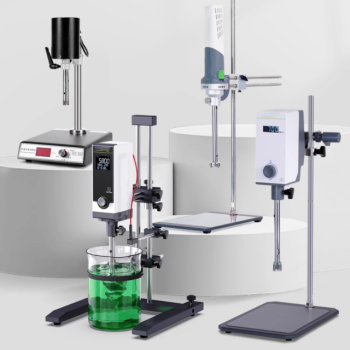
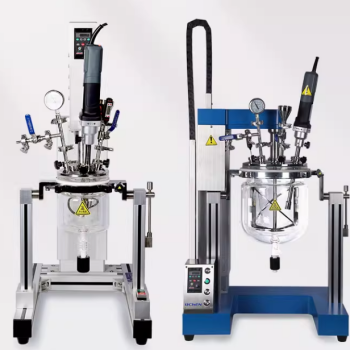
An ultrasonic homogenizer serves the critical function of dispersing agglomerated catalyst powders into a solvent to create a uniform, stable slurry. By generating intense shear forces through a process called cavitation, it breaks down particle clusters and thoroughly mixes them with binders. This high-energy dispersion is a non-negotiable prerequisite for achieving consistent film thickness and strong adhesion in thin-film coatings.
The homogenizer acts as the bridge between raw powder and a viable coating solution. By shattering agglomerates through cavitation, it creates a stable, consistent slurry that guarantees uniform film thickness, strong adhesion, and reliable catalyst performance.
The Mechanism of Dispersion
To understand why this tool is effective, you must look at the physical forces it applies to the liquid mixture.
The Physics of Cavitation
The device transmits high-frequency sound waves into the slurry. This creates cavitation, a phenomenon where microscopic vacuum bubbles form and violently collapse. The energy released during this collapse generates powerful local shear forces.
Breaking Down Agglomerates
Catalyst powders, particularly open-framework materials and nanomaterials, naturally stick together due to forces like Van der Waals attraction. The shear forces generated by the homogenizer overcome these bonds, shattering large clusters into their primary particles.
Creating a Stable Emulsion
Beyond breaking solids, the homogenizer ensures the thorough mixing of incompatible phases. It can disperse aqueous phases into droplets as small as several hundred nanometers, ensuring that binders and metal precursors are evenly distributed throughout the solvent.
Impact on Thin-Film Quality
The quality of your final coating is determined before the deposition process even begins. The state of the ink dictates the properties of the film.
Uniform Film Thickness
If the slurry contains large clumps, the resulting film will be uneven. High-energy dispersion creates a homogeneous ink, which allows for a smooth, consistent application during the film-forming process.
Enhanced Adhesion
Proper mixing ensures that binders are fully integrated with the catalyst particles. This creates a stronger structural network within the ink, leading to stronger adhesion of the film to the substrate once dried.
Maximizing Active Sites
For applications like sensors or electrodes, the catalyst must be chemically active. By breaking down agglomerates, the homogenizer ensures that the surface area of the catalyst is fully exposed. This leads to fully exposed active sites and controllable chemical stoichiometry, directly improving the reproducibility and sensitivity of the final device.
Operational Trade-offs
While ultrasonic homogenization is powerful, it introduces high energy into your sample. It is important to recognize the variables at play to avoid processing errors.
Heat Generation
The cavitation process releases significant energy, which often manifests as heat. If not managed, this temperature rise can degrade sensitive binders or evaporate the solvent prematurely, altering the slurry's viscosity.
Structural Integrity
The goal is to break agglomerates, not the fundamental structure of the catalyst itself. Excessive exposure to high-intensity shear forces can potentially damage the morphology of fragile open-framework materials or nanotubes.
Making the Right Choice for Your Goal
When integrating ultrasonic homogenization into your workflow, align your processing parameters with your specific output requirements.
- If your primary focus is structural durability: Prioritize the thorough mixing of binders to ensure strong adhesion and mechanical stability of the film.
- If your primary focus is electrochemical performance: Focus on achieving the finest possible particle dispersion to maximize the surface area of exposed active sites.
Effective homogenization turns a mixture of raw ingredients into a precision-engineered material ready for high-performance coating.
Summary Table:
| Feature | Role of Ultrasonic Homogenizer | Impact on Coating Quality |
|---|---|---|
| Mechanism | High-intensity cavitation and shear forces | Breaks down Van der Waals clusters |
| Dispersion | Nano-scale particle refinement | Ensures smooth, uniform film thickness |
| Mixing | Homogeneous binder & precursor integration | Enhances adhesion to the substrate |
| Performance | Maximum surface area exposure | Increases active sites for electrochemical efficiency |
| Stability | Prevention of particle re-agglomeration | Consistent slurry viscosity and shelf life |
Elevate Your Material Research with KINTEK Precision
Transitioning from raw catalyst powders to high-performance thin films requires more than just mixing—it requires precision dispersion. At KINTEK, we specialize in the high-performance laboratory equipment necessary to master this transition. From advanced ultrasonic homogenizers and shakers to high-temperature furnaces (CVD, PECVD, vacuum) and hydraulic presses, we provide the tools needed for every stage of material synthesis.
Whether you are developing next-generation electrodes using our electrolytic cells or preparing stable slurries for battery research, our comprehensive portfolio of consumables like PTFE products, ceramics, and crucibles ensures your laboratory maintains the highest standards of reliability.
Ready to optimize your slurry preparation and coating performance? Contact KINTEK today to discover the perfect equipment solution for your lab!
References
- Weijin Li, Roland A. Fischer. Open Framework Material Based Thin Films: Electrochemical Catalysis and State‐of‐the‐art Technologies. DOI: 10.1002/aenm.202202972
This article is also based on technical information from Kintek Solution Knowledge Base .
Related Products
- High Shear Homogenizer for Pharmaceutical and Cosmetic Applications
- High Performance Lab Homogenizer for Pharma Cosmetics and Food R&D
- Lab Sterile Slapping Type Homogenizer for Tissue Mashing and Dispersing
- Laboratory High Throughput Tissue Grinding Mill Grinder
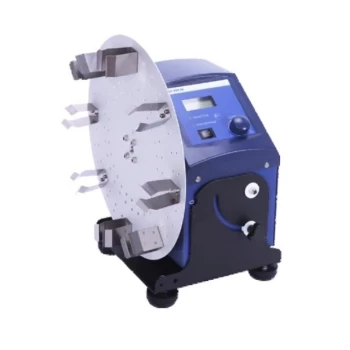
- Laboratory Disc Rotary Mixer for Efficient Sample Mixing and Homogenization
People Also Ask
- Why Use a High Shear Homogenizer for Cathode Slurries? Optimize Double-Layer Solid-State Battery Production
- What is the function of high-shear dispersion equipment in corona-resistant nanocomposites? Elevate Your Insulation
- What is the necessity of using an industrial-grade high-shear homogenizer for biomass washing? Ensure Process Efficiency
- What are the advantages of using a high-shear homogenizer for BED/GMA coatings? Achieve Superior Nano-Dispersion
- What role does a high-shear homogenizer play in ODC catalyst suspensions? Unlock Superior Electrochemical Efficiency