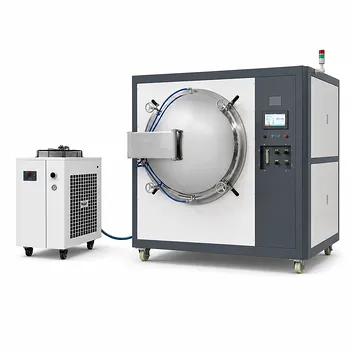
The vacuum environment within a hot pressing furnace acts as a critical purification and protection mechanism. It serves the dual function of chemically protecting the Copper (Cu) and Tungsten Carbide (WC) components from oxidation while physically removing contaminants that hinder densification. This creates a pristine environment necessary for atomic-level bonding.
Core Takeaway The vacuum environment is not merely a passive void; it is an active processing tool that eliminates oxides and adsorbed gases to purify grain boundaries. This purification is the prerequisite for forming strong sintering necks, which directly dictates the composite's final electrical conductivity and mechanical strength.
Chemical Protection and Contaminant Removal
The primary role of the vacuum is to manage the chemical stability of the materials and the cleanliness of the sintering atmosphere.
Prevention of Oxidation
At high sintering temperatures, both copper matrices and tungsten carbide particles are highly susceptible to reacting with oxygen.
The vacuum environment eliminates oxygen from the chamber, preventing the formation of oxide layers on the particle surfaces. This preservation is essential because oxide layers act as barriers that weaken the bond between the metal matrix and the ceramic reinforcement.
Elimination of Adsorbed Gases
Powder particles naturally hold onto moisture and gases on their surfaces.
If these adsorbed gases and volatiles are not removed, they become trapped inside the material during densification, leading to residual porosity. The vacuum creates a pressure differential that effectively pulls these contaminants out of the powder gaps before the material seals shut.
Enhancing Microstructural Integrity
Beyond basic cleaning, the vacuum environment fundamentally alters how the particles interact and bond at the microscopic level.
Purification of Grain Boundaries
By removing surface impurities and preventing new oxides from forming, the vacuum ensures clean grain boundaries.
A pure grain boundary allows for direct contact between the copper and tungsten carbide. This "clean" interface is vital for allowing atoms to diffuse across the boundary, creating a cohesive solid rather than a loosely packed aggregate.
Promotion of Sintering Necks
The vacuum facilitates the initial stages of bonding, known as sintering neck formation.
Because the particle surfaces are chemically active and free of contaminants, diffusion occurs more readily. This promotes better wetting of the solid phase by the liquid phase (if present) and accelerates the growth of connections (necks) between particles.
The Impact on Final Material Performance
The functions described above culminate in tangible improvements to the material's macroscopic properties.
Improving Electrical Conductivity
Electrical conductivity relies on the uninterrupted flow of electrons through the material.
Impurities and oxide layers at grain boundaries act as resistors, scattering electrons and reducing performance. By creating purified grain boundaries, the vacuum environment minimizes this resistance, significantly enhancing the overall conductivity of the Cu/WC composite.
Maximizing Mechanical Properties
The strength of a composite is defined by the quality of the bond between its constituents.
The vacuum ensures a pure interfacial bond free of voids and brittle oxide layers. This results in higher material density, optimized fracture toughness, and superior hardness, as the external load can be effectively transferred between the copper matrix and the hard tungsten carbide particles.
Understanding the Trade-offs
While vacuum hot pressing is superior for quality, it introduces specific challenges that must be managed.
Equipment and Process Complexity
Achieving the necessary vacuum levels (often as high as $1 \times 10^{-2}$ Pa or greater) requires sophisticated pumping systems and seals. This adds significant capital cost and maintenance complexity compared to conventional atmospheric sintering.
The Necessity of Synergy
A common pitfall is assuming the vacuum alone guarantees density.
The vacuum must work in synergy with mechanical pressure (often 30–50 MPa) and precise heat. Without the simultaneous application of axial pressure, the vacuum can clean the particles, but it cannot force them together effectively enough to eliminate all residual pores and achieve near-full densification.
Making the Right Choice for Your Goal
To maximize the benefits of vacuum hot pressing for your specific application:
- If your primary focus is Electrical Conductivity: Prioritize high vacuum levels to ensure maximum purification of grain boundaries, reducing electron scattering.
- If your primary focus is Mechanical Strength: Focus on the synergy between vacuum and pressure to eliminate all residual pores and ensure a defect-free interfacial bond.
- If your primary focus is Process Efficiency: Ensure your cycle time includes adequate "hold time" under vacuum before maximum pressure is applied to allow trapped volatiles to fully escape.
The vacuum environment is the invisible key that transforms a mixture of powders into a high-performance, unified composite.
Summary Table:
| Function | Mechanism | Impact on Material |
|---|---|---|
| Oxidation Prevention | Eliminates oxygen from the chamber | Ensures clean particle surfaces and strong interfacial bonding |
| Gas Elimination | Removes moisture and volatiles | Reduces residual porosity and prevents internal defects |
| Boundary Purification | Cleans grain boundaries | Lowers electron scattering and improves electrical conductivity |
| Enhanced Sintering | Promotes sintering neck formation | Increases material density and overall mechanical strength |
Elevate Your Material Research with KINTEK Precision
Achieve unmatched densification and purity in your composite materials with KINTEK’s advanced vacuum hot pressing furnaces. Whether you are working on high-conductivity Cu/WC composites or advanced ceramics, our comprehensive range of laboratory equipment—including vacuum, tube, and induction melting furnaces, hydraulic pellet presses, and high-purity crucibles—is designed to meet the most rigorous scientific standards.
Ready to optimize your sintering process? Contact us today to discover how our tailored thermal and pressure solutions can enhance your lab's efficiency and material performance.
Related Products
- Vacuum Hot Press Furnace Heated Vacuum Press Machine Tube Furnace
- 600T Vacuum Induction Hot Press Furnace for Heat Treat and Sintering
- Vacuum Hot Press Furnace Machine Heated Vacuum Press
- Vacuum Hot Press Furnace Machine for Lamination and Heating
- Vacuum Heat Treat and Pressure Sintering Furnace for High Temperature Applications
People Also Ask
- What advantages does a vacuum hot press furnace provide for LSLBO ceramic electrolytes? Achieve 94% Relative Density
- What role does a Vacuum Hot Press (VHP) furnace play in the densification of austenitic stainless steel 316 composites?
- What are the advantages of using a vacuum hot pressing furnace? Superior Densification for 2024Al/Gr/SiC Composites
- What are the advantages of a vacuum hot press furnace for LTPO solid electrolytes? Boost Density and Conductivity
- What core processing conditions does a vacuum hot press furnace provide? Achieve High-Density Cu-SiC/Diamond Composites