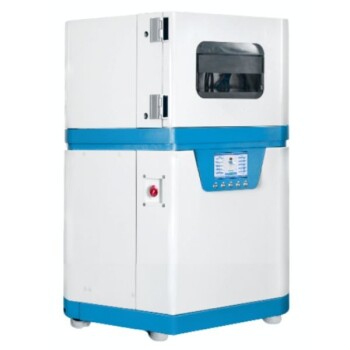
A vacuum hot pressing furnace acts as the critical consolidation engine for producing high-quality aluminum-tin (Al-Sn) and graphene nanocomposites. It achieves this by simultaneously applying high thermal energy (typically around 540°C) and substantial mechanical pressure (approximately 40 MPa) within a strictly controlled vacuum environment (e.g., 10^-3 Torr) to transform loose powders into a dense, integrated solid.
The Core Value The primary function of this equipment is to overcome the natural barriers to bonding found in aluminum and graphene. By removing air to prevent oxidation and mechanically forcing particles together, it facilitates atomic diffusion and plastic flow, resulting in a composite with near-theoretical density and superior interfacial strength.
The Mechanics of Densification
The Necessity of the Vacuum Environment
Aluminum is highly reactive and naturally forms a tough oxide layer when exposed to air. In a nanocomposite, these oxides act as contaminants that weaken the material.
The vacuum hot pressing furnace operates at vacuum levels such as 10^-3 Torr. This environment serves two functions: it prevents further oxidation of the aluminum matrix during heating and helps strip away volatile impurities. This ensures that the metal particles and graphene sheets have clean surfaces, allowing for direct contact and stronger bonding.
Driving Plastic Flow and Diffusion
Temperature alone is often insufficient to densify nanocomposites fully. The furnace applies uniaxial mechanical pressure (e.g., 40 MPa) while the material is heated.
At 540°C, the aluminum matrix softens. The external pressure forces this softened metal to flow plastically, physically filling the microscopic voids between powder particles. Simultaneously, this pressure accelerates atomic diffusion, causing atoms to migrate across particle boundaries to create a solid, continuous metallurgical bond.
Optimizing the Composite Structure
Managing the Liquid Phase
In Al-Sn alloys, tin has a significantly lower melting point than aluminum. As the temperature rises, local liquid phases may appear.
Precise pressure control is vital here. If the pressure is too high when the tin melts, the liquid metal can be squeezed out of the mold, altering the chemical composition of the final product. The furnace allows for regulated pressure application to promote densification without expelling the necessary alloying elements.
Preserving Graphene Integrity
Graphene provides strength and conductivity, but it is sensitive to thermal stress and oxidation.
The furnace's ability to control heating rates (e.g., 10°C/min) ensures the composite is heated steadily. This stability prevents "thermal shock" and abnormal grain growth. Furthermore, it protects the structural integrity of the graphene, ensuring it remains distributed as a reinforcement rather than degrading or agglomerating due to temperature fluctuations.
Understanding the Trade-offs
While vacuum hot pressing is superior for quality, it presents specific operational challenges that must be managed.
Process Speed vs. Quality
This is a batch process that is generally slower than conventional sintering. The requirement to pump down to a high vacuum and the need for controlled heating and cooling rates to protect the graphene lengthens the cycle time significantly.
The Risk of Component Loss
As noted regarding the liquid phase, there is a distinct risk of compositional drift. If the pressure schedule is not perfectly synchronized with the temperature profile, low-melting-point components (like Tin in Al-Sn) can be lost to "squeeze out," resulting in a final part that is porous or chemically incorrect despite the high-tech processing.
Making the Right Choice for Your Goal
To maximize the utility of a vacuum hot pressing furnace for Al-Sn/Graphene composites, align your process parameters with your specific performance targets:
- If your primary focus is Maximum Density and Strength: Prioritize high pressure (up to 40 MPa) and ensure the vacuum is maintained at 10^-3 Torr or better to maximize plastic flow and eliminate all porosity.
- If your primary focus is Compositional Accuracy: meticulously program the pressure application to relax slightly during the temperature window where Tin enters its liquid phase to prevent material squeeze-out.
- If your primary focus is Electrical Conductivity: strict control of the heating rate is required to prevent grain coarsening and ensure the graphene network remains intact and conductive.
The vacuum hot pressing furnace is not merely a heating device; it is a precision instrument that forces incompatible materials to bond into a unified, high-performance solid.
Summary Table:
| Parameter | Specification/Value | Role in Process |
|---|---|---|
| Vacuum Level | 10^-3 Torr | Prevents oxidation; removes impurities for clean bonding |
| Temperature | ~540°C | Softens Al-matrix to facilitate plastic flow and diffusion |
| Pressure | ~40 MPa | Eliminates voids; promotes near-theoretical densification |
| Heating Rate | ~10°C/min | Protects graphene integrity and prevents thermal shock |
| Target Goal | High Density & Strength | Forced atomic diffusion and metallurgical bonding |
Elevate Your Material Research with KINTEK
Precision is non-negotiable when working with sensitive nanocomposites like Al-Sn and graphene. KINTEK specializes in advanced laboratory equipment, providing high-performance vacuum hot pressing furnaces, high-temperature furnaces, and crushing and milling systems designed to meet the rigorous demands of material science.
Our solutions empower your lab to achieve superior interfacial strength and perfect chemical composition. Whether you need reliable hydraulic presses, isostatic presses, or essential PTFE and ceramic consumables, KINTEK is your partner in innovation.
Ready to optimize your densification process? Contact our experts today and find the perfect equipment for your research goals.
Related Products
- Vacuum Hot Press Furnace Heated Vacuum Press Machine Tube Furnace
- 600T Vacuum Induction Hot Press Furnace for Heat Treat and Sintering
- Vacuum Hot Press Furnace Machine Heated Vacuum Press
- Vacuum Hot Press Furnace Machine for Lamination and Heating
- Vacuum Heat Treat and Pressure Sintering Furnace for High Temperature Applications
People Also Ask
- What advantages does a vacuum hot press furnace provide for LSLBO ceramic electrolytes? Achieve 94% Relative Density
- What role does a Vacuum Hot Press (VHP) furnace play in the densification of austenitic stainless steel 316 composites?
- What are the advantages of using a vacuum hot pressing furnace? Superior Densification for 2024Al/Gr/SiC Composites
- What are the advantages of a vacuum hot press furnace for LTPO solid electrolytes? Boost Density and Conductivity
- What core processing conditions does a vacuum hot press furnace provide? Achieve High-Density Cu-SiC/Diamond Composites