Knowledge Vacuum Furnace What is a retort in heat treatment? Achieve Superior Surface Quality and Metallurgical Control
Author avatar

Tech Team · Kintek Solution

Updated 2 months ago

What is a retort in heat treatment? Achieve Superior Surface Quality and Metallurgical Control


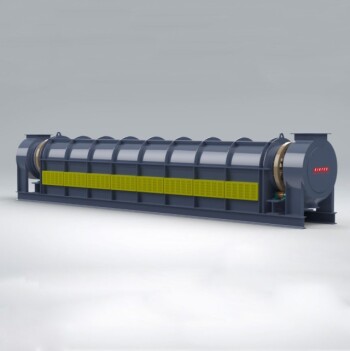
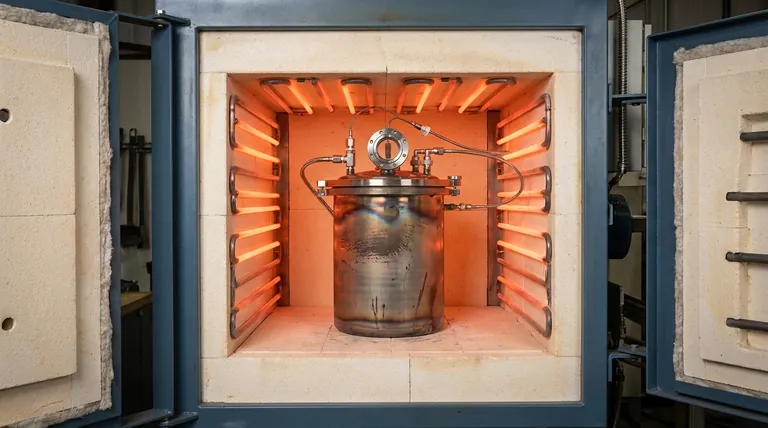
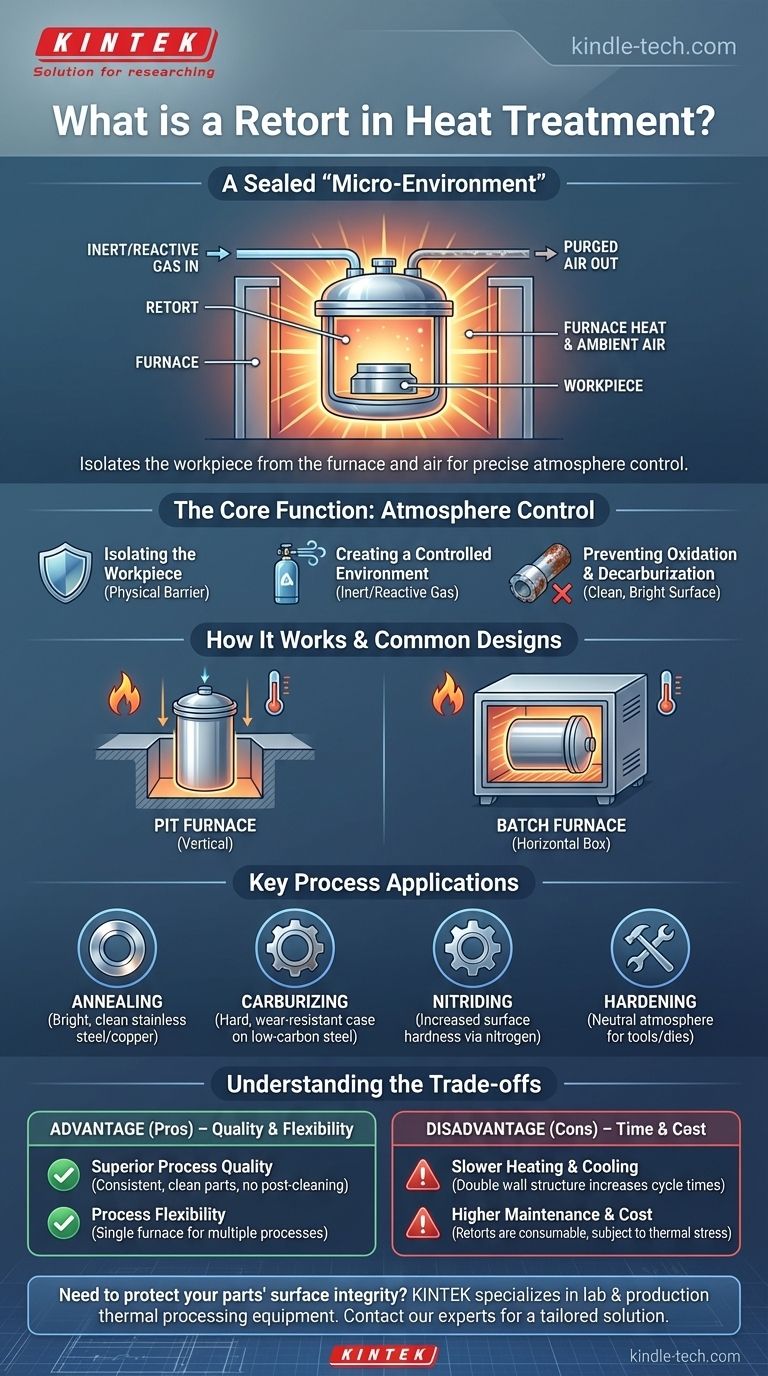
In the simplest terms, a retort is a sealed, often metallic, container used inside a furnace during heat treatment. Its purpose is to isolate the workpiece from the furnace's direct heating environment and the outside air. This separation allows for precise control over the gaseous atmosphere surrounding the part, which is critical for achieving specific metallurgical outcomes.

The core takeaway is this: a retort is not the furnace itself, but a specialized chamber placed within it. Think of it as creating a "micro-environment" to protect the material's surface and control chemical reactions during the heating process.
What is a retort in heat treatment? Achieve Superior Surface Quality and Metallurgical Control

The Core Function: Atmosphere Control

The entire reason for using a retort comes down to one critical factor: atmosphere control. Without it, heating metals to high temperatures in the presence of air would cause undesirable reactions.

Isolating the Workpiece

A retort acts as a physical barrier. It separates the parts being treated from the furnace's heating elements (whether gas-fired or electric) and any ambient air that might leak into the main furnace chamber.

Creating a Controlled Environment

Once sealed, the air inside the retort is purged and replaced with a specific gas or gas mixture. This can be an inert gas (like nitrogen or argon) to simply prevent reactions, or a reactive gas designed to intentionally change the part's surface chemistry.

Preventing Oxidation and Decarburization

The most common use of a retort is to prevent oxidation (scaling) and decarburization (loss of carbon from the surface of steel). By replacing oxygen with an inert or controlled atmosphere, the metal surface remains clean, bright, and maintains its intended hardness and properties.

How Retort Furnaces Work

While designs vary, the fundamental principle is consistent. The process involves placing the parts inside the retort, sealing it, and then placing the entire sealed container into the main furnace for heating.

The Basic Setup

The system consists of two main parts: the outer furnace, which provides the thermal energy, and the inner retort, which contains the workload and the controlled atmosphere. These retorts are typically made from high-temperature nickel-chromium alloys to withstand thermal cycling.

Common Process Applications

Retorts are essential for processes where the surface of the material cannot be compromised. This includes:

  • Annealing: Especially bright annealing of stainless steel or copper.
  • Carburizing: Adding carbon to the surface of low-carbon steel to create a hard, wear-resistant case.
  • Nitriding: Diffusing nitrogen into the surface of steel to increase surface hardness.
  • Hardening: Heating tools and dies in a neutral atmosphere to prevent decarburization.

Common Designs: Pit vs. Batch

Retort furnaces are often configured as pit furnaces, where a cylindrical retort is lowered vertically into a furnace in the floor. This is ideal for long, shaft-like parts. They also come in horizontal batch (or "box") furnace designs, which function much like a conventional oven.

Understanding the Trade-offs

Using a retort provides superior quality, but it comes with clear operational trade-offs that are important to understand.

Advantage: Superior Process Quality

By perfectly controlling the atmosphere, retorts deliver clean, bright parts with highly consistent and repeatable metallurgical properties. This eliminates the need for post-treatment cleaning operations like sandblasting.

Advantage: Process Flexibility

A single retort furnace can be used for a wide variety of processes—from annealing to carburizing—simply by changing the atmosphere introduced into the retort.

Disadvantage: Slower Heating and Cooling

The retort itself is a layer of metal that heat must conduct through. This "double wall" structure means cycle times are inherently longer compared to direct-heating or vacuum furnaces, which reduces overall throughput.

Disadvantage: Higher Maintenance and Cost

Retorts are consumables. They are subjected to extreme thermal stress, which eventually leads to warping, cracking, and failure. These high-alloy containers are expensive to replace and represent a significant operational cost.

Making the Right Choice for Your Process

Deciding whether a retort furnace is appropriate depends entirely on the metallurgical requirements of the part and your operational priorities.

  • If your primary focus is the highest surface quality and precise chemistry: A retort is essential for processes like bright annealing, carburizing, or nitriding where surface integrity is paramount.
  • If your primary focus is bulk heat treatment where some surface oxidation is acceptable: A direct-fired or atmosphere furnace without a sealed retort may be a more cost-effective and higher-throughput solution.
  • If your primary focus is rapid cycle times with high cleanliness: A vacuum furnace is a strong alternative, as it provides an even cleaner environment and can often heat and cool faster, though with a higher initial investment.

Ultimately, a retort is the tool you choose when the integrity and chemistry of the material's surface are non-negotiable.

Summary Table:

Feature Advantage Disadvantage
Atmosphere Control Prevents oxidation/decarburization; enables reactive processes Higher operational complexity
Process Quality Delivers clean, bright parts with consistent properties Slower heating/cooling cycles
Process Flexibility Single furnace can handle annealing, carburizing, nitriding High maintenance cost (retort is a consumable)

Need to protect your parts' surface integrity during heat treatment?

KINTEK specializes in lab and production-scale thermal processing equipment. Whether you are bright annealing stainless steel or carburizing tool steels, our expertise can help you select the right furnace technology—including retort systems—to achieve your precise metallurgical goals and improve your process reliability.

Contact our thermal processing experts today to discuss your application and get a tailored solution.

Visual Guide
What is a retort in heat treatment? Achieve Superior Surface Quality and Metallurgical Control Visual Guide

Related Products

People Also Ask

Related Products

Laboratory Vacuum Tilt Rotary Tube Furnace Rotating Tube Furnace

Laboratory Vacuum Tilt Rotary Tube Furnace Rotating Tube Furnace

Discover the versatility of Laboratory Rotary Furnace: Ideal for calcination, drying, sintering, and high-temperature reactions. Adjustable rotating and tilting functions for optimal heating. Suitable for vacuum and controlled atmosphere environments. Learn more now!

Rotary Tube Furnace Split Multi Heating Zone Rotating Tube Furnace

Rotary Tube Furnace Split Multi Heating Zone Rotating Tube Furnace

Multi zone rotary furnace for high-precision temperature control with 2-8 independent heating zones. Ideal for lithium ion battery electrode materials and high-temperature reactions. Can work under vacuum and controlled atmosphere.

Vacuum Sealed Continuous Working Rotary Tube Furnace Rotating Tube Furnace

Vacuum Sealed Continuous Working Rotary Tube Furnace Rotating Tube Furnace

Experience efficient material processing with our vacuum-sealed rotary tube furnace. Perfect for experiments or industrial production, equipped with optional features for controlled feeding and optimized results. Order now.

Electric Rotary Kiln Small Rotary Furnace Biomass Pyrolysis Plant

Electric Rotary Kiln Small Rotary Furnace Biomass Pyrolysis Plant

Learn about Rotary Biomass Pyrolysis Furnaces & how they decompose organic material at high temps without oxygen. Use for biofuels, waste processing, chemicals & more.

Electric Rotary Kiln Small Rotary Furnace for Activated Carbon Regeneration

Electric Rotary Kiln Small Rotary Furnace for Activated Carbon Regeneration

Revitalize your activated carbon with KinTek's Electric Regeneration Furnace. Achieve efficient and cost-effective regeneration with our highly automated rotary kiln and intelligent thermal controller.

Electric Rotary Kiln Continuous Working Small Rotary Furnace Heating Pyrolysis Plant

Electric Rotary Kiln Continuous Working Small Rotary Furnace Heating Pyrolysis Plant

Efficiently calcine and dry bulk powder and lump fluid materials with an electric heating rotary furnace. Ideal for processing lithium ion battery materials and more.

High Temperature Muffle Oven Furnace for Laboratory Debinding and Pre Sintering

High Temperature Muffle Oven Furnace for Laboratory Debinding and Pre Sintering

KT-MD High temperature debinding and pre-sintering furnace for ceramic materials with various molding processes. Ideal for electronic components such as MLCC and NFC.

Dental Porcelain Zirconia Sintering Ceramic Furnace Chairside with Transformer

Dental Porcelain Zirconia Sintering Ceramic Furnace Chairside with Transformer

Experience top-notch sintering with Chairside Sintering Furnace with Transformer. Easy to operate, noise-free pallet, and automatic temperature calibration. Order now!

Vertical High Temperature Graphite Vacuum Graphitization Furnace

Vertical High Temperature Graphite Vacuum Graphitization Furnace

Vertical high temperature graphitization furnace for carbonization and graphitization of carbon materials up to 3100℃.Suitable for shaped graphitization of carbon fiber filaments and other materials sintered in a carbon environment.Applications in metallurgy, electronics, and aerospace for producing high-quality graphite products like electrodes and crucibles.

Ultra-High Temperature Graphite Vacuum Graphitization Furnace

Ultra-High Temperature Graphite Vacuum Graphitization Furnace

The ultra-high temperature graphitization furnace utilizes medium frequency induction heating in a vacuum or inert gas environment. The induction coil generates an alternating magnetic field, inducing eddy currents in the graphite crucible, which heats up and radiates heat to the workpiece, bringing it to the desired temperature. This furnace is primarily used for graphitization and sintering of carbon materials, carbon fiber materials, and other composite materials.

Electric Rotary Kiln Pyrolysis Furnace Plant Machine Calciner Small Rotary Kiln Rotating Furnace

Electric Rotary Kiln Pyrolysis Furnace Plant Machine Calciner Small Rotary Kiln Rotating Furnace

Electric rotary kiln - precisely controlled, it's ideal for calcination and drying of materials like lithium cobalate, rare earths, and non-ferrous metals.

Laboratory Rapid Thermal Processing (RTP) Quartz Tube Furnace

Laboratory Rapid Thermal Processing (RTP) Quartz Tube Furnace

Get lightning-fast heating with our RTP Rapid Heating Tube Furnace. Designed for precise, high-speed heating and cooling with convenient sliding rail and TFT touch screen controller. Order now for ideal thermal processing!

Vacuum Heat Treat Furnace with Ceramic Fiber Liner

Vacuum Heat Treat Furnace with Ceramic Fiber Liner

Vacuum furnace with polycrystalline ceramic fiber insulation liner for excellent heat insulation and uniform temperature field. Choose from 1200℃ or 1700℃ max. working temperature with high vacuum performance and precise temperature control.

Large Vertical Graphite Vacuum Graphitization Furnace

Large Vertical Graphite Vacuum Graphitization Furnace

A large vertical high-temperature graphitization furnace is a type of industrial furnace used for the graphitization of carbon materials, such as carbon fiber and carbon black. It is a high-temperature furnace that can reach temperatures of up to 3100°C.

Laboratory Muffle Oven Furnace Bottom Lifting Muffle Furnace

Laboratory Muffle Oven Furnace Bottom Lifting Muffle Furnace

Efficiently produce batches with excellent temperature uniformity using our Bottom Lifting Furnace. Features two electric lifting stages and advanced temperature control up to 1600℃.

Graphite Vacuum Furnace Bottom Discharge Graphitization Furnace for Carbon Materials

Graphite Vacuum Furnace Bottom Discharge Graphitization Furnace for Carbon Materials

Bottom-out graphitization furnace for carbon materials, ultra-high temperature furnace up to 3100°C, suitable for graphitization and sintering of carbon rods and carbon blocks. Vertical design, bottom discharging, convenient feeding and discharging, high temperature uniformity, low energy consumption, good stability, hydraulic lifting system, convenient loading and unloading.

Horizontal High Temperature Graphite Vacuum Graphitization Furnace

Horizontal High Temperature Graphite Vacuum Graphitization Furnace

Horizontal Graphitization Furnace: This type of furnace is designed with the heating elements placed horizontally, allowing for uniform heating of the sample. It's well-suited for graphitizing large or bulky samples that require precise temperature control and uniformity.

Controlled Nitrogen Inert Hydrogen Atmosphere Furnace

Controlled Nitrogen Inert Hydrogen Atmosphere Furnace

KT-AH Hydrogen atmosphere furnace - induction gas furnace for sintering/annealing with built-in safety features, dual housing design, and energy-saving efficiency. Ideal for lab and industrial use.

2200 ℃ Graphite Vacuum Heat Treat Furnace

2200 ℃ Graphite Vacuum Heat Treat Furnace

Discover the power of the KT-VG Graphite Vacuum Furnace - with a maximum working temperature of 2200℃, it's perfect for vacuum sintering of various materials. Learn more now.

1700℃ Controlled Atmosphere Furnace Nitrogen Inert Atmosphere Furnace

1700℃ Controlled Atmosphere Furnace Nitrogen Inert Atmosphere Furnace

KT-17A Controlled atmosphere furnace: 1700℃ heating, vacuum sealing technology, PID temperature control, and versatile TFT smart touch screen controller for laboratory and industrial use.


Leave Your Message