Knowledge CVD materials What is an example of a thin film? Discover the Microscopic Layers Powering Modern Tech
Author avatar

Tech Team · Kintek Solution

Updated 2 months ago

What is an example of a thin film? Discover the Microscopic Layers Powering Modern Tech


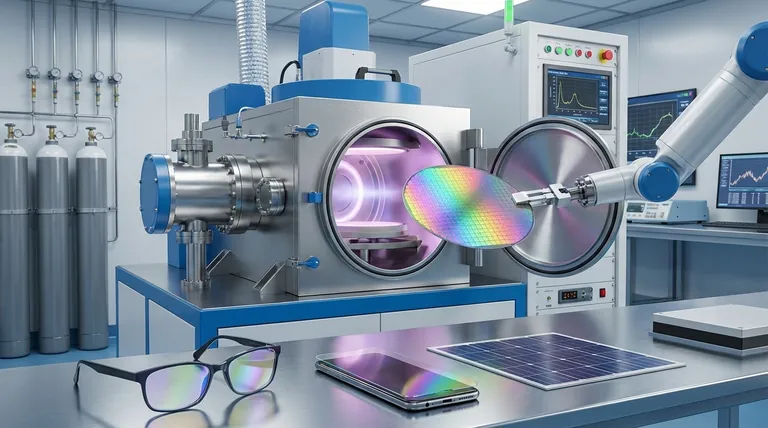
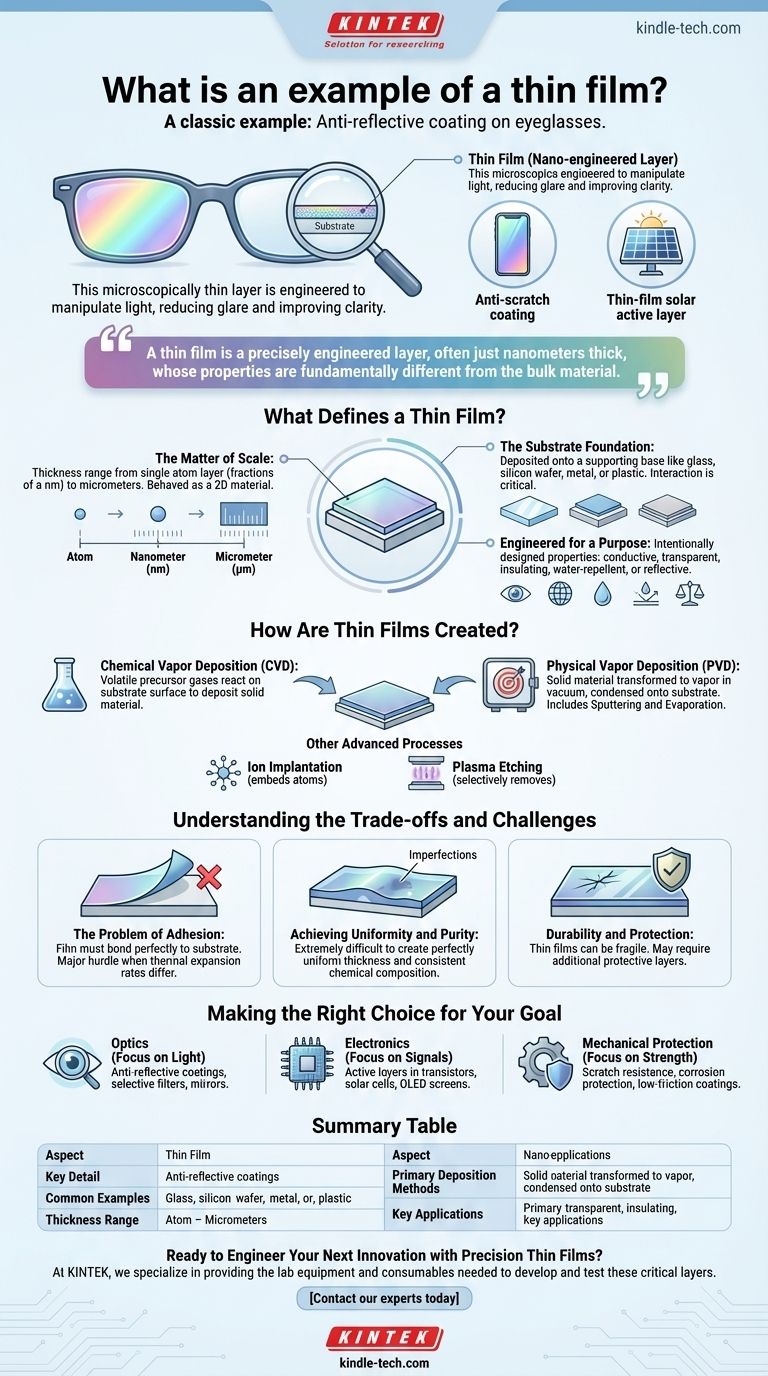
A classic example of a thin film is the anti-reflective coating on a pair of eyeglasses. This microscopically thin layer is engineered to manipulate light, reducing glare and improving clarity. Other common examples include the protective anti-scratch coatings on smartphone screens and the active layers in thin-film solar panels.

A thin film is more than just a small amount of material. It is a precisely engineered layer, often just nanometers thick, whose properties are fundamentally different from the bulk material, making it a critical component in countless modern technologies.
What is an example of a thin film? Discover the Microscopic Layers Powering Modern Tech

What Defines a Thin Film?

A thin film is a layer of material deposited onto a supporting base, or substrate. Its defining characteristic is its extreme dimensional asymmetry—its thickness is vastly smaller than its length and width.

The Matter of Scale

A thin film’s thickness can range from a single layer of atoms (fractions of a nanometer) up to several micrometers. Because its third dimension (height) is so suppressed, it behaves in many ways like a two-dimensional material.

This extreme thinness is what gives the film unique properties that are not present in the same material in its bulk form.

The Substrate Foundation

Thin films are almost never freestanding; they are deposited onto a substrate. This base can be made of various materials, such as glass, silicon wafers, metal, or plastic, depending on the final application.

The interaction between the film and the substrate is critical for the device's function and durability.

Engineered for a Purpose

The properties of a thin film are not accidental. They are intentionally designed to meet specific application requirements, which can be optical, electronic, mechanical, or chemical.

For instance, a film can be designed to be conductive, transparent, insulating, water-repellent, or reflective to certain wavelengths of light. Often, a single film must meet multiple requirements at once.

How Are Thin Films Created?

Creating uniform, high-quality thin films requires highly controlled and specialized manufacturing processes. The two primary methods are chemical and physical deposition.

Chemical Vapor Deposition (CVD)

In CVD, the substrate is exposed to volatile precursor gases. A chemical reaction is induced on the substrate's surface, causing a solid material—the thin film—to be deposited.

Physical Vapor Deposition (PVD)

PVD encompasses a set of vacuum deposition methods. It involves physically transforming a solid material into a vapor, transporting it through a vacuum, and condensing it onto the substrate's surface as a thin film. Sputtering and evaporation are common PVD techniques.

Other Advanced Processes

Beyond deposition, other techniques are used to create or modify films. Ion implantation embeds atoms into a surface to change its properties, while plasma etching selectively removes material to create patterns.

Understanding the Trade-offs and Challenges

While incredibly useful, manufacturing and working with thin films present significant engineering challenges that define their limitations and cost.

The Problem of Adhesion

A film is only as good as its bond to the substrate. Ensuring the layer sticks perfectly and permanently without peeling or flaking is a major hurdle, especially when the film and substrate have different thermal expansion rates.

Achieving Uniformity and Purity

Creating a film with a perfectly uniform thickness and consistent chemical composition across an entire surface is extremely difficult. Even microscopic defects or impurities can ruin the performance of an electronic or optical device.

Durability and Protection

By their very nature, thin films can be fragile. A film designed for a specific optical or electronic property may not be mechanically robust, often requiring additional protective layers—which are themselves thin films.

Making the Right Choice for Your Goal

The function of a thin film is dictated entirely by its engineered properties. Its application is a direct result of the problem you need to solve.

  • If your primary focus is on optics: You will use thin films as anti-reflective coatings on lenses, selective filters in cameras, or reflective layers in mirrors and displays.
  • If your primary focus is on electronics: You will encounter thin films as the fundamental active layers in transistors, the light-absorbing material in solar cells, and the emissive layers in OLED screens.
  • If your primary focus is on mechanical protection: You will apply hard, durable thin films to provide scratch resistance for screens, corrosion protection for metals, or low-friction coatings for moving parts.

Ultimately, these microscopic layers are the invisible foundation enabling the performance and durability of the technology we rely on every day.

Summary Table:

Aspect Key Detail
Common Examples Anti-reflective coatings on glasses, smartphone screen protectors, thin-film solar panels
Thickness Range Fractions of a nanometer to several micrometers
Primary Deposition Methods Chemical Vapor Deposition (CVD), Physical Vapor Deposition (PVD)
Key Applications Optics (anti-glare), Electronics (solar cells, transistors), Mechanical Protection (scratch resistance)

Ready to Engineer Your Next Innovation with Precision Thin Films?

Thin films are the foundation of high-performance technology, from advanced optics to durable protective coatings. At KINTEK, we specialize in providing the lab equipment and consumables needed to develop and test these critical layers. Whether you're working on next-generation displays, solar cells, or protective coatings, our solutions help you achieve the uniformity, adhesion, and purity your projects demand.

Let's build the future, one layer at a time. Contact our experts today to discuss your specific laboratory needs!

Visual Guide
What is an example of a thin film? Discover the Microscopic Layers Powering Modern Tech Visual Guide

Related Products

People Also Ask

Related Products

Custom CVD Diamond Coating for Lab Applications

Custom CVD Diamond Coating for Lab Applications

CVD Diamond Coating: Superior Thermal Conductivity, Crystal Quality, and Adhesion for Cutting Tools, Friction, and Acoustic Applications

Laboratory CVD Boron Doped Diamond Materials

Laboratory CVD Boron Doped Diamond Materials

CVD boron-doped diamond: A versatile material enabling tailored electrical conductivity, optical transparency, and exceptional thermal properties for applications in electronics, optics, sensing, and quantum technologies.

Electron Beam Evaporation Coating Oxygen-Free Copper Crucible and Evaporation Boat

Electron Beam Evaporation Coating Oxygen-Free Copper Crucible and Evaporation Boat

Electron Beam Evaporation Coating Oxygen-Free Copper Crucible enables precise co-deposition of various materials. Its controlled temperature and water-cooled design ensure pure and efficient thin film deposition.

Tungsten Evaporation Boat for Thin Film Deposition

Tungsten Evaporation Boat for Thin Film Deposition

Learn about tungsten boats, also known as evaporated or coated tungsten boats. With a high tungsten content of 99.95%, these boats are ideal for high-temperature environments and widely used in various industries. Discover their properties and applications here.

Molybdenum Tungsten Tantalum Evaporation Boat for High Temperature Applications

Molybdenum Tungsten Tantalum Evaporation Boat for High Temperature Applications

Evaporation boat sources are used in thermal evaporation systems and are suitable for depositing various metals, alloys and materials. Evaporation boat sources are available in different thicknesses of tungsten, tantalum and molybdenum to ensure compatibility with a variety of power sources. As a container, it is used for vacuum evaporation of materials. They can be used for thin film deposition of various materials, or designed to be compatible with techniques such as electron beam fabrication.

Chemical Vapor Deposition CVD Equipment System Chamber Slide PECVD Tube Furnace with Liquid Gasifier PECVD Machine

Chemical Vapor Deposition CVD Equipment System Chamber Slide PECVD Tube Furnace with Liquid Gasifier PECVD Machine

KT-PE12 Slide PECVD System: Wide power range, programmable temp control, fast heating/cooling with sliding system, MFC mass flow control & vacuum pump.

HFCVD Machine System Equipment for Drawing Die Nano-Diamond Coating

HFCVD Machine System Equipment for Drawing Die Nano-Diamond Coating

The nano-diamond composite coating drawing die uses cemented carbide (WC-Co) as the substrate, and uses the chemical vapor phase method ( CVD method for short ) to coat the conventional diamond and nano-diamond composite coating on the surface of the inner hole of the mold.

915MHz MPCVD Diamond Machine Microwave Plasma Chemical Vapor Deposition System Reactor

915MHz MPCVD Diamond Machine Microwave Plasma Chemical Vapor Deposition System Reactor

915MHz MPCVD Diamond Machine and its multi-crystal effective growth, the maximum area can reach 8 inches, the maximum effective growth area of single crystal can reach 5 inches. This equipment is mainly used for the production of large-size polycrystalline diamond films, the growth of long single crystal diamonds, the low-temperature growth of high-quality graphene, and other materials that require energy provided by microwave plasma for growth.

CVD Diamond for Thermal Management Applications

CVD Diamond for Thermal Management Applications

CVD diamond for thermal management: High-quality diamond with thermal conductivity up to 2000 W/mK, ideal for heat spreaders, laser diodes, and GaN on Diamond (GOD) applications.

Microwave Plasma Chemical Vapor Deposition MPCVD Machine System Reactor for Lab and Diamond Growth

Microwave Plasma Chemical Vapor Deposition MPCVD Machine System Reactor for Lab and Diamond Growth

Get high-quality diamond films with our Bell-jar Resonator MPCVD machine designed for lab and diamond growth. Discover how Microwave Plasma Chemical Vapor Deposition works for growing diamonds using carbon gas and plasma.

Customer Made Versatile CVD Tube Furnace Chemical Vapor Deposition Chamber System Equipment

Customer Made Versatile CVD Tube Furnace Chemical Vapor Deposition Chamber System Equipment

Get your exclusive CVD furnace with KT-CTF16 Customer Made Versatile Furnace. Customizable sliding, rotating, and tilting functions for precise reactions. Order now!

CVD Diamond Wire Drawing Die Blanks for Precision Applications

CVD Diamond Wire Drawing Die Blanks for Precision Applications

CVD diamond wire drawing die blanks: superior hardness, abrasion resistance, and applicability in wire drawing various materials. Ideal for abrasive wear machining applications like graphite processing.

CVD Diamond Dressing Tools for Precision Applications

CVD Diamond Dressing Tools for Precision Applications

Experience the Unbeatable Performance of CVD Diamond Dresser Blanks: High Thermal Conductivity, Exceptional Wear Resistance, and Orientation Independence.

CVD Diamond Cutting Tool Blanks for Precision Machining

CVD Diamond Cutting Tool Blanks for Precision Machining

CVD Diamond Cutting Tools: Superior Wear Resistance, Low Friction, High Thermal Conductivity for Non-Ferrous Materials, Ceramics, Composites Machining

RF PECVD System Radio Frequency Plasma-Enhanced Chemical Vapor Deposition RF PECVD

RF PECVD System Radio Frequency Plasma-Enhanced Chemical Vapor Deposition RF PECVD

RF-PECVD is an acronym for "Radio Frequency Plasma-Enhanced Chemical Vapor Deposition." It deposits DLC (Diamond-like carbon film) on germanium and silicon substrates. It is utilized in the 3-12um infrared wavelength range.

Inclined Rotary Plasma Enhanced Chemical Vapor Deposition PECVD Equipment Tube Furnace Machine

Inclined Rotary Plasma Enhanced Chemical Vapor Deposition PECVD Equipment Tube Furnace Machine

Upgrade your coating process with PECVD coating equipment. Ideal for LED, power semiconductors, MEMS and more. Deposits high-quality solid films at low temps.

Thin-Layer Spectral Electrolysis Electrochemical Cell

Thin-Layer Spectral Electrolysis Electrochemical Cell

Discover the benefits of our thin-layer spectral electrolysis cell. Corrosion-resistant, complete specifications, and customizable for your needs.

CVD Diamond Optical Windows for Lab Applications

CVD Diamond Optical Windows for Lab Applications

Diamond optical windows: exceptional broad band infrared transparency, excellent thermal conductivity & low scattering in infrared, for high-power IR laser & microwave windows applications.

Multi Heating Zones CVD Tube Furnace Machine Chemical Vapor Deposition Chamber System Equipment

Multi Heating Zones CVD Tube Furnace Machine Chemical Vapor Deposition Chamber System Equipment

KT-CTF14 Multi Heating Zones CVD Furnace - Precise Temperature Control and Gas Flow for Advanced Applications. Max temp up to 1200℃, 4 channels MFC mass flow meter, and 7" TFT touch screen controller.

Round Bidirectional Press Mold for Lab

Round Bidirectional Press Mold for Lab

The round bidirectional press mold is a specialized tool used in high-pressure molding processes, particularly for creating intricate shapes from metal powders.


Leave Your Message