Knowledge What is extruded graphite used for? Cost-Effective Conductivity for Industrial Processes
Author avatar

Tech Team · Kintek Solution

Updated 1 week ago

What is extruded graphite used for? Cost-Effective Conductivity for Industrial Processes


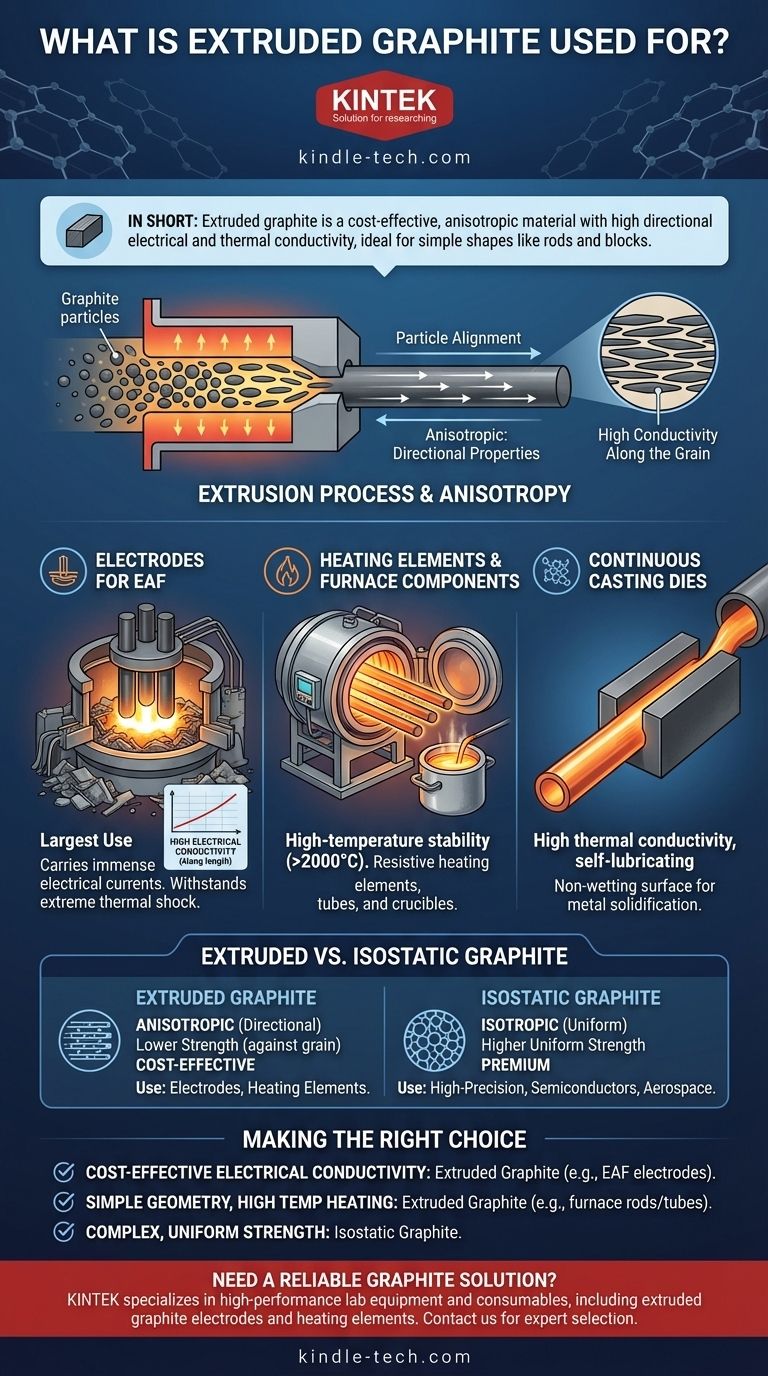
In short, extruded graphite is primarily used for applications where cost-effectiveness and high electrical or thermal conductivity in a specific direction are critical. Its most common uses are as electrodes in electric arc furnaces for steel recycling, heating elements in high-temperature industrial furnaces, and crucibles for melting metals.

The core principle to understand is that the extrusion process aligns the graphite particles, creating a material with excellent directional properties. This makes it the ideal, economical choice for simpler shapes like rods and blocks but less suitable for complex components requiring uniform strength in all directions.

What is extruded graphite used for? Cost-Effective Conductivity for Industrial Processes

The Defining Properties of Extruded Graphite

To understand its applications, we must first understand how extruded graphite is made and what characteristics result from that process. It is not an all-purpose material; it is a specialized tool for specific jobs.

The Extrusion Process and Anisotropy

Extruded graphite is produced by mixing petroleum coke and a binder, heating it, and forcing it through a die to form a shape, typically a rod or block.

This process forces the flat, plate-like graphite particles to align parallel to the direction of extrusion. This alignment creates a material that is anisotropic, meaning its properties are different when measured along the grain versus against the grain.

Directional Conductivity

The primary consequence of this anisotropy is excellent electrical and thermal conductivity along the length of the extruded shape (with the grain). The aligned particles create an efficient path for electricity and heat to travel.

Conductivity is significantly lower when measured across the grain, a crucial factor in engineering design.

Cost-Effectiveness

Compared to other methods of producing synthetic graphite, such as isostatic pressing, extrusion is a more economical, high-volume manufacturing process. This makes it the default choice for applications that consume large quantities of graphite.

Primary Applications in Detail

The unique combination of conductivity, high-temperature stability, and cost-effectiveness makes extruded graphite indispensable in several key industries.

Electrodes for Electric Arc Furnaces (EAF)

This is the largest single use for extruded graphite. Massive graphite electrodes, often over two feet in diameter, are used to carry immense electrical currents into electric arc furnaces.

The current melts scrap steel as part of the recycling process. Extruded graphite is the only material that can provide the required electrical conductivity and withstand the extreme thermal shock of this environment at an acceptable cost.

Heating Elements and Furnace Components

In vacuum or inert-atmosphere furnaces that operate at very high temperatures, extruded graphite rods and tubes are often used as resistive heating elements.

Their ability to maintain strength and conduct electricity at temperatures well over 2000°C is critical. They are also formed into crucibles for metallurgical processes involving the melting of non-ferrous metals.

Continuous Casting Dies

In the production of metals like copper and aluminum, molten metal is often pulled through a die to form rods, tubes, and other shapes.

Extruded graphite is an excellent material for these dies due to its high thermal conductivity (which helps solidify the metal), self-lubricating nature, and the fact that most molten metals will not wet its surface.

Understanding the Trade-offs: Extruded vs. Isostatic Graphite

Choosing the right type of graphite is critical. The most common alternative to extruded graphite is isostatic graphite, which serves a very different purpose.

Anisotropy vs. Isotropy

As we've covered, extruded graphite is anisotropic. Its strength and conductivity are directional.

Isostatic graphite is made by pressing graphite powder from all directions at once, resulting in a random particle orientation. This makes it isotropic, meaning its properties are uniform and consistent in all directions.

Strength and Grain Structure

Isostatic graphite has a much finer grain structure and higher mechanical strength. Its uniformity makes it ideal for machining intricate, high-precision components that cannot have weak points.

Extruded graphite has a larger grain structure and lower mechanical strength, particularly against the grain. It is not suitable for complex structural parts that experience multi-directional stress.

Cost and Performance

This is the essential trade-off. Extruded graphite is the cost-effective workhorse. Isostatic graphite is a premium, high-performance material used in demanding, advanced applications like semiconductor manufacturing, nuclear reactors, and aerospace components.

Making the Right Choice for Your Goal

Your application's specific requirements for performance, geometry, and cost will determine which material is appropriate.

  • If your primary focus is cost-effective electrical conductivity for large-scale processes: Extruded graphite is the industry standard for applications like electric arc furnace electrodes.
  • If your primary focus is high-temperature heating elements with simple geometries: Extruded graphite offers the best balance of performance and cost for furnace components like rods and tubes.
  • If your primary focus is complex components requiring uniform strength and fine detail: You must specify a higher-grade isotropic material, such as isostatic graphite.

Ultimately, selecting the correct material begins with understanding that not all graphite is created equal.

Summary Table:

Property Extruded Graphite Isostatic Graphite
Structure Anisotropic (directional) Isotropic (uniform)
Primary Use Electrodes, heating elements, crucibles High-precision components, semiconductors
Cost Cost-effective Premium
Strength Directional, lower against the grain High, uniform in all directions

Need a reliable graphite solution for your industrial or lab application? KINTEK specializes in high-performance lab equipment and consumables, including extruded graphite components like electrodes and heating elements. Our experts can help you select the right material for cost-effective conductivity and high-temperature stability. Contact us today to discuss your specific needs and enhance your process efficiency with KINTEK's trusted solutions.

Visual Guide
What is extruded graphite used for? Cost-Effective Conductivity for Industrial Processes Visual Guide

Related Products

People Also Ask

Related Products

Horizontal High Temperature Graphite Vacuum Graphitization Furnace

Horizontal High Temperature Graphite Vacuum Graphitization Furnace

Horizontal Graphitization Furnace: This type of furnace is designed with the heating elements placed horizontally, allowing for uniform heating of the sample. It's well-suited for graphitizing large or bulky samples that require precise temperature control and uniformity.

Graphite Vacuum Furnace Bottom Discharge Graphitization Furnace for Carbon Materials

Graphite Vacuum Furnace Bottom Discharge Graphitization Furnace for Carbon Materials

Bottom-out graphitization furnace for carbon materials, ultra-high temperature furnace up to 3100°C, suitable for graphitization and sintering of carbon rods and carbon blocks. Vertical design, bottom discharging, convenient feeding and discharging, high temperature uniformity, low energy consumption, good stability, hydraulic lifting system, convenient loading and unloading.

High Purity Pure Graphite Crucible for Evaporation

High Purity Pure Graphite Crucible for Evaporation

Vessels for high temperature applications, where materials are kept at extremely high temperatures to evaporate, allowing thin films to be deposited on substrates.

1200℃ Muffle Furnace Oven for Laboratory

1200℃ Muffle Furnace Oven for Laboratory

Upgrade your lab with our 1200℃ Muffle Furnace. Achieve fast, precise heating with Japan alumina fibers and Molybdenum coils. Features TFT touch screen controller for easy programming and data analysis. Order now!

1700℃ Muffle Oven Furnace for Laboratory

1700℃ Muffle Oven Furnace for Laboratory

Get superior heat control with our 1700℃ Muffle Furnace. Equipped with intelligent temperature microprocessor, TFT touch screen controller & advanced insulation materials for precise heating up to 1700C. Order now!

Vacuum Heat Treat and Pressure Sintering Furnace for High Temperature Applications

Vacuum Heat Treat and Pressure Sintering Furnace for High Temperature Applications

Vacuum pressure sintering furnaces are designed for high temperature hot pressing applications in metal and ceramic sintering. Its advanced features ensure precise temperature control, reliable pressure maintenance, and a robust design for seamless operation.

600T Vacuum Induction Hot Press Furnace for Heat Treat and Sintering

600T Vacuum Induction Hot Press Furnace for Heat Treat and Sintering

Discover the 600T Vacuum Induction Hot Press Furnace, designed for high-temperature sintering experiments in vacuum or protected atmospheres. Its precise temperature and pressure control, adjustable working pressure, and advanced safety features make it ideal for nonmetal materials, carbon composites, ceramics, and metal powders.

1400℃ Controlled Atmosphere Furnace with Nitrogen and Inert Atmosphere

1400℃ Controlled Atmosphere Furnace with Nitrogen and Inert Atmosphere

Achieve precise heat treatment with KT-14A controlled atmosphere furnace. Vacuum sealed with a smart controller, it's ideal for lab and industrial use up to 1400℃.

High Temperature Alumina (Al2O3) Furnace Tube for Engineering Advanced Fine Ceramics

High Temperature Alumina (Al2O3) Furnace Tube for Engineering Advanced Fine Ceramics

High temperature alumina furnace tube combines the advantages of high hardness of alumina, good chemical inertness and steel, and has excellent wear resistance, thermal shock resistance and mechanical shock resistance.

1700℃ Controlled Atmosphere Furnace Nitrogen Inert Atmosphere Furnace

1700℃ Controlled Atmosphere Furnace Nitrogen Inert Atmosphere Furnace

KT-17A Controlled atmosphere furnace: 1700℃ heating, vacuum sealing technology, PID temperature control, and versatile TFT smart touch screen controller for laboratory and industrial use.

Multi Heating Zones CVD Tube Furnace Machine Chemical Vapor Deposition Chamber System Equipment

Multi Heating Zones CVD Tube Furnace Machine Chemical Vapor Deposition Chamber System Equipment

KT-CTF14 Multi Heating Zones CVD Furnace - Precise Temperature Control and Gas Flow for Advanced Applications. Max temp up to 1200℃, 4 channels MFC mass flow meter, and 7" TFT touch screen controller.

Customer Made Versatile CVD Tube Furnace Chemical Vapor Deposition Chamber System Equipment

Customer Made Versatile CVD Tube Furnace Chemical Vapor Deposition Chamber System Equipment

Get your exclusive CVD furnace with KT-CTF16 Customer Made Versatile Furnace. Customizable sliding, rotating, and tilting functions for precise reactions. Order now!

Custom PTFE Teflon Parts Manufacturer for Hydrothermal Synthesis Reactor Polytetrafluoroethylene Carbon Paper and Carbon Cloth Nano-growth

Custom PTFE Teflon Parts Manufacturer for Hydrothermal Synthesis Reactor Polytetrafluoroethylene Carbon Paper and Carbon Cloth Nano-growth

Acid and alkali resistant polytetrafluoroethylene experimental fixtures meet different requirements. The material is made of brand new polytetrafluoroethylene material, which has excellent chemical stability, corrosion resistance, airtightness, high lubricity and non-stickiness, electrical corrosion and good anti-aging ability, and can work for a long time at temperatures from -180℃ to +250℃.

Vacuum Hot Press Furnace Machine for Lamination and Heating

Vacuum Hot Press Furnace Machine for Lamination and Heating

Experience clean and precise lamination with Vacuum Lamination Press. Perfect for wafer bonding, thin-film transformations, and LCP lamination. Order now!

Ultra-Vacuum Electrode Feedthrough Connector Flange Power Electrode Lead for High-Precision Applications

Ultra-Vacuum Electrode Feedthrough Connector Flange Power Electrode Lead for High-Precision Applications

Discover the Ultra-Vacuum Electrode Feedthrough Connector Flange, perfect for high-precision applications. Ensure reliable connections in ultra-vacuum environments with advanced sealing and conductive technology.

Laboratory Scientific Electric Heating Blast Drying Oven

Laboratory Scientific Electric Heating Blast Drying Oven

The desktop fast autoclave sterilizer is a compact and reliable device used for rapid sterilization of medical, pharmaceutical, and research items.

Electron Beam Evaporation Coating Oxygen-Free Copper Crucible and Evaporation Boat

Electron Beam Evaporation Coating Oxygen-Free Copper Crucible and Evaporation Boat

Electron Beam Evaporation Coating Oxygen-Free Copper Crucible enables precise co-deposition of various materials. Its controlled temperature and water-cooled design ensure pure and efficient thin film deposition.

Custom PTFE Teflon Parts Manufacturer for Hollow Etching Flower Basket ITO FTO Developing Glue Removal

Custom PTFE Teflon Parts Manufacturer for Hollow Etching Flower Basket ITO FTO Developing Glue Removal

PTFE adjustable height flower basket (Teflon flower baskets) are made of high-purity experimental grade PTFE, with excellent chemical stability, corrosion resistance, sealing and high and low temperature resistance.

Customizable PEM Electrolysis Cells for Diverse Research Applications

Customizable PEM Electrolysis Cells for Diverse Research Applications

Custom PEM test cell for electrochemical research. Durable, versatile, for fuel cells & CO2 reduction. Fully customizable. Get a quote!

Custom PTFE Teflon Parts Manufacturer for Culture Dish and Evaporation Dish

Custom PTFE Teflon Parts Manufacturer for Culture Dish and Evaporation Dish

The PTFE culture dish evaporating dish is a versatile laboratory tool known for its chemical resistance and high-temperature stability. PTFE, a fluoropolymer, offers exceptional non-stick properties and durability, making it ideal for various applications in research and industry, including filtration, pyrolysis, and membrane technology.


Leave Your Message