Knowledge Resources What is high temperature sintering of ceramics? Transform Powder into Dense, High-Performance Components
Author avatar

Tech Team · Kintek Solution

Updated 2 months ago

What is high temperature sintering of ceramics? Transform Powder into Dense, High-Performance Components


High-temperature sintering of ceramics is a thermal treatment process used to convert a loosely packed ceramic powder into a dense, solid object. By applying heat at temperatures below the material's melting point, the individual powder particles are fused, significantly enhancing the material's mechanical strength, hardness, and thermal stability.

The core principle of sintering is not to melt the material, but to use thermal energy to drive atomic diffusion. This process eliminates the empty spaces between powder particles, creating strong chemical bonds and forming a solid, coherent mass.
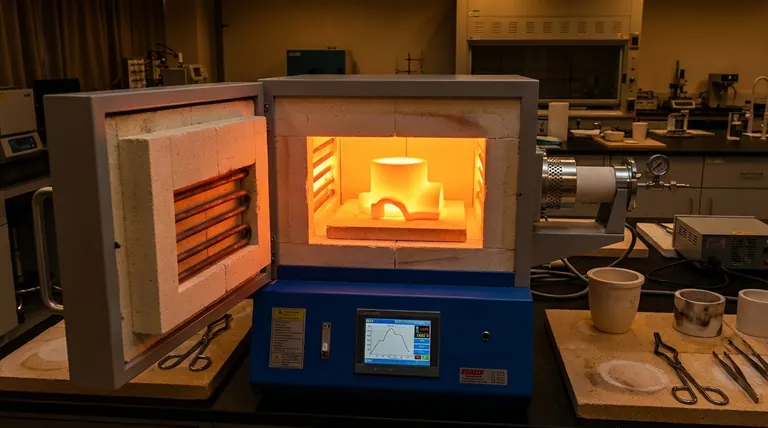
What is high temperature sintering of ceramics? Transform Powder into Dense, High-Performance Components

The Fundamental Goal: From Powder to Solid

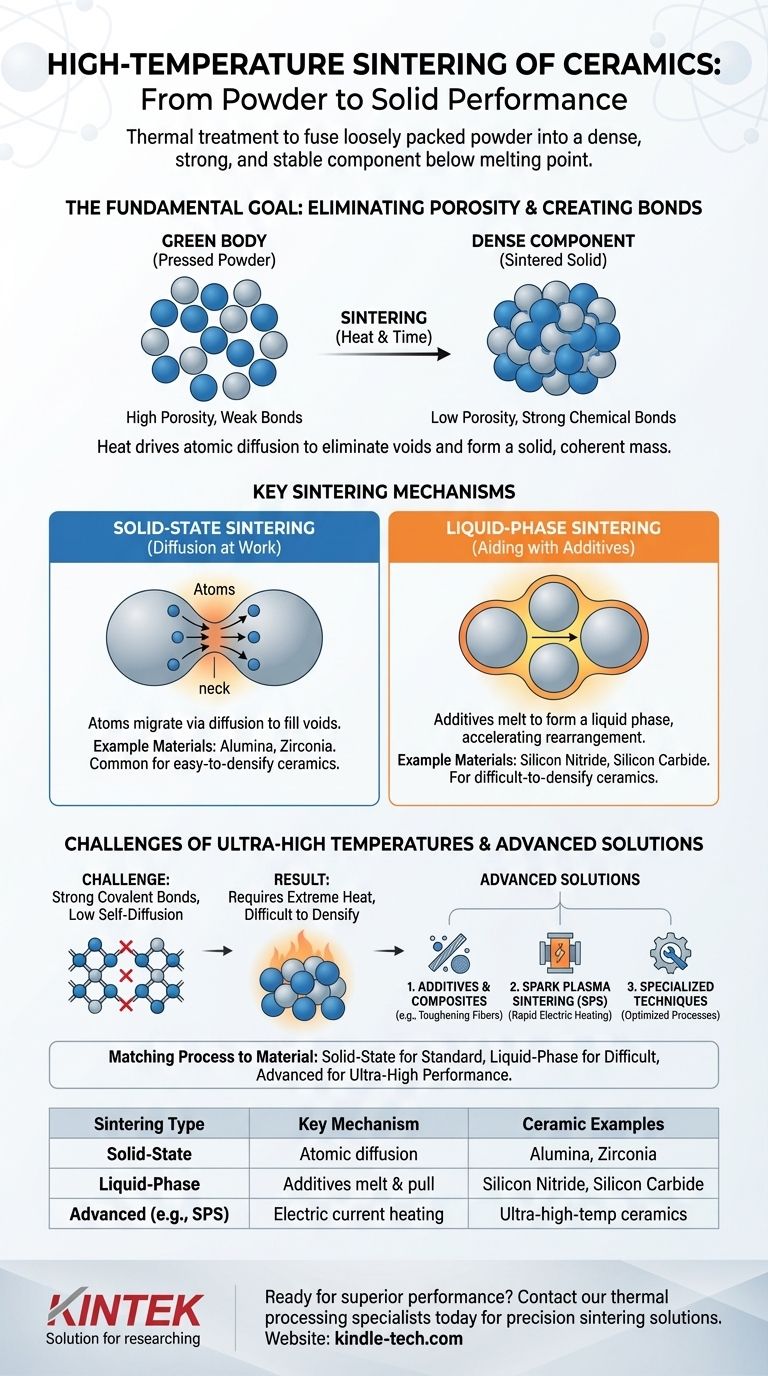
Sintering is the critical manufacturing step that transforms a shaped part made of pressed powder—often called a "green body"—into a durable, high-performance ceramic component. The primary objective is to achieve maximum density.

Eliminating Porosity

The initial green body is highly porous, filled with air gaps between each particle. Sintering systematically reduces and eliminates this porosity, causing the component to shrink and become much denser.

Creating Strong Bonds

Heat provides the energy for atoms to move across the boundaries of adjacent particles. This atomic transport creates new, strong chemical bonds, effectively welding the particles together into a solid polycrystalline structure.

Key Sintering Mechanisms

The way atoms move to densify the material depends on the ceramic's intrinsic properties. The two primary mechanisms are solid-state and liquid-phase sintering.

Solid-State Sintering (Diffusion at Work)

For ceramics like alumina and zirconia, densification occurs entirely in the solid state. Atoms migrate from the bulk of the particles to the "necks" forming between them, gradually filling the voids through a process called diffusion.

This method relies entirely on the material's natural tendency for atoms to move at high temperatures.

Liquid-Phase Sintering (Aiding with Additives)

For ceramics that are notoriously difficult to densify, such as silicon nitride and silicon carbide, a different approach is used. Additives are mixed with the initial powder.

At sintering temperature, these additives melt to form a small amount of liquid. This liquid wets the ceramic particles and pulls them together through capillary forces, dramatically accelerating rearrangement and densification.

The Unique Challenges of Ultra-High Temperatures

Sintering certain advanced ceramics presents significant challenges due to their fundamental material properties, requiring extreme temperatures and specialized techniques.

Strong Covalent Bonds

Materials like silicon carbide feature exceptionally strong covalent bonds. These bonds lock atoms in place, making it incredibly difficult for them to diffuse, which is the very mechanism needed for solid-state sintering.

Low Self-Diffusion Rates

Because of these strong bonds, such materials have very low self-diffusion rates. This inherent resistance to atomic movement means that extremely high temperatures are needed to force densification, and even then, achieving full density can be difficult, sometimes resulting in lower fracture toughness.

Advanced Solutions

To overcome these issues, engineers use strategies like adding toughening fibers to create composite materials. They also employ advanced processes like Spark Plasma Sintering (SPS), which uses an electric current to rapidly heat the material, achieving high density at relatively lower temperatures and in much shorter times.

Matching the Process to the Material

The choice of sintering method is dictated by the properties of the ceramic and the performance requirements of the final component.

  • If your material is relatively easy to densify (e.g., alumina): Standard solid-state sintering is the most direct and effective path to achieving a dense final product.
  • If your material is highly resistant to densification (e.g., silicon carbide): Liquid-phase sintering is often necessary to facilitate particle rearrangement and achieve high density efficiently.
  • If your goal is maximum performance from an ultra-high-temperature ceramic: Advanced techniques like composite reinforcement or Spark Plasma Sintering are required to overcome the material's inherent limitations.

Ultimately, sintering is the essential art of transforming loose powder into a precisely engineered, high-performance solid.

Summary Table:

Sintering Type Key Mechanism Common Ceramic Examples
Solid-State Sintering Atomic diffusion in solid state Alumina, Zirconia
Liquid-Phase Sintering Additives melt to form a liquid phase Silicon Nitride, Silicon Carbide
Advanced (e.g., SPS) Electric current for rapid heating Ultra-high-temperature ceramics

Ready to achieve superior material performance?

The precise thermal control required for successful ceramic sintering is critical. KINTEK specializes in high-performance lab furnaces and equipment designed for demanding processes like high-temperature sintering. Whether you are working with alumina, silicon carbide, or advanced composites, our solutions provide the uniform heating and temperature stability you need to transform your ceramic powders into dense, reliable components.

Let's discuss how our sintering expertise can enhance your R&D or production. Contact our thermal processing specialists today for a personalized consultation.

Visual Guide
What is high temperature sintering of ceramics? Transform Powder into Dense, High-Performance Components Visual Guide

Related Products

People Also Ask

Related Products

High Temperature Alumina (Al2O3) Furnace Tube for Engineering Advanced Fine Ceramics

High Temperature Alumina (Al2O3) Furnace Tube for Engineering Advanced Fine Ceramics

High temperature alumina furnace tube combines the advantages of high hardness of alumina, good chemical inertness and steel, and has excellent wear resistance, thermal shock resistance and mechanical shock resistance.

High Temperature Muffle Oven Furnace for Laboratory Debinding and Pre Sintering

High Temperature Muffle Oven Furnace for Laboratory Debinding and Pre Sintering

KT-MD High temperature debinding and pre-sintering furnace for ceramic materials with various molding processes. Ideal for electronic components such as MLCC and NFC.

Vacuum Heat Treat and Pressure Sintering Furnace for High Temperature Applications

Vacuum Heat Treat and Pressure Sintering Furnace for High Temperature Applications

Vacuum pressure sintering furnaces are designed for high temperature hot pressing applications in metal and ceramic sintering. Its advanced features ensure precise temperature control, reliable pressure maintenance, and a robust design for seamless operation.

2200 ℃ Tungsten Vacuum Heat Treat and Sintering Furnace

2200 ℃ Tungsten Vacuum Heat Treat and Sintering Furnace

Experience the ultimate refractory metal furnace with our Tungsten vacuum furnace. Capable of reaching 2200℃, perfect for sintering advanced ceramics and refractory metals. Order now for high-quality results.

Ultra-High Temperature Graphite Vacuum Graphitization Furnace

Ultra-High Temperature Graphite Vacuum Graphitization Furnace

The ultra-high temperature graphitization furnace utilizes medium frequency induction heating in a vacuum or inert gas environment. The induction coil generates an alternating magnetic field, inducing eddy currents in the graphite crucible, which heats up and radiates heat to the workpiece, bringing it to the desired temperature. This furnace is primarily used for graphitization and sintering of carbon materials, carbon fiber materials, and other composite materials.

2200 ℃ Graphite Vacuum Heat Treat Furnace

2200 ℃ Graphite Vacuum Heat Treat Furnace

Discover the power of the KT-VG Graphite Vacuum Furnace - with a maximum working temperature of 2200℃, it's perfect for vacuum sintering of various materials. Learn more now.

1700℃ Laboratory High Temperature Tube Furnace with Alumina Tube

1700℃ Laboratory High Temperature Tube Furnace with Alumina Tube

Looking for a high-temperature tube furnace? Check out our 1700℃ Tube Furnace with Alumina Tube. Perfect for research and industrial applications up to 1700C.

Dental Porcelain Zirconia Sintering Ceramic Furnace Chairside with Transformer

Dental Porcelain Zirconia Sintering Ceramic Furnace Chairside with Transformer

Experience top-notch sintering with Chairside Sintering Furnace with Transformer. Easy to operate, noise-free pallet, and automatic temperature calibration. Order now!

Dental Porcelain Zirconia Sintering Ceramic Vacuum Press Furnace

Dental Porcelain Zirconia Sintering Ceramic Vacuum Press Furnace

Get precise dental results with Dental Vacuum Press Furnace. Automatic temperature calibration, low noise tray, and touch screen operation. Order now!

1200℃ Split Tube Furnace with Quartz Tube Laboratory Tubular Furnace

1200℃ Split Tube Furnace with Quartz Tube Laboratory Tubular Furnace

KT-TF12 split tube furnace: high-purity insulation, embedded heating wire coils, and max. 1200C. Widely used for new materials and chemical vapour deposition.

1700℃ Muffle Oven Furnace for Laboratory

1700℃ Muffle Oven Furnace for Laboratory

Get superior heat control with our 1700℃ Muffle Furnace. Equipped with intelligent temperature microprocessor, TFT touch screen controller & advanced insulation materials for precise heating up to 1700C. Order now!

1400℃ Muffle Oven Furnace for Laboratory

1400℃ Muffle Oven Furnace for Laboratory

Get precise high-temperature control up to 1500℃ with KT-14M Muffle furnace. Equipped with a smart touch screen controller and advanced insulation materials.

Vacuum Heat Treat and Sintering Furnace with 9MPa Air Pressure

Vacuum Heat Treat and Sintering Furnace with 9MPa Air Pressure

The air pressure sintering furnace is a high-tech equipment commonly used for the sintering of advanced ceramic materials. It combines vacuum sintering and pressure sintering techniques to achieve high-density and high-strength ceramics.

1200℃ Muffle Furnace Oven for Laboratory

1200℃ Muffle Furnace Oven for Laboratory

Upgrade your lab with our 1200℃ Muffle Furnace. Achieve fast, precise heating with Japan alumina fibers and Molybdenum coils. Features TFT touch screen controller for easy programming and data analysis. Order now!

1400℃ Controlled Atmosphere Furnace with Nitrogen and Inert Atmosphere

1400℃ Controlled Atmosphere Furnace with Nitrogen and Inert Atmosphere

Achieve precise heat treatment with KT-14A controlled atmosphere furnace. Vacuum sealed with a smart controller, it's ideal for lab and industrial use up to 1400℃.

Vacuum Heat Treat Furnace with Ceramic Fiber Liner

Vacuum Heat Treat Furnace with Ceramic Fiber Liner

Vacuum furnace with polycrystalline ceramic fiber insulation liner for excellent heat insulation and uniform temperature field. Choose from 1200℃ or 1700℃ max. working temperature with high vacuum performance and precise temperature control.

1700℃ Controlled Atmosphere Furnace Nitrogen Inert Atmosphere Furnace

1700℃ Controlled Atmosphere Furnace Nitrogen Inert Atmosphere Furnace

KT-17A Controlled atmosphere furnace: 1700℃ heating, vacuum sealing technology, PID temperature control, and versatile TFT smart touch screen controller for laboratory and industrial use.

Vertical High Temperature Graphite Vacuum Graphitization Furnace

Vertical High Temperature Graphite Vacuum Graphitization Furnace

Vertical high temperature graphitization furnace for carbonization and graphitization of carbon materials up to 3100℃.Suitable for shaped graphitization of carbon fiber filaments and other materials sintered in a carbon environment.Applications in metallurgy, electronics, and aerospace for producing high-quality graphite products like electrodes and crucibles.

Advanced Engineering Fine Ceramics Alumina Ceramic Saggar for Fine Corundum

Advanced Engineering Fine Ceramics Alumina Ceramic Saggar for Fine Corundum

Alumina sagger products have the characteristics of high temperature resistance, good thermal shock stability, small expansion coefficient, anti-stripping, and good anti-powdering performance.

600T Vacuum Induction Hot Press Furnace for Heat Treat and Sintering

600T Vacuum Induction Hot Press Furnace for Heat Treat and Sintering

Discover the 600T Vacuum Induction Hot Press Furnace, designed for high-temperature sintering experiments in vacuum or protected atmospheres. Its precise temperature and pressure control, adjustable working pressure, and advanced safety features make it ideal for nonmetal materials, carbon composites, ceramics, and metal powders.


Leave Your Message