Knowledge cvd machine What is LPCVD advantages and disadvantages? Balancing Film Quality and Thermal Budget
Author avatar

Tech Team · Kintek Solution

Updated 2 months ago

What is LPCVD advantages and disadvantages? Balancing Film Quality and Thermal Budget


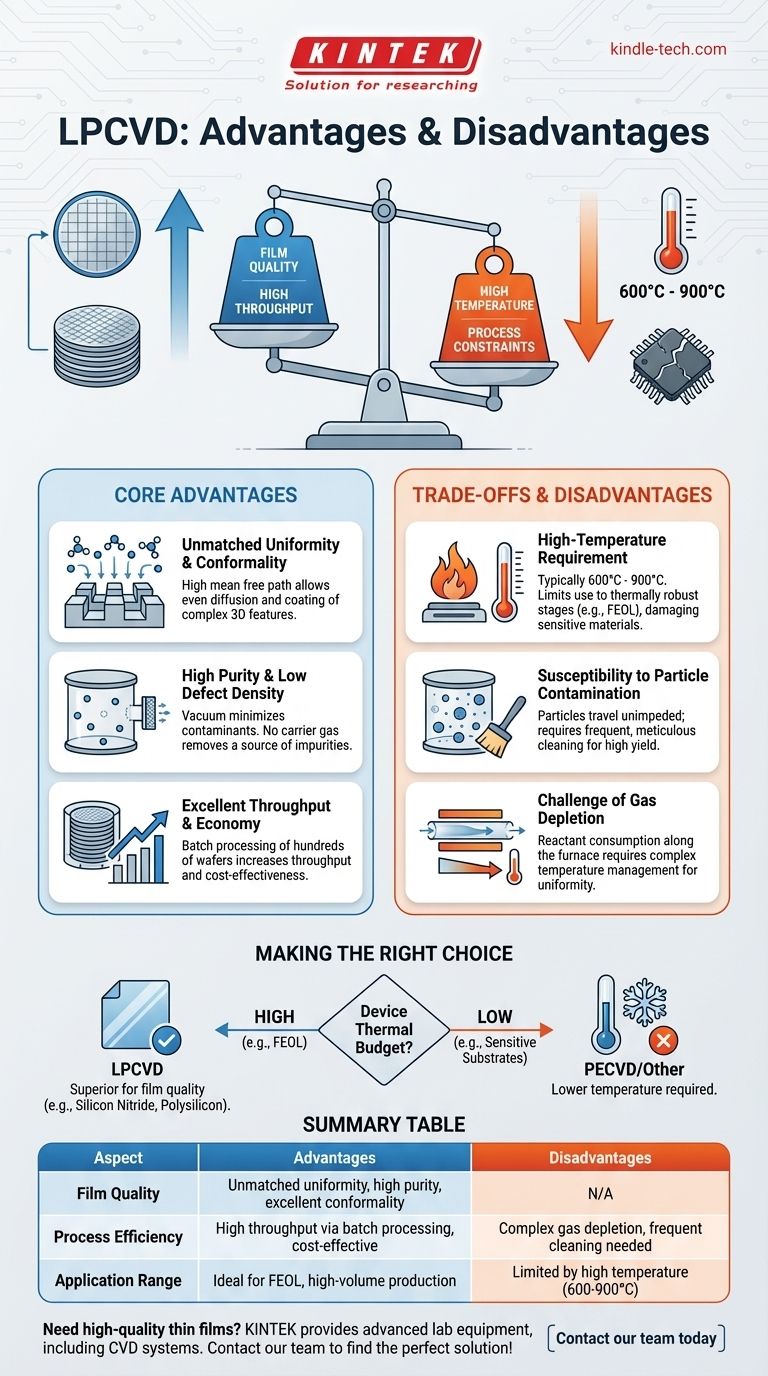
In short, LPCVD's primary advantage is its ability to produce exceptionally uniform and pure thin films at high throughput, making it highly economical. Its main disadvantage is the high processing temperature required, which can damage other components on a device and limits where it can be used in a manufacturing sequence.

The decision to use Low-Pressure Chemical Vapor Deposition (LPCVD) is almost always a direct trade-off between film quality and temperature. It is the preferred method when superior film properties are critical and the underlying device can withstand the high thermal budget.
What is LPCVD advantages and disadvantages? Balancing Film Quality and Thermal Budget

The Core Advantages of LPCVD

LPCVD became a cornerstone of semiconductor manufacturing because it excels in areas critical for building microscopic, high-performance devices. Its benefits stem directly from its low-pressure operating environment.

Unmatched Film Uniformity and Conformality

At low pressures (vacuum), gas molecules can travel much farther before colliding with each other. This increased mean free path is the key to LPCVD's success.

Reactant gases can diffuse freely and evenly across all wafer surfaces, including the complex vertical sidewalls of microscopic trenches. This results in a film that is highly uniform across the wafer and highly conformal over 3D structures.

High Purity and Low Defect Density

The deposition process occurs in a vacuum, which inherently minimizes the presence of unwanted contaminants.

Furthermore, LPCVD does not require a carrier gas to transport the reactive chemicals. This eliminates a major source of potential impurities, leading to films with higher purity and fewer defects compared to atmospheric pressure methods.

Excellent Throughput and Economy

Because the film deposition is so uniform, wafers don't need to lie flat facing the gas source. Instead, they can be stacked vertically in cassettes, standing on edge and packed tightly together.

This "batch processing" allows hundreds of wafers to be coated in a single run, dramatically increasing throughput and making LPCVD a very cost-effective solution for high-volume manufacturing.

Understanding the Trade-offs and Disadvantages

While powerful, LPCVD is not a universal solution. Its drawbacks are significant and must be carefully considered by process engineers.

The High-Temperature Requirement

LPCVD is a thermally-driven process, often requiring temperatures between 600°C and 900°C to initiate the chemical reactions. This high thermal budget is its single greatest limitation.

Many devices have components, such as aluminum or copper interconnects, that cannot tolerate such high temperatures. Therefore, LPCVD is often restricted to the front-end-of-line (FEOL) fabrication stages, before temperature-sensitive materials are deposited.

Susceptibility to Particle Contamination

While the vacuum environment is inherently clean, any particles that do form within the chamber can travel unimpeded and deposit onto the wafers, causing killer defects.

This means LPCVD systems require frequent and meticulous cleaning cycles to maintain high yields, which adds to operational overhead.

The Challenge of Gas Depletion

In a long furnace tube used for batch processing, the reactant gases get consumed as they flow from the front of the tube to the back. This gas depletion can cause wafers at the end of the line to receive a thinner film.

To compensate, engineers must create a temperature gradient along the furnace—running it hotter at the back—to speed up the reaction rate and achieve uniform thickness across the entire batch. This adds a layer of process complexity.

Making the Right Choice for Your Application

Choosing a deposition method requires balancing the need for film quality against the process constraints of your device.

  • If your primary focus is the highest film quality and conformality for foundational layers: LPCVD is the superior choice for materials like silicon nitride or polysilicon when a high thermal budget is acceptable.
  • If your primary focus is depositing films on temperature-sensitive substrates: LPCVD is unsuitable. A lower-temperature process like Plasma-Enhanced CVD (PECVD) is the necessary alternative.
  • If your primary focus is high-volume, cost-effective production for a thermally robust device: LPCVD's batch processing capability makes it an excellent economic choice, as seen in both semiconductor and solar cell manufacturing.

Ultimately, selecting LPCVD hinges on whether your device's thermal budget can accommodate its high-temperature operation to gain its superior film properties.

Summary Table:

Aspect Advantages Disadvantages
Film Quality Unmatched uniformity, high purity, excellent conformality N/A
Process Efficiency High throughput via batch processing, cost-effective Complex gas depletion management, frequent cleaning needed
Application Range Ideal for FEOL, high-volume production (e.g., semiconductors, solar cells) Limited by high temperature (600-900°C), unsuitable for temperature-sensitive materials

Need to deposit high-quality thin films for your lab? The choice between LPCVD and other methods depends on your specific thermal and quality requirements. KINTEK specializes in providing advanced lab equipment and consumables, including CVD systems, to meet your precise research and production needs. Our experts can help you select the right technology to optimize your process. Contact our team today to discuss your application and find the perfect solution!

Visual Guide
What is LPCVD advantages and disadvantages? Balancing Film Quality and Thermal Budget Visual Guide

Related Products

People Also Ask

Related Products

Inclined Rotary Plasma Enhanced Chemical Vapor Deposition PECVD Equipment Tube Furnace Machine

Inclined Rotary Plasma Enhanced Chemical Vapor Deposition PECVD Equipment Tube Furnace Machine

Upgrade your coating process with PECVD coating equipment. Ideal for LED, power semiconductors, MEMS and more. Deposits high-quality solid films at low temps.

Inclined Rotary Plasma Enhanced Chemical Vapor Deposition PECVD Equipment Tube Furnace Machine

Inclined Rotary Plasma Enhanced Chemical Vapor Deposition PECVD Equipment Tube Furnace Machine

Introducing our inclined rotary PECVD furnace for precise thin film deposition. Enjoy automatic matching source, PID programmable temperature control, and high accuracy MFC mass flowmeter control. Built-in safety features for peace of mind.

Chemical Vapor Deposition CVD Equipment System Chamber Slide PECVD Tube Furnace with Liquid Gasifier PECVD Machine

Chemical Vapor Deposition CVD Equipment System Chamber Slide PECVD Tube Furnace with Liquid Gasifier PECVD Machine

KT-PE12 Slide PECVD System: Wide power range, programmable temp control, fast heating/cooling with sliding system, MFC mass flow control & vacuum pump.

Laboratory CVD Boron Doped Diamond Materials

Laboratory CVD Boron Doped Diamond Materials

CVD boron-doped diamond: A versatile material enabling tailored electrical conductivity, optical transparency, and exceptional thermal properties for applications in electronics, optics, sensing, and quantum technologies.

Microwave Plasma Chemical Vapor Deposition MPCVD Machine System Reactor for Lab and Diamond Growth

Microwave Plasma Chemical Vapor Deposition MPCVD Machine System Reactor for Lab and Diamond Growth

Get high-quality diamond films with our Bell-jar Resonator MPCVD machine designed for lab and diamond growth. Discover how Microwave Plasma Chemical Vapor Deposition works for growing diamonds using carbon gas and plasma.

RF PECVD System Radio Frequency Plasma-Enhanced Chemical Vapor Deposition RF PECVD

RF PECVD System Radio Frequency Plasma-Enhanced Chemical Vapor Deposition RF PECVD

RF-PECVD is an acronym for "Radio Frequency Plasma-Enhanced Chemical Vapor Deposition." It deposits DLC (Diamond-like carbon film) on germanium and silicon substrates. It is utilized in the 3-12um infrared wavelength range.

Multi Heating Zones CVD Tube Furnace Machine Chemical Vapor Deposition Chamber System Equipment

Multi Heating Zones CVD Tube Furnace Machine Chemical Vapor Deposition Chamber System Equipment

KT-CTF14 Multi Heating Zones CVD Furnace - Precise Temperature Control and Gas Flow for Advanced Applications. Max temp up to 1200℃, 4 channels MFC mass flow meter, and 7" TFT touch screen controller.

915MHz MPCVD Diamond Machine Microwave Plasma Chemical Vapor Deposition System Reactor

915MHz MPCVD Diamond Machine Microwave Plasma Chemical Vapor Deposition System Reactor

915MHz MPCVD Diamond Machine and its multi-crystal effective growth, the maximum area can reach 8 inches, the maximum effective growth area of single crystal can reach 5 inches. This equipment is mainly used for the production of large-size polycrystalline diamond films, the growth of long single crystal diamonds, the low-temperature growth of high-quality graphene, and other materials that require energy provided by microwave plasma for growth.

Reference Electrode Calomel Silver Chloride Mercury Sulfate for Laboratory Use

Reference Electrode Calomel Silver Chloride Mercury Sulfate for Laboratory Use

Find high-quality reference electrodes for electrochemical experiments with complete specifications. Our models offer resistance to acid and alkali, durability, and safety, with customization options available to meet your specific needs.

Cylindrical Resonator MPCVD Machine System Reactor for Microwave Plasma Chemical Vapor Deposition and Lab Diamond Growth

Cylindrical Resonator MPCVD Machine System Reactor for Microwave Plasma Chemical Vapor Deposition and Lab Diamond Growth

Learn about Cylindrical Resonator MPCVD Machine, the microwave plasma chemical vapor deposition method used for growing diamond gemstones and films in the jewelry and semi-conductor industries. Discover its cost-effective advantages over traditional HPHT methods.

Customer Made Versatile CVD Tube Furnace Chemical Vapor Deposition Chamber System Equipment

Customer Made Versatile CVD Tube Furnace Chemical Vapor Deposition Chamber System Equipment

Get your exclusive CVD furnace with KT-CTF16 Customer Made Versatile Furnace. Customizable sliding, rotating, and tilting functions for precise reactions. Order now!

Multifunctional Electrolytic Electrochemical Cell Water Bath Single Layer Double Layer

Multifunctional Electrolytic Electrochemical Cell Water Bath Single Layer Double Layer

Discover our high-quality Multifunctional Electrolytic Cell Water Baths. Choose from single or double-layer options with superior corrosion resistance. Available in 30ml to 1000ml sizes.

Custom CVD Diamond Coating for Lab Applications

Custom CVD Diamond Coating for Lab Applications

CVD Diamond Coating: Superior Thermal Conductivity, Crystal Quality, and Adhesion for Cutting Tools, Friction, and Acoustic Applications

CVD Diamond Optical Windows for Lab Applications

CVD Diamond Optical Windows for Lab Applications

Diamond optical windows: exceptional broad band infrared transparency, excellent thermal conductivity & low scattering in infrared, for high-power IR laser & microwave windows applications.

CVD Diamond Dressing Tools for Precision Applications

CVD Diamond Dressing Tools for Precision Applications

Experience the Unbeatable Performance of CVD Diamond Dresser Blanks: High Thermal Conductivity, Exceptional Wear Resistance, and Orientation Independence.

Optical Water Bath Electrolytic Electrochemical Cell

Optical Water Bath Electrolytic Electrochemical Cell

Upgrade your electrolytic experiments with our Optical Water Bath. With controllable temperature and excellent corrosion resistance, it's customizable for your specific needs. Discover our complete specifications today.

Visual High-Pressure Reactor for In-Situ Observation

Visual High-Pressure Reactor for In-Situ Observation

The visual high-pressure reactor uses transparent sapphire or quartz glass, maintaining high strength and optical clarity under extreme conditions for real-time reaction observation.

HFCVD Machine System Equipment for Drawing Die Nano-Diamond Coating

HFCVD Machine System Equipment for Drawing Die Nano-Diamond Coating

The nano-diamond composite coating drawing die uses cemented carbide (WC-Co) as the substrate, and uses the chemical vapor phase method ( CVD method for short ) to coat the conventional diamond and nano-diamond composite coating on the surface of the inner hole of the mold.

CVD Diamond for Thermal Management Applications

CVD Diamond for Thermal Management Applications

CVD diamond for thermal management: High-quality diamond with thermal conductivity up to 2000 W/mK, ideal for heat spreaders, laser diodes, and GaN on Diamond (GOD) applications.

CVD Diamond Cutting Tool Blanks for Precision Machining

CVD Diamond Cutting Tool Blanks for Precision Machining

CVD Diamond Cutting Tools: Superior Wear Resistance, Low Friction, High Thermal Conductivity for Non-Ferrous Materials, Ceramics, Composites Machining


Leave Your Message