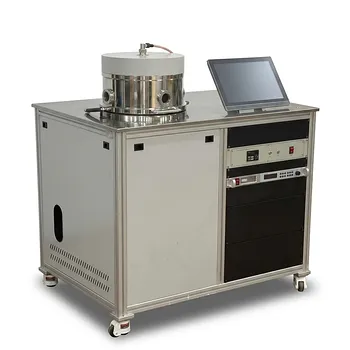
Plasma Enhanced Chemical Vapor Deposition (PECVD) equipment facilitates directional growth primarily by generating a localized electric field within the reaction chamber. By introducing a plasma source into the traditional CVD process, the system creates electric field lines that force carbon nanotubes (CNTs) to grow vertically relative to the substrate, rather than in a random, tangled manner.
Core Takeaway: While standard CVD relies on heat for random growth, PECVD utilizes plasma to generate an electric field that acts as a physical guide. This aligns the nanotubes perpendicular to the substrate while simultaneously allowing for synthesis at significantly lower temperatures, preserving sensitive materials.
The Mechanism of Directional Alignment
The Electric Field as a Guide
The defining feature of PECVD equipment is the introduction of a plasma source. This source generates an electric field perpendicular to the substrate surface.
Guided Vertical Growth
Under the influence of this field, the carbon nanotubes interact with catalytic particles on the surface. Instead of growing randomly, the nanotubes align themselves along the electric field lines. This results in vertically aligned arrays, which are essential for applications requiring precise orientation, such as electron emitters or sensor arrays.
The Role of Plasma Energy
Lowering Activation Temperatures
In traditional CVD, high temperatures (often above 800°C) are required to crack the hydrocarbon gas feedstock. PECVD equipment uses plasma to excite the reaction gases, supplying the necessary energy for chemical decomposition.
Enabling Low-Temperature Substrates
Because the plasma provides the energy, the substrate itself does not need to be as hot. PECVD allows for deposition at temperatures typically between 200°C and 400°C. This enables the direct growth of aligned nanotubes on temperature-sensitive materials, such as glass or conductive transparent substrates, which would melt or degrade in a standard furnace.
Key Process Parameters
Controlling the Environment
The growth process occurs in a highly controlled micro-reaction environment, typically at pressures between 2 and 10 Torr. The equipment allows for precise regulation of the feedstock gas (often acetylene) and carrier gas (often nitrogen).
Catalyst and Surface Chemistry
The growth is not dependent on the field alone; it requires careful management of the catalyst. Factors such as the catalyst type, its pretreatment, and the presence of a diffusion barrier significantly influence the density and quality of the nanotube "forest."
Understanding the Trade-offs
Increased Process Complexity
While PECVD offers superior alignment, it introduces a multitude of complex variables. Operators must manage plasma chemistry, plasma heating effects, and electromagnetic field dynamics simultaneously. This makes the process more difficult to optimize than standard thermal CVD.
Risk of Ion Bombardment
The plasma environment creates high-energy ions. While these ions help decompose the gas, excessive ion bombardment can damage the structural integrity of the growing nanotubes or induce defects in the crystal lattice.
Making the Right Choice for Your Goal
To determine if PECVD is the right tool for your specific application, consider your constraints regarding substrate material and alignment needs.
- If your primary focus is Vertical Alignment: PECVD is the requisite choice, as the electric field provides the necessary force to guide nanotubes into perpendicular arrays.
- If your primary focus is Temperature Sensitivity: PECVD is ideal, allowing you to synthesize materials on glass or plastics at temperatures below 400°C, far lower than the >800°C required by thermal CVD.
- If your primary focus is Bulk Powder Production: Standard thermal CVD may be more efficient, as it avoids the complexity of plasma physics and electric field management.
By leveraging the electric field of PECVD, you transform carbon nanotube synthesis from a chaotic chemical reaction into a precise, architecturally controlled manufacturing process.
Summary Table:
| Feature | Thermal CVD | PECVD |
|---|---|---|
| Growth Orientation | Random / Tangled | Vertically Aligned (Directional) |
| Primary Energy Source | Thermal Heat | Plasma-Generated Electric Field |
| Deposition Temperature | High (>800°C) | Low (200°C - 400°C) |
| Alignment Mechanism | None (Surface Crowding) | Electric Field Guidance |
| Substrate Compatibility | Heat-resistant only | Heat-sensitive (Glass, Plastics) |
| Main Application | Bulk Powder Production | Electron Emitters, Sensor Arrays |
Elevate your nanotechnology research with KINTEK’s advanced PECVD systems. Whether you are developing next-generation sensor arrays or working with temperature-sensitive substrates like glass and polymers, our high-precision PECVD and CVD reactors provide the architectural control you need. Beyond carbon nanotube synthesis, KINTEK specializes in a comprehensive range of laboratory equipment, including high-temperature muffle and vacuum furnaces, hydraulic presses, and specialized battery research tools. Contact us today to discover how our tailored solutions can optimize your material synthesis and lab efficiency!
References
- Wan Nor Roslam Wan Isahak, Ahmed A. Al‐Amiery. Oxygenated Hydrocarbons from Catalytic Hydrogenation of Carbon Dioxide. DOI: 10.3390/catal13010115
This article is also based on technical information from Kintek Solution Knowledge Base .
Related Products
- Inclined Rotary Plasma Enhanced Chemical Vapor Deposition PECVD Equipment Tube Furnace Machine
- Chemical Vapor Deposition CVD Equipment System Chamber Slide PECVD Tube Furnace with Liquid Gasifier PECVD Machine
- Inclined Rotary Plasma Enhanced Chemical Vapor Deposition PECVD Equipment Tube Furnace Machine
- RF PECVD System Radio Frequency Plasma-Enhanced Chemical Vapor Deposition RF PECVD
- Multi Heating Zones CVD Tube Furnace Machine Chemical Vapor Deposition Chamber System Equipment
People Also Ask
- What is plasma enhanced chemical vapor deposition PECVD equipment? A Guide to Low-Temperature Thin Film Deposition
- What are the core advantages of PE-CVD in OLED encapsulation? Protect Sensitive Layers with Low-Temp Film Deposition
- What is plasma enhanced chemical vapour deposition PECVD used for? Enable Low-Temp Thin Films for Electronics & Solar
- How does PECVD facilitate Ru-C nanocomposite films? Precision Low-Temperature Thin Film Synthesis
- What is the necessity of depositing a silicon nitride (SiNx) thin film using PECVD? Optimize QSSPC Lifetime Measurement