Knowledge lab furnace accessories What is metallographic sandpaper and how should it be used? A Guide to Flawless Sample Preparation
Author avatar

Tech Team · Kintek Solution

Updated 3 months ago

What is metallographic sandpaper and how should it be used? A Guide to Flawless Sample Preparation


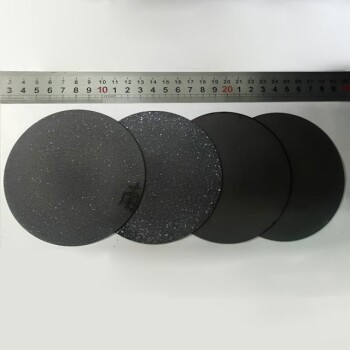
At its core, metallographic sandpaper is a precision tool designed for the systematic grinding of material samples in preparation for microscopic analysis. It consists of a water-resistant paper backing coated with a specific size of abrasive grain, most commonly silicon carbide (SiC), used in sequential stages to remove surface damage and achieve a flat, smooth finish.

The true purpose of using metallographic sandpaper is not simply to grind a sample, but to methodically remove layers of deformation from cutting or sectioning, preparing a pristine surface that reveals the material's true internal microstructure.
What is metallographic sandpaper and how should it be used? A Guide to Flawless Sample Preparation

The Role of Grinding in Material Analysis

Metallographic preparation is a multi-step process, and grinding is the critical foundation upon which all subsequent steps (polishing and etching) are built. A poorly executed grinding stage cannot be corrected later.

What Defines Metallographic Sandpaper?

The tool itself is composed of two key elements: a water-resistant paper base and a tightly graded abrasive material. Silicon carbide is the standard choice due to its hardness and sharp cutting edges, which efficiently remove material.

Understanding Grit Numbers

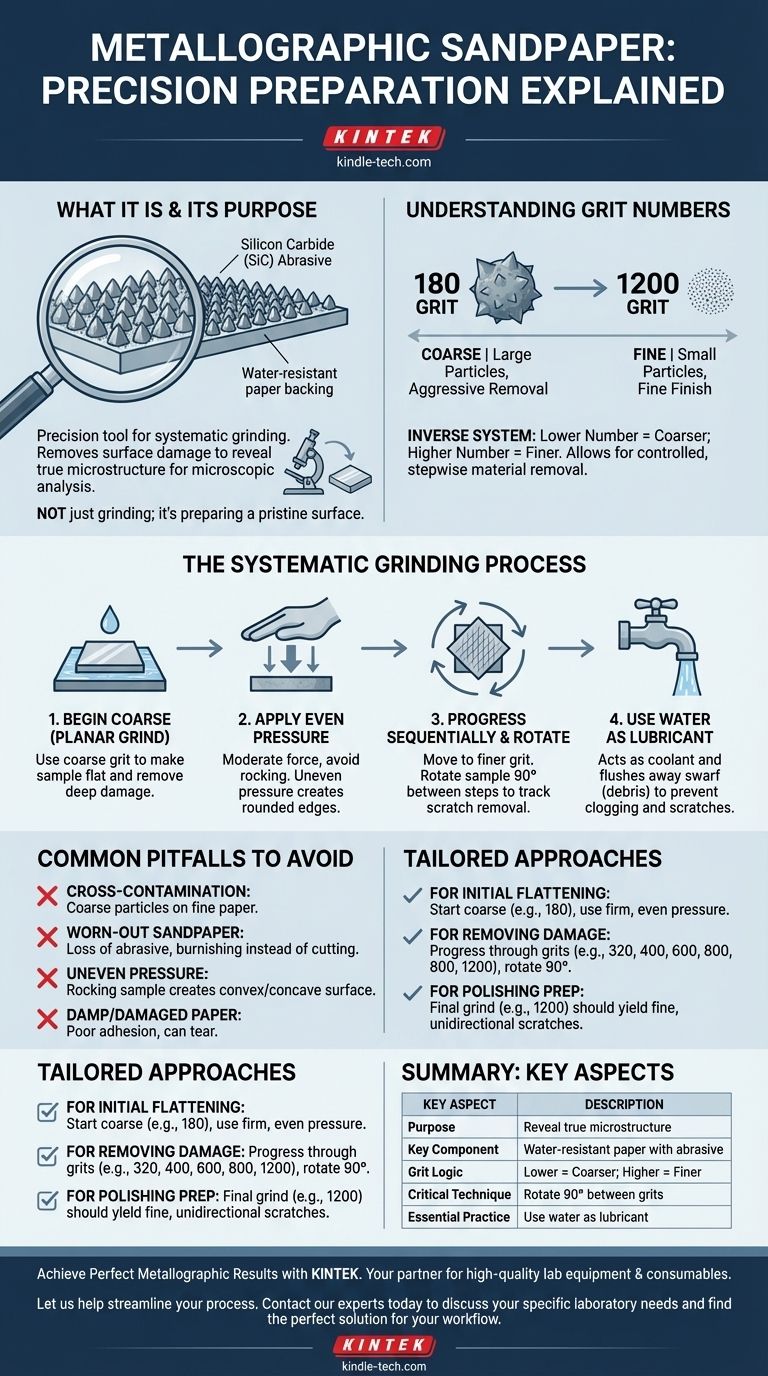
The sandpaper's coarseness is defined by its grit number. This system is inverse: a lower grit number (e.g., 180, 240) indicates a larger, more aggressive abrasive particle, while a higher grit number (e.g., 800, 1200) indicates a much finer particle.

This range allows for a controlled, stepwise process of material removal, starting coarse and finishing fine.

The Systematic Grinding Process

Success in metallographic grinding relies on a consistent and repeatable technique. The goal is to remove the damage from the previous step with the next, finer abrasive.

Begin with a Coarse Grit

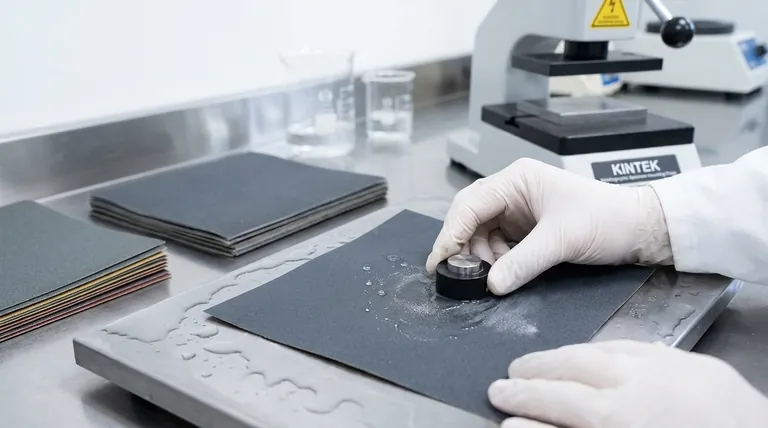
The first step, often called planar grinding, uses a coarse grit to make the sample perfectly flat and remove the deep damage from sectioning or cutting.

Apply Even, Moderate Pressure

Force should be applied evenly across the entire sample. Pressing too hard will introduce deep, new scratches and subsurface deformation, which will be difficult to remove in later stages.

Progress Through Grits Sequentially

After the initial planar grind, you move to the next finer grit. A critical technique is to rotate the sample 90 degrees between each grit change. This makes the scratches from the previous, coarser step easy to see. You continue grinding until all previous scratches are gone, leaving only a new, finer pattern.

Use Water as a Lubricant

Grinding is almost always performed wet. A steady flow of water over the sandpaper acts as a lubricant and a coolant, and most importantly, it flushes away swarf (the removed material and abrasive debris) to prevent it from clogging the paper and scratching the sample.

Common Pitfalls to Avoid

Mistakes made during grinding are the most common source of poor metallographic results. Understanding these pitfalls is essential for achieving an accurate analysis.

Cross-Contamination of Grits

Never allow coarser grit particles to contaminate a finer grit paper. A single 240-grit particle on a 1200-grit paper will create deep, rogue scratches that ruin the finish. Use separate areas and ensure thorough cleaning of the sample and your hands between steps.

Using Worn-Out Sandpaper

Sandpaper must be replaced when it loses its cutting ability. A worn paper, identified by a significant loss of abrasive material, will burnish or smear the material rather than cut it, introducing deformation instead of removing it.

The Consequences of Uneven Pressure

Applying pressure unevenly, such as by rocking the sample, will round the edges and create a convex or concave surface. This makes achieving focus across the entire sample under a microscope impossible.

Using Damp or Damaged Paper

If the paper is damp before being placed on the grinding platen, it may not adhere properly and can tear. Always ensure the paper is flat and dry before starting.

Making the Right Choice for Your Goal

Your approach should be tailored to the specific stage of preparation you are in.

  • If your primary focus is initial flattening: Start with a coarse grit (e.g., 180 or 240) and use firm, even pressure until the entire surface is uniform.
  • If your primary focus is removing damage: Progress methodically through each grit (e.g., 320, 400, 600, 800, 1200), using the 90-degree rotation technique to ensure all previous scratches are eliminated.
  • If your primary focus is preparing for polishing: Your final grinding step (e.g., 1200 grit) should result in a surface with only very fine, unidirectional scratches, setting the stage for a flawless final polish.

Mastering this foundational grinding process is the single most important step toward revealing the true, clear story hidden within your material.

Summary Table:

Key Aspect Description
Purpose Systematically remove surface damage to reveal a material's true microstructure.
Key Component Water-resistant paper coated with abrasive grains (e.g., Silicon Carbide).
Grit Number Logic Lower number = coarser grit; Higher number = finer grit.
Critical Technique Rotate sample 90° between each grit change to track scratch removal.
Essential Practice Always use water as a lubricant and coolant to flush away debris.

Achieve Perfect Metallographic Results Every Time

Mastering sample preparation is critical for accurate material analysis. The right tools and consumables make all the difference. KINTEK specializes in high-quality lab equipment and consumables, including precision metallographic sandpapers and grinding supplies, to ensure your laboratory operates at peak efficiency and delivers reliable data.

Let us help you streamline your process. Contact our experts today to discuss your specific laboratory needs and find the perfect solution for your workflow.

Visual Guide
What is metallographic sandpaper and how should it be used? A Guide to Flawless Sample Preparation Visual Guide

Related Products

People Also Ask

Related Products

Professional Cutting Tools for Carbon Paper Cloth Diaphragm Copper Aluminum Foil and More

Professional Cutting Tools for Carbon Paper Cloth Diaphragm Copper Aluminum Foil and More

Professional tools for cutting lithium sheets, carbon paper, carbon cloth, separators, copper foil, aluminum foil, etc., with round and square shapes and different sizes of blades.

Electrode Polishing Material for Electrochemical Experiments

Electrode Polishing Material for Electrochemical Experiments

Looking for a way to polish your electrodes for electrochemical experiments? Our polishing materials are here to help! Follow our easy instructions for best results.

Silicon Carbide (SIC) Ceramic Sheet Wear-Resistant Engineering Advanced Fine Ceramics

Silicon Carbide (SIC) Ceramic Sheet Wear-Resistant Engineering Advanced Fine Ceramics

Silicon carbide (sic) ceramic sheet is composed of high-purity silicon carbide and ultra-fine powder, which is formed by vibration molding and high-temperature sintering.

Square Lab Press Mold for Laboratory Applications

Square Lab Press Mold for Laboratory Applications

Create uniform samples easily with Square Lab Press Mold - available in various sizes. Ideal for battery, cement, ceramics, and more. Custom sizes available.

Laboratory CVD Boron Doped Diamond Materials

Laboratory CVD Boron Doped Diamond Materials

CVD boron-doped diamond: A versatile material enabling tailored electrical conductivity, optical transparency, and exceptional thermal properties for applications in electronics, optics, sensing, and quantum technologies.

Boron Nitride (BN) Ceramic Plate

Boron Nitride (BN) Ceramic Plate

Boron nitride (BN) ceramic plates do not use aluminum water to wet, and can provide comprehensive protection for the surface of materials that directly contact molten aluminum, magnesium, zinc alloys and their slag.

Single Punch Manual Tablet Press Machine TDP Tablet Punching Machine

Single Punch Manual Tablet Press Machine TDP Tablet Punching Machine

Single punch manual tablet punching machine can press various granular, crystal or powdery raw materials with good fluidity into disc-shaped, cylindrical, spherical, convex, concave and other various geometric shapes (such as square, triangle, ellipse, capsule shape, etc.), and can also press products with text and patterns.

Round Bidirectional Press Mold for Lab

Round Bidirectional Press Mold for Lab

The round bidirectional press mold is a specialized tool used in high-pressure molding processes, particularly for creating intricate shapes from metal powders.

Single Punch Electric Tablet Press Machine TDP Tablet Punching Machine

Single Punch Electric Tablet Press Machine TDP Tablet Punching Machine

The electric tablet punching machine is a laboratory equipment designed for pressing various granular and powdery raw materials into discs and other geometric shapes. It is commonly used in pharmaceutical, healthcare products, food, and other industries for small batch production and processing. The machine is compact, lightweight, and easy to operate, making it suitable for use in clinics, schools, laboratories, and research units.

Reference Electrode Calomel Silver Chloride Mercury Sulfate for Laboratory Use

Reference Electrode Calomel Silver Chloride Mercury Sulfate for Laboratory Use

Find high-quality reference electrodes for electrochemical experiments with complete specifications. Our models offer resistance to acid and alkali, durability, and safety, with customization options available to meet your specific needs.

12 Inch 24 Inch High Precision Automatic Diamond Wire Cutting Machine Laboratory Saw Precision Wire EDM Cutting Machine

12 Inch 24 Inch High Precision Automatic Diamond Wire Cutting Machine Laboratory Saw Precision Wire EDM Cutting Machine

The high precision automatic diamond wire cutting machine is a versatile cutting tool that uses a diamond wire to cut through a wide range of materials, including conductive and non-conductive materials, ceramics, glass, rocks, gems, jade, meteorites, monocrystalline silicon, silicon carbide, polycrystalline silicon, refractory bricks, epoxy boards, and ferrite bodies. It is especially suitable for cutting various brittle crystals with high hardness, high value, and easy to break.

Cylindrical Press Mold with Scale for Lab

Cylindrical Press Mold with Scale for Lab

Discover precision with our Cylindrical Press Mold. Ideal for high-pressure applications, it molds various shapes and sizes, ensuring stability and uniformity. Perfect for lab use.

Laboratory Disc Cup Vibratory Mill for Sample Grinding

Laboratory Disc Cup Vibratory Mill for Sample Grinding

The vibrating disc mill is suitable for non-destructive crushing and fine grinding of samples with large particle sizes, and can quickly prepare samples with analytical fineness and purity.

Precision Wire Saw Laboratory Cutting Machine with 800mm x 800mm Workbench for Diamond Single Wire Circular Small Cutting

Precision Wire Saw Laboratory Cutting Machine with 800mm x 800mm Workbench for Diamond Single Wire Circular Small Cutting

Diamond wire cutting machines are mainly used for precision cutting of ceramics, crystals, glass, metals, rocks, thermoelectric materials, infrared optical materials, composite materials, biomedical materials and other material analysis samples. Especially suitable for precision cutting of ultra-thin plates with thickness up to 0.2mm.

Powerful Plastic Crusher Machine

Powerful Plastic Crusher Machine

KINTEK's powerful plastic crusher machines process 60-1350 KG/H of diverse plastics, ideal for labs and recycling. Durable, efficient, and customizable.

Custom PTFE Teflon Parts Manufacturer for PTFE Mesh F4 Sieve

Custom PTFE Teflon Parts Manufacturer for PTFE Mesh F4 Sieve

PTFE mesh sieve is a specialized test sieve designed for particle analysis in various industries, featuring a non-metallic mesh woven from PTFE filament. This synthetic mesh is ideal for applications where metal contamination is a concern . PTFE sieves are crucial for maintaining the integrity of samples in sensitive environments, ensuring accurate and reliable results in particle size distribution analysis.

Precision Machined Silicon Nitride (SiN) Ceramic Sheet for Engineering Advanced Fine Ceramics

Precision Machined Silicon Nitride (SiN) Ceramic Sheet for Engineering Advanced Fine Ceramics

Silicon nitride plate is a commonly used ceramic material in the metallurgical industry due to its uniform performance at high temperatures.

Battery Lab Equipment 304 Stainless Steel Strip Foil 20um Thick for Battery Test

Battery Lab Equipment 304 Stainless Steel Strip Foil 20um Thick for Battery Test

304 is a versatile stainless steel, which is widely used in the production of equipment and parts that require good overall performance (corrosion resistance and formability).

Mini Planetary Ball Mill Machine for Laboratory Milling

Mini Planetary Ball Mill Machine for Laboratory Milling

Discover the KT-P400 desktop planetary ball mill, ideal for grinding and mixing small samples in the lab. Enjoy stable performance, long service life, and practicality. Functions include timing and overload protection.

Disc Cup Vibrating Mill Multi-Platform for Lab

Disc Cup Vibrating Mill Multi-Platform for Lab

The multi-platform vibrating disc mill is suitable for non-destructive crushing and fine grinding of samples with large particle sizes. It is suitable for crushing and grinding applications of medium-hard, high-hard, brittle, fibrous, and elastic materials.


Leave Your Message