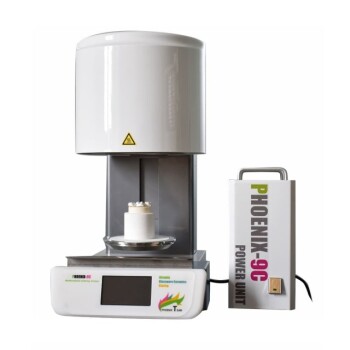
Knowledge dental furnace What is sintering in dentistry? Transform Zirconia into High-Strength Dental Restorations
Author avatar

Tech Team · Kintek Solution

Updated 2 months ago

What is sintering in dentistry? Transform Zirconia into High-Strength Dental Restorations


In dentistry, sintering is a critical heat-treatment process that transforms a porous, chalk-like block of ceramic material into a dense, high-strength final restoration. This process is most commonly associated with zirconia, where it is responsible for the material's exceptional durability and esthetics. It essentially fuses individual ceramic particles together without melting them.

Sintering is not simply baking; it is a precisely controlled transformation. This process is what converts an oversized, fragile, milled shape into a strong, accurately sized, and clinically viable dental crown, bridge, or implant abutment.
What is sintering in dentistry? Transform Zirconia into High-Strength Dental Restorations

The Transformation: From "Green State" to Final Form

To understand sintering, you must first understand the material's initial state after it has been milled by a CAD/CAM system.

What is the "Green State"?

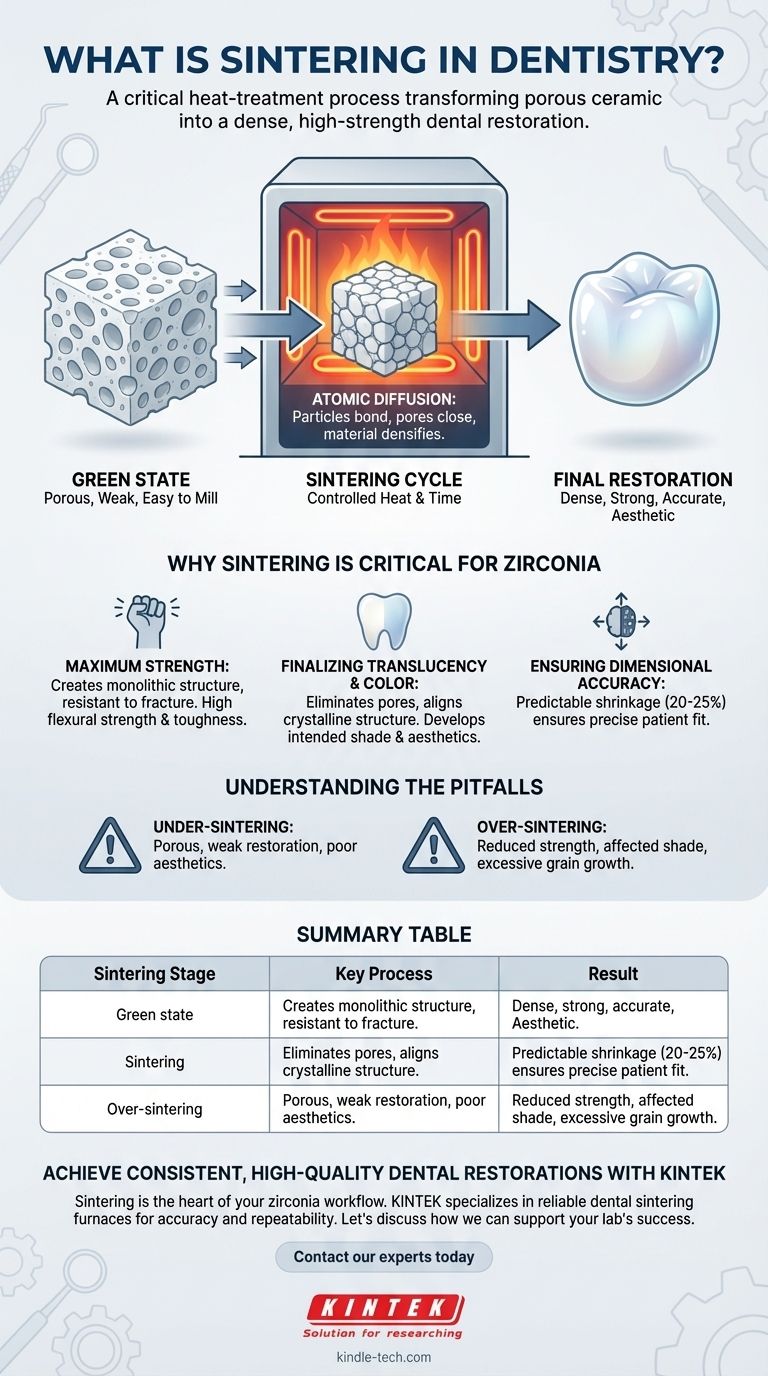
The "green state" refers to the material before sintering. In this stage, zirconia is soft, porous, and easily milled into a detailed anatomical shape.

Think of it as a block of highly compacted powder. The particles are pressed together but not yet chemically or physically fused. This makes the material weak and unsuitable for any clinical use.

The Role of Heat and Time

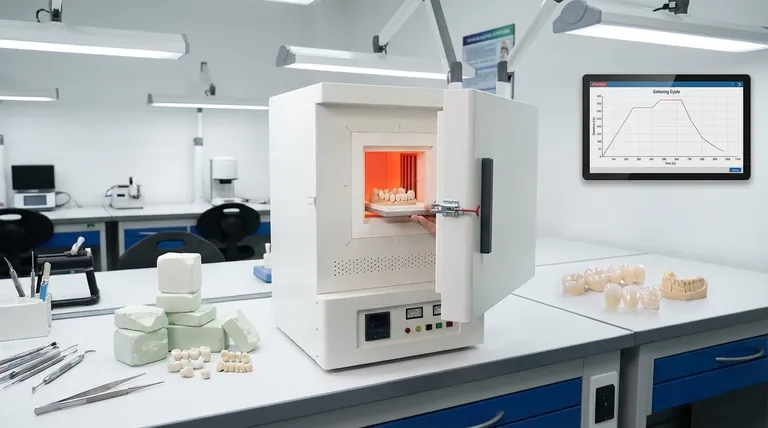
The green-state restoration is placed into a specialized, high-temperature furnace. The furnace follows a precise heating program, known as a sintering cycle.

As the temperature rises, the individual ceramic particles begin to bond at their points of contact. This process, driven by atomic diffusion, eliminates the pores between the particles.

The Result: Densification and Shrinkage

The primary outcome of sintering is densification. As the voids between particles are removed, the material becomes incredibly dense and solid.

This densification causes the restoration to shrink predictably. Zirconia typically shrinks by 20-25%. This shrinkage is a known factor, and the design software automatically enlarges the initial restoration design to compensate perfectly.

Why Sintering is Critical for Zirconia

Sintering is the step that unlocks the material properties that make zirconia a cornerstone of modern restorative dentistry.

Achieving Maximum Strength

The fusion of particles creates a monolithic structure that is highly resistant to fracture. Sintering is directly responsible for zirconia's high flexural strength and fracture toughness, allowing it to be used for long-span bridges and restorations in high-stress areas.

Finalizing Translucency and Color

The process also has a major impact on aesthetics. In the green state, zirconia is completely opaque. Sintering reduces light scattering by eliminating pores and aligning the material's crystalline structure.

This is what develops the final translucency and allows the pre-applied coloring ions to express the intended tooth shade.

Ensuring Dimensional Accuracy

The success of the entire digital workflow depends on predictable shrinkage. An accurate sintering cycle ensures the final restoration shrinks to the exact dimensions specified in the digital design, guaranteeing a precise fit for the patient.

Understanding the Pitfalls and Trade-offs

The sintering cycle is a delicate balance of temperature, heating rate, and time. Deviating from the manufacturer's validated parameters can severely compromise the final restoration.

The Risk of Under-Sintering

If the temperature is too low or the hold time is too short, the material will not fully densify. This results in a porous, weak restoration with poor aesthetics that is highly susceptible to premature failure.

The Risk of Over-Sintering

If the temperature is too high or the hold time is too long, it can cause excessive grain growth within the zirconia's microstructure. This can paradoxically reduce strength and negatively impact the material's translucency and shade.

Contamination and Inaccuracy

A contaminated or poorly calibrated furnace can also ruin the outcome. Debris inside the furnace can discolor the restoration, while an inaccurate temperature can lead to under- or over-sintering, destroying the restoration's integrity and fit.

Making the Right Choice for Predictable Results

Mastering the sintering process means following validated protocols precisely to ensure consistent, high-quality outcomes.

  • If your primary focus is strength and longevity: Always use the exact sintering cycle recommended by the zirconia manufacturer for that specific material.
  • If your primary focus is optimal aesthetics: Ensure your furnace is clean and calibrated regularly, as temperature accuracy directly impacts the final shade and translucency.
  • If your primary focus is efficiency: Only use "speed" or "fast" sintering cycles if they are explicitly validated by the manufacturer for the specific zirconia puck you are using.

Ultimately, understanding sintering empowers you to control the final properties of your ceramic restorations, turning a digital design into a clinical success.

Summary Table:

Sintering Stage Key Process Result
Green State Milled zirconia block, porous and weak Easy to shape, but not clinically usable
Sintering Cycle Heating in a specialized furnace (atomic diffusion) Particles bond, pores close, material densifies
Final Restoration Predictable 20-25% shrinkage, shade development Dense, strong, accurate, and aesthetic restoration

Achieve consistent, high-quality dental restorations with KINTEK.

Sintering is the heart of your zirconia workflow, and precision is non-negotiable. KINTEK specializes in dental lab equipment, including reliable sintering furnaces designed for accuracy and repeatability. Whether your focus is ultimate strength, perfect aesthetics, or efficient production, the right equipment ensures your restorations meet the highest clinical standards every time.

Let's discuss how we can support your lab's success. Contact our experts today to find the perfect sintering solution for your specific zirconia materials and workflow needs.

Visual Guide
What is sintering in dentistry? Transform Zirconia into High-Strength Dental Restorations Visual Guide

Related Products

People Also Ask

Related Products

Dental Porcelain Zirconia Sintering Ceramic Furnace Chairside with Transformer

Dental Porcelain Zirconia Sintering Ceramic Furnace Chairside with Transformer

Experience top-notch sintering with Chairside Sintering Furnace with Transformer. Easy to operate, noise-free pallet, and automatic temperature calibration. Order now!

Dental Porcelain Zirconia Sintering Ceramic Vacuum Press Furnace

Dental Porcelain Zirconia Sintering Ceramic Vacuum Press Furnace

Get precise dental results with Dental Vacuum Press Furnace. Automatic temperature calibration, low noise tray, and touch screen operation. Order now!

Vacuum Dental Porcelain Sintering Furnace

Vacuum Dental Porcelain Sintering Furnace

Get precise and reliable results with KinTek's Vacuum Porcelain Furnace. Suitable for all porcelain powders, it features hyperbolic ceramic furnace function, voice prompt, and automatic temperature calibration.

High Temperature Muffle Oven Furnace for Laboratory Debinding and Pre Sintering

High Temperature Muffle Oven Furnace for Laboratory Debinding and Pre Sintering

KT-MD High temperature debinding and pre-sintering furnace for ceramic materials with various molding processes. Ideal for electronic components such as MLCC and NFC.

Spark Plasma Sintering Furnace SPS Furnace

Spark Plasma Sintering Furnace SPS Furnace

Discover the benefits of Spark Plasma Sintering Furnaces for rapid, low-temperature material preparation. Uniform heating, low cost & eco-friendly.

600T Vacuum Induction Hot Press Furnace for Heat Treat and Sintering

600T Vacuum Induction Hot Press Furnace for Heat Treat and Sintering

Discover the 600T Vacuum Induction Hot Press Furnace, designed for high-temperature sintering experiments in vacuum or protected atmospheres. Its precise temperature and pressure control, adjustable working pressure, and advanced safety features make it ideal for nonmetal materials, carbon composites, ceramics, and metal powders.

Vacuum Heat Treat and Sintering Furnace with 9MPa Air Pressure

Vacuum Heat Treat and Sintering Furnace with 9MPa Air Pressure

The air pressure sintering furnace is a high-tech equipment commonly used for the sintering of advanced ceramic materials. It combines vacuum sintering and pressure sintering techniques to achieve high-density and high-strength ceramics.

Vacuum Heat Treat and Molybdenum Wire Sintering Furnace for Vacuum Sintering

Vacuum Heat Treat and Molybdenum Wire Sintering Furnace for Vacuum Sintering

A vacuum molybdenum wire sintering furnace is a vertical or bedroom structure, which is suitable for withdrawal, brazing, sintering and degassing of metal materials under high vacuum and high temperature conditions. It is also suitable for dehydroxylation treatment of quartz materials.

Vacuum Heat Treat Sintering Brazing Furnace

Vacuum Heat Treat Sintering Brazing Furnace

A vacuum brazing furnace is a type of industrial furnace used for brazing, a metalworking process that joins two pieces of metal using a filler metal that melts at a lower temperature than the base metals. Vacuum brazing furnaces are typically used for high-quality applications where a strong, clean joint is required.

Mesh belt controlled atmosphere furnace

Mesh belt controlled atmosphere furnace

Discover our KT-MB mesh belt sintering furnace - perfect for high-temperature sintering of electronic components & glass insulators. Available for open air or controlled atmosphere environments.

Small Vacuum Heat Treat and Tungsten Wire Sintering Furnace

Small Vacuum Heat Treat and Tungsten Wire Sintering Furnace

The small vacuum tungsten wire sintering furnace is a compact experimental vacuum furnace specially designed for universities and scientific research institutes. The furnace features a CNC welded shell and vacuum piping to ensure leak-free operation. Quick-connect electrical connections facilitate relocation and debugging, and the standard electrical control cabinet is safe and convenient to operate.

Vacuum Heat Treat and Pressure Sintering Furnace for High Temperature Applications

Vacuum Heat Treat and Pressure Sintering Furnace for High Temperature Applications

Vacuum pressure sintering furnaces are designed for high temperature hot pressing applications in metal and ceramic sintering. Its advanced features ensure precise temperature control, reliable pressure maintenance, and a robust design for seamless operation.

2200 ℃ Tungsten Vacuum Heat Treat and Sintering Furnace

2200 ℃ Tungsten Vacuum Heat Treat and Sintering Furnace

Experience the ultimate refractory metal furnace with our Tungsten vacuum furnace. Capable of reaching 2200℃, perfect for sintering advanced ceramics and refractory metals. Order now for high-quality results.

Ultra-High Temperature Graphite Vacuum Graphitization Furnace

Ultra-High Temperature Graphite Vacuum Graphitization Furnace

The ultra-high temperature graphitization furnace utilizes medium frequency induction heating in a vacuum or inert gas environment. The induction coil generates an alternating magnetic field, inducing eddy currents in the graphite crucible, which heats up and radiates heat to the workpiece, bringing it to the desired temperature. This furnace is primarily used for graphitization and sintering of carbon materials, carbon fiber materials, and other composite materials.

2200 ℃ Graphite Vacuum Heat Treat Furnace

2200 ℃ Graphite Vacuum Heat Treat Furnace

Discover the power of the KT-VG Graphite Vacuum Furnace - with a maximum working temperature of 2200℃, it's perfect for vacuum sintering of various materials. Learn more now.

Controlled Nitrogen Inert Hydrogen Atmosphere Furnace

Controlled Nitrogen Inert Hydrogen Atmosphere Furnace

KT-AH Hydrogen atmosphere furnace - induction gas furnace for sintering/annealing with built-in safety features, dual housing design, and energy-saving efficiency. Ideal for lab and industrial use.

Vacuum Heat Treat Furnace with Ceramic Fiber Liner

Vacuum Heat Treat Furnace with Ceramic Fiber Liner

Vacuum furnace with polycrystalline ceramic fiber insulation liner for excellent heat insulation and uniform temperature field. Choose from 1200℃ or 1700℃ max. working temperature with high vacuum performance and precise temperature control.

Graphite Vacuum Continuous Graphitization Furnace

Graphite Vacuum Continuous Graphitization Furnace

High-temperature graphitization furnace is a professional equipment for graphitization treatment of carbon materials. It is a key equipment for the production of high-quality graphite products. It has high temperature, high efficiency and uniform heating. It is suitable for various high-temperature treatments and graphitization treatments. It is widely used in metallurgy, electronics, aerospace, etc. industry.

Vertical High Temperature Graphite Vacuum Graphitization Furnace

Vertical High Temperature Graphite Vacuum Graphitization Furnace

Vertical high temperature graphitization furnace for carbonization and graphitization of carbon materials up to 3100℃.Suitable for shaped graphitization of carbon fiber filaments and other materials sintered in a carbon environment.Applications in metallurgy, electronics, and aerospace for producing high-quality graphite products like electrodes and crucibles.

Horizontal High Temperature Graphite Vacuum Graphitization Furnace

Horizontal High Temperature Graphite Vacuum Graphitization Furnace

Horizontal Graphitization Furnace: This type of furnace is designed with the heating elements placed horizontally, allowing for uniform heating of the sample. It's well-suited for graphitizing large or bulky samples that require precise temperature control and uniformity.


Leave Your Message