Knowledge Vacuum Furnace What is the annealing process on properties? Achieve Softer, More Ductile Materials
Author avatar

Tech Team · Kintek Solution

Updated 3 months ago

What is the annealing process on properties? Achieve Softer, More Ductile Materials


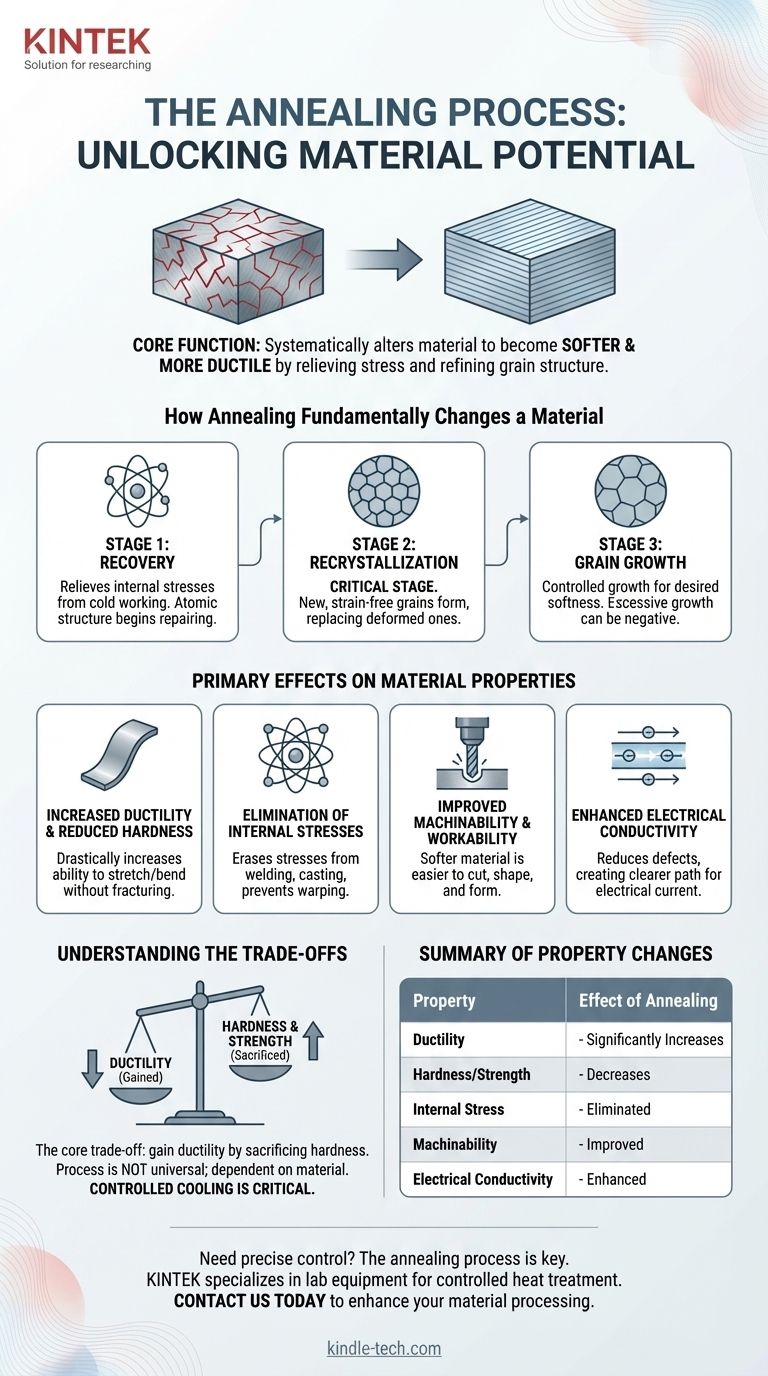
At its core, the annealing process systematically alters a material's properties by making it softer and more ductile. This is achieved through a controlled heat treatment cycle that involves heating the material to a specific temperature, holding it there, and then cooling it slowly. The primary goals are to relieve internal stresses, increase softness and ductility, and refine the material's internal grain structure, making it easier to work with.

The central purpose of annealing is to fundamentally "reset" a material's microstructure. By reducing internal defects and relieving stress, it trades hardness and strength for a significant increase in ductility and workability.
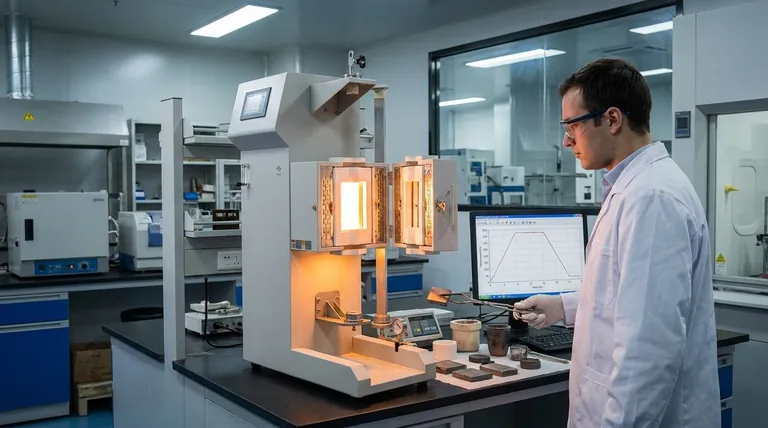
What is the annealing process on properties? Achieve Softer, More Ductile Materials

How Annealing Fundamentally Changes a Material

Annealing is not merely a heating process; it's a precise, three-stage transformation at the microscopic level. Understanding these stages is key to understanding its effects on a material's final properties.

Stage 1: Recovery

Before any major structural changes, the material first undergoes recovery. As the temperature rises, this initial stage relieves internal stresses that may have been introduced during processes like cold working or machining. The atomic structure gains enough energy to begin repairing minor defects.

Stage 2: Recrystallization

This is the most critical stage. As the material is held at its target temperature, new, strain-free grains begin to form and grow. These new crystals replace the old, deformed ones that were full of dislocations—microscopic defects that make a material hard and brittle.

Stage 3: Grain Growth

If the material is held at the annealing temperature for too long, the new, strain-free grains will continue to grow larger. This stage must be carefully controlled, as excessive grain growth can sometimes negatively impact certain properties, but a controlled growth phase is essential for achieving the desired softness.

The Primary Effects on Material Properties

The microstructural reset that occurs during annealing translates directly into tangible changes in the material's mechanical and physical behavior.

Increased Ductility and Reduced Hardness

This is the most well-known effect. By eliminating dislocations and creating a more uniform grain structure, annealing drastically increases a material's ability to be stretched, bent, or formed without fracturing. This comes at the direct expense of hardness and tensile strength.

Elimination of Internal Stresses

Processes like welding, casting, and cold forming create significant stress within a material's structure. Annealing allows the atomic lattice to relax into a lower-energy state, effectively erasing this internal stress. This is critical for preventing warping, cracking, or dimensional instability later in the part's life.

Improved Machinability and Workability

A softer, more ductile, and stress-free material is fundamentally easier to cut, shape, and form. The improved workability after annealing reduces tool wear and allows for more aggressive manufacturing processes, such as deep drawing or complex bending.

Enhanced Electrical Conductivity

The crystal structure dislocations that make a material hard also impede the flow of electrons. By reducing the number of these defects, the annealing process creates a clearer path for electrical current, often resulting in a measurable increase in conductivity.

Understanding the Trade-offs

Annealing is a powerful tool, but its application involves balancing competing properties. It is not a universal solution for improving a material.

The Hardness vs. Ductility Balance

The core trade-off is unavoidable: you gain ductility by sacrificing hardness and strength. The goal of annealing is to move the material to a softer, more workable state. If high strength is the end goal, another form of heat treatment will be required after the forming process is complete.

The Process is Not Universal

The correct annealing process is highly dependent on the specific material. The required temperatures, hold times, and cooling rates for steel are vastly different from those for aluminum, copper, or brass. Each alloy system has its own unique requirements to achieve the desired microstructural changes.

Controlled Cooling is Critical

The rate of cooling is arguably as important as the heating temperature. The characteristically slow cooling rate of annealing is what allows the new, stress-free grain structure to form properly. Cooling too quickly can introduce new stresses or create a different, harder microstructure, defeating the purpose of the process.

Making the Right Choice for Your Goal

Annealing should be viewed as a precise tool to prepare a material for a specific task or to restore its properties after a demanding process.

  • If your primary focus is preparing for significant shaping (e.g., deep drawing or stamping): Annealing is essential to maximize ductility and prevent the material from cracking during forming.
  • If your primary focus is stabilizing a part after welding or heavy machining: A stress-relief anneal is critical to prevent future distortion and ensure dimensional accuracy.
  • If your primary focus is restoring workability to a strain-hardened material: Annealing can reset the microstructure, making the material soft and ductile again for further processing steps.

Ultimately, annealing provides you with precise control over a material's internal structure to achieve specific, predictable engineering outcomes.

Summary Table:

Property Change Effect of Annealing
Ductility Significantly Increases
Hardness/Strength Decreases
Internal Stress Eliminated
Machinability Improved
Electrical Conductivity Enhanced

Need precise control over your material's properties? The annealing process is key to achieving softer, more workable metals for manufacturing and R&D. KINTEK specializes in the lab equipment and consumables required for controlled heat treatment, serving the precise needs of laboratories and material scientists. Contact us today to discuss how our solutions can enhance your material processing and achieve your specific engineering outcomes.

Visual Guide
What is the annealing process on properties? Achieve Softer, More Ductile Materials Visual Guide

Related Products

People Also Ask

Related Products

Controlled Nitrogen Inert Hydrogen Atmosphere Furnace

Controlled Nitrogen Inert Hydrogen Atmosphere Furnace

KT-AH Hydrogen atmosphere furnace - induction gas furnace for sintering/annealing with built-in safety features, dual housing design, and energy-saving efficiency. Ideal for lab and industrial use.

Vacuum Heat Treat Furnace with Ceramic Fiber Liner

Vacuum Heat Treat Furnace with Ceramic Fiber Liner

Vacuum furnace with polycrystalline ceramic fiber insulation liner for excellent heat insulation and uniform temperature field. Choose from 1200℃ or 1700℃ max. working temperature with high vacuum performance and precise temperature control.

High Temperature Muffle Oven Furnace for Laboratory Debinding and Pre Sintering

High Temperature Muffle Oven Furnace for Laboratory Debinding and Pre Sintering

KT-MD High temperature debinding and pre-sintering furnace for ceramic materials with various molding processes. Ideal for electronic components such as MLCC and NFC.

Laboratory Muffle Oven Furnace Bottom Lifting Muffle Furnace

Laboratory Muffle Oven Furnace Bottom Lifting Muffle Furnace

Efficiently produce batches with excellent temperature uniformity using our Bottom Lifting Furnace. Features two electric lifting stages and advanced temperature control up to 1600℃.

Non Consumable Vacuum Arc Induction Melting Furnace

Non Consumable Vacuum Arc Induction Melting Furnace

Explore the benefits of Non-Consumable Vacuum Arc Furnace with high melting point electrodes. Small, easy to operate & eco-friendly. Ideal for laboratory research on refractory metals & carbides.

1200℃ Controlled Atmosphere Furnace Nitrogen Inert Atmosphere Furnace

1200℃ Controlled Atmosphere Furnace Nitrogen Inert Atmosphere Furnace

Discover our KT-12A Pro Controlled atmosphere furnace - high precision, heavy duty vacuum chamber, versatile smart touch screen controller, and excellent temperature uniformity up to 1200C. Ideal for both laboratory and industrial application.

1700℃ Controlled Atmosphere Furnace Nitrogen Inert Atmosphere Furnace

1700℃ Controlled Atmosphere Furnace Nitrogen Inert Atmosphere Furnace

KT-17A Controlled atmosphere furnace: 1700℃ heating, vacuum sealing technology, PID temperature control, and versatile TFT smart touch screen controller for laboratory and industrial use.

Vertical High Temperature Graphite Vacuum Graphitization Furnace

Vertical High Temperature Graphite Vacuum Graphitization Furnace

Vertical high temperature graphitization furnace for carbonization and graphitization of carbon materials up to 3100℃.Suitable for shaped graphitization of carbon fiber filaments and other materials sintered in a carbon environment.Applications in metallurgy, electronics, and aerospace for producing high-quality graphite products like electrodes and crucibles.

Horizontal High Temperature Graphite Vacuum Graphitization Furnace

Horizontal High Temperature Graphite Vacuum Graphitization Furnace

Horizontal Graphitization Furnace: This type of furnace is designed with the heating elements placed horizontally, allowing for uniform heating of the sample. It's well-suited for graphitizing large or bulky samples that require precise temperature control and uniformity.

Vacuum Heat Treat and Pressure Sintering Furnace for High Temperature Applications

Vacuum Heat Treat and Pressure Sintering Furnace for High Temperature Applications

Vacuum pressure sintering furnaces are designed for high temperature hot pressing applications in metal and ceramic sintering. Its advanced features ensure precise temperature control, reliable pressure maintenance, and a robust design for seamless operation.

1400℃ Controlled Atmosphere Furnace with Nitrogen and Inert Atmosphere

1400℃ Controlled Atmosphere Furnace with Nitrogen and Inert Atmosphere

Achieve precise heat treatment with KT-14A controlled atmosphere furnace. Vacuum sealed with a smart controller, it's ideal for lab and industrial use up to 1400℃.

Mesh belt controlled atmosphere furnace

Mesh belt controlled atmosphere furnace

Discover our KT-MB mesh belt sintering furnace - perfect for high-temperature sintering of electronic components & glass insulators. Available for open air or controlled atmosphere environments.

Ultra-High Temperature Graphite Vacuum Graphitization Furnace

Ultra-High Temperature Graphite Vacuum Graphitization Furnace

The ultra-high temperature graphitization furnace utilizes medium frequency induction heating in a vacuum or inert gas environment. The induction coil generates an alternating magnetic field, inducing eddy currents in the graphite crucible, which heats up and radiates heat to the workpiece, bringing it to the desired temperature. This furnace is primarily used for graphitization and sintering of carbon materials, carbon fiber materials, and other composite materials.

Graphite Vacuum Furnace Bottom Discharge Graphitization Furnace for Carbon Materials

Graphite Vacuum Furnace Bottom Discharge Graphitization Furnace for Carbon Materials

Bottom-out graphitization furnace for carbon materials, ultra-high temperature furnace up to 3100°C, suitable for graphitization and sintering of carbon rods and carbon blocks. Vertical design, bottom discharging, convenient feeding and discharging, high temperature uniformity, low energy consumption, good stability, hydraulic lifting system, convenient loading and unloading.

Large Vertical Graphite Vacuum Graphitization Furnace

Large Vertical Graphite Vacuum Graphitization Furnace

A large vertical high-temperature graphitization furnace is a type of industrial furnace used for the graphitization of carbon materials, such as carbon fiber and carbon black. It is a high-temperature furnace that can reach temperatures of up to 3100°C.

Graphite Vacuum Continuous Graphitization Furnace

Graphite Vacuum Continuous Graphitization Furnace

High-temperature graphitization furnace is a professional equipment for graphitization treatment of carbon materials. It is a key equipment for the production of high-quality graphite products. It has high temperature, high efficiency and uniform heating. It is suitable for various high-temperature treatments and graphitization treatments. It is widely used in metallurgy, electronics, aerospace, etc. industry.

Lab-Scale Vacuum Induction Melting Furnace

Lab-Scale Vacuum Induction Melting Furnace

Get precise alloy composition with our Vacuum Induction Melting Furnace. Ideal for aerospace, nuclear energy, and electronic industries. Order now for effective smelting and casting of metals and alloys.

Vacuum Heat Treat and Molybdenum Wire Sintering Furnace for Vacuum Sintering

Vacuum Heat Treat and Molybdenum Wire Sintering Furnace for Vacuum Sintering

A vacuum molybdenum wire sintering furnace is a vertical or bedroom structure, which is suitable for withdrawal, brazing, sintering and degassing of metal materials under high vacuum and high temperature conditions. It is also suitable for dehydroxylation treatment of quartz materials.

Vacuum Arc Induction Melting Furnace

Vacuum Arc Induction Melting Furnace

Discover the power of Vacuum Arc Furnace for melting active & refractory metals. High-speed, remarkable degassing effect, and free of contamination. Learn more now!

Multi-zone Laboratory Tube Furnace

Multi-zone Laboratory Tube Furnace

Experience precise, efficient thermal testing with our Multi Zone Tube Furnace. Independent heating zones and temperature sensors allow for controlled high-temperature gradient heating fields. Order now for advanced thermal analysis!


Leave Your Message



















