Knowledge What is the ball mill based on the principle of? Impact and Attrition for Efficient Grinding
Author avatar

Tech Team · Kintek Solution

Updated 6 days ago

What is the ball mill based on the principle of? Impact and Attrition for Efficient Grinding


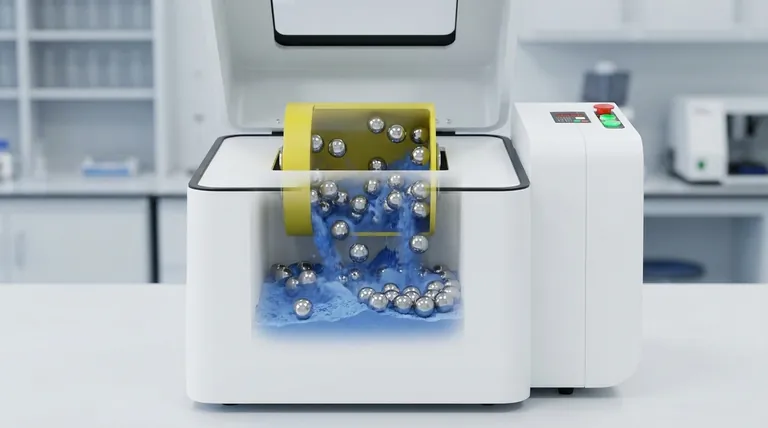
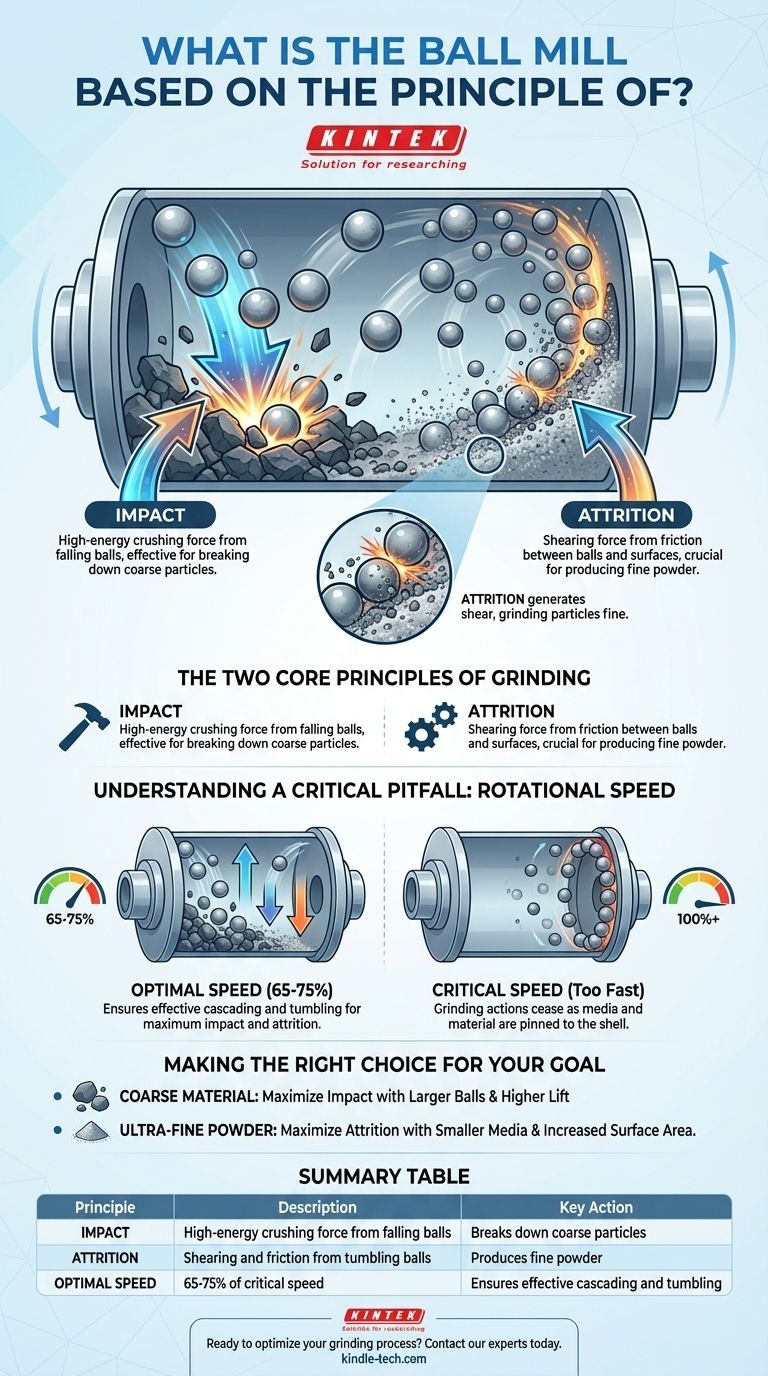
At its core, a ball mill operates on the combined principles of impact and attrition. Inside a rotating cylinder, heavy grinding media (like steel balls) are lifted and then fall, creating a powerful impact that smashes the material. Simultaneously, as these balls tumble and rub against each other and the material, they generate attrition, a shearing force that grinds the particles into a fine powder.

The essential function of a ball mill is to use the controlled, chaotic motion of tumbling media within a rotating drum to systematically crush and grind materials down to a desired particle size.
What is the ball mill based on the principle of? Impact and Attrition for Efficient Grinding

Deconstructing the Ball Mill's Operation

To grasp the principles, you must first visualize the machine's components and their coordinated movement. The design is mechanically simple but highly effective.

The Rotating Cylinder

A ball mill is fundamentally a hollow cylinder or shell that rotates on a horizontal axis. The material to be ground is fed into one end, and the finely ground product is discharged from the other.

The Grinding Media

The cylinder is partially filled, typically to about 30% of its volume, with grinding media. These are most often hard steel or ceramic balls, though rods or pebbles can also be used.

The Grinding Process in Motion

As the cylinder rotates, it carries the grinding media and the material up its inner wall. The effectiveness of the entire process depends on what happens next, which is dictated by the speed of this rotation.

The Two Core Principles of Grinding

The actual size reduction happens through two distinct but complementary actions occurring simultaneously inside the mill.

Principle 1: Impact

As the balls are lifted by the rotating wall, they reach a point where gravity overcomes the forces holding them to the shell. They then cascade and drop, falling onto the material at the bottom of the mill.

This fall creates a high-energy impact, a crushing force that is highly effective at breaking down larger, coarser particles into smaller pieces.

Principle 2: Attrition

Attrition is the grinding action that results from friction and shear. As the mass of balls tumbles, the individual balls rub and slide against one another and against the cylinder's inner surface.

Material caught between these moving surfaces is subjected to intense shearing forces, wearing it down into a very fine powder. This action is crucial for achieving the final desired fineness.

Understanding a Critical Pitfall: Rotational Speed

The efficiency of a ball mill is almost entirely dependent on operating it at the correct speed. The wrong speed can render the machine ineffective.

The Concept of "Critical Speed"

Critical speed is the specific rotational speed at which the centrifugal force is so great that it pins the grinding media and material against the inner wall of the cylinder.

When this happens, the balls no longer tumble or fall. They simply rotate with the shell, and the grinding actions of both impact and attrition cease completely.

The Importance of Optimal Speed

A ball mill must operate at a percentage below its critical speed, typically around 65-75%.

If the speed is too slow, the balls will just roll at the bottom of the mill, producing minimal impact. If it's too fast, it approaches critical speed and the grinding stops. The optimal speed ensures the balls are lifted high enough for a powerful impact while still allowing for a constant cascading and tumbling motion.

Making the Right Choice for Your Goal

Understanding the two core principles allows you to optimize the process for a specific outcome, as ball mills are used for everything from mineral processing to making paint pigments and ceramics.

  • If your primary focus is breaking down coarse material: You want to maximize the impact force by using larger grinding balls and an operating speed that elevates them as high as possible before they fall.
  • If your primary focus is producing an ultra-fine powder: You want to maximize the attrition force by using smaller media, which increases the total surface area and the number of contact points for grinding.

Ultimately, the ball mill's genius lies in its simplicity, using gravity and friction to transform coarse solids into fine powder through a controlled, continuous process.

Summary Table:

Principle Description Key Action
Impact High-energy crushing force from falling balls Breaks down coarse particles
Attrition Shearing and friction from tumbling balls Produces fine powder
Optimal Speed 65-75% of critical speed Ensures effective cascading and tumbling

Ready to optimize your grinding process?

Whether your goal is coarse crushing or producing ultra-fine powders, the right ball mill is critical for your lab's efficiency and results. KINTEK specializes in high-quality lab equipment, including ball mills tailored to your specific material and particle size requirements.

Contact our experts today to discuss how we can help you achieve superior grinding performance and enhance your laboratory's capabilities.

Visual Guide
What is the ball mill based on the principle of? Impact and Attrition for Efficient Grinding Visual Guide

Related Products

People Also Ask

Related Products

Laboratory Single Horizontal Jar Mill

Laboratory Single Horizontal Jar Mill

KT-JM3000 is a mixing and grinding instrument for placing a ball milling tank with a volume of 3000ml or less. It adopts frequency conversion control to realize timing, constant speed, direction change, overload protection and other functions.

High-Energy Omnidirectional Planetary Ball Mill Milling Machine for Laboratory

High-Energy Omnidirectional Planetary Ball Mill Milling Machine for Laboratory

The KT-P4000E is a new product derived from the vertical high-energy planetary ball mill with a 360° swivel function. Experience faster, uniform, and smaller sample output results with 4 ≤1000ml ball mill jars.

High Energy Planetary Ball Mill Milling Machine for Laboratory

High Energy Planetary Ball Mill Milling Machine for Laboratory

Experience fast and effective sample processing with the F-P2000 high-energy planetary ball mill. This versatile equipment offers precise control and excellent grinding capabilities. Perfect for laboratories, it features multiple grinding bowls for simultaneous testing and high output. Achieve optimal results with its ergonomic design, compact structure, and advanced features. Ideal for a wide range of materials, it ensures consistent particle size reduction and low maintenance.

High-Energy Omnidirectional Planetary Ball Mill Machine for Laboratory

High-Energy Omnidirectional Planetary Ball Mill Machine for Laboratory

The KT-P2000E is a new product derived from the vertical high-energy planetary ball mill with a 360°rotation function. The product not only has the characteristics of the vertical high-energy ball mill, but also has a unique 360°rotation function for the planetary body.

High Energy Planetary Ball Mill Milling Machine for Laboratory

High Energy Planetary Ball Mill Milling Machine for Laboratory

The biggest feature is that the high energy planetary ball mill can not only perform fast and effective grinding, but also has good crushing ability

High Energy Planetary Ball Mill for Laboratory Horizontal Tank Type Milling Machine

High Energy Planetary Ball Mill for Laboratory Horizontal Tank Type Milling Machine

KT-P4000H uses the unique Y-axis planetary motion trajectory, and utilizes the collision, friction and gravity between the sample and the grinding ball to have a certain anti-sinking ability, which can obtain better grinding or mixing effects and further improve the sample output.

High Energy Vibratory Laboratory Ball Mill Double Tank Type

High Energy Vibratory Laboratory Ball Mill Double Tank Type

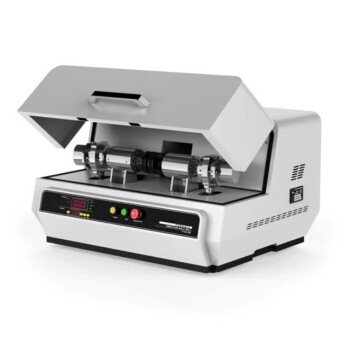
High-energy vibration ball mill is a small desktop laboratory grinding instrument. It uses 1700r/min high-frequency three-dimensional vibration to make the sample achieve the result of grinding or mixing.

Laboratory Horizontal Planetary Ball Mill Milling Machine

Laboratory Horizontal Planetary Ball Mill Milling Machine

Improve sample uniformity with our Horizontal Planetary Ball Mills. KT-P400H reduces sample deposition and KT-P400E has multi-directional capabilities. Safe, convenient and efficient with overload protection.

High Energy Vibratory Laboratory Ball Mill Grinding Mill Single Tank Type

High Energy Vibratory Laboratory Ball Mill Grinding Mill Single Tank Type

High-energy vibration ball mill is a small desktop laboratory grinding instrument.It can be ball-milled or mixed with different particle sizes and materials by dry and wet methods.

High Energy Vibratory Ball Mill for Lab Use

High Energy Vibratory Ball Mill for Lab Use

The high-energy vibrating ball mill is a high-energy oscillating and impacting multifunctional laboratory ball mill. The table-top type is easy to operate, small in size, comfortable and safe.

Laboratory Ten-Body Horizontal Jar Mill for Lab Use

Laboratory Ten-Body Horizontal Jar Mill for Lab Use

The Ten-body horizontal jar mill is for 10 ball mill pots (3000ml or less). It has frequency conversion control, rubber roller movement, and PE protective cover.

Laboratory Test Sieves and Sieving Machines

Laboratory Test Sieves and Sieving Machines

Precision lab test sieves & sieving machines for accurate particle analysis. Stainless steel, ISO-compliant, 20μm-125mm range. Request specs now!

Anti-Cracking Press Mold for Lab Use

Anti-Cracking Press Mold for Lab Use

The anti-cracking press mold is a specialized equipment designed for molding various shapes and sizes of film using high pressure and electric heating.

Precision Machined Zirconia Ceramic Ball for Engineering Advanced Fine Ceramics

Precision Machined Zirconia Ceramic Ball for Engineering Advanced Fine Ceramics

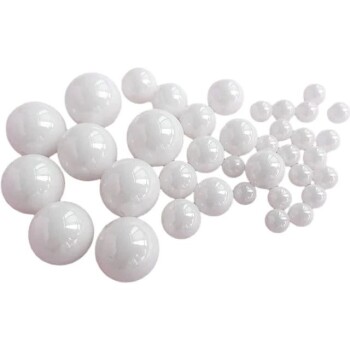
zirconia ceramic ball have the characteristics of high strength, high hardness, PPM wear level, high fracture toughness, good wear resistance, and high specific gravity.

Laboratory Sterilizer Lab Autoclave Vertical Pressure Steam Sterilizer for Liquid Crystal Display Automatic Type

Laboratory Sterilizer Lab Autoclave Vertical Pressure Steam Sterilizer for Liquid Crystal Display Automatic Type

Liquid crystal display automatic vertical sterilizer is a safe, reliable and automatic control sterilization equipment, which is composed of heating system, microcomputer control system and overheating and overvoltage protection system.

Benchtop Laboratory Vacuum Freeze Dryer

Benchtop Laboratory Vacuum Freeze Dryer

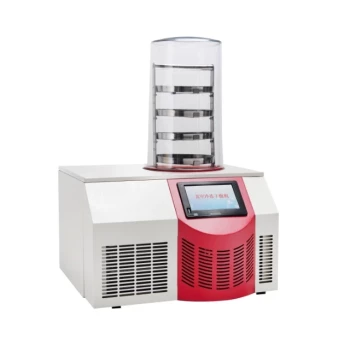
Benchtop laboratory freeze dryer for efficient lyophilization of biological, pharmaceutical, and food samples. Features intuitive touchscreen, high-performance refrigeration, and durable design. Preserve sample integrity—consult now!

Benchtop Laboratory Freeze Dryer for Lab Use

Benchtop Laboratory Freeze Dryer for Lab Use

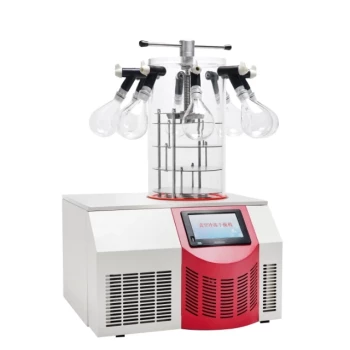
Premium benchtop laboratory freeze dryer for lyophilization, preserving samples with ≤ -60°C cooling. Ideal for pharmaceuticals & research.

Laboratory Vibratory Sieve Shaker Machine Slap Vibrating Sieve

Laboratory Vibratory Sieve Shaker Machine Slap Vibrating Sieve

KT-T200TAP is a slapping and oscillating sieving instrument for laboratory desktop use, with 300 rpm horizontal circular motion and 300 vertical slapping motions to simulate manual sieving to help sample particles pass through better.

Laboratory Sterilizer Lab Autoclave Pulse Vacuum Lifting Sterilizer

Laboratory Sterilizer Lab Autoclave Pulse Vacuum Lifting Sterilizer

The pulse vacuum lifting sterilizer is a state-of-the-art equipment for efficient and precise sterilization. It uses pulsating vacuum technology, customizable cycles, and a user-friendly design for easy operation and safety.

HFCVD Machine System Equipment for Drawing Die Nano-Diamond Coating

HFCVD Machine System Equipment for Drawing Die Nano-Diamond Coating

The nano-diamond composite coating drawing die uses cemented carbide (WC-Co) as the substrate, and uses the chemical vapor phase method ( CVD method for short ) to coat the conventional diamond and nano-diamond composite coating on the surface of the inner hole of the mold.


Leave Your Message