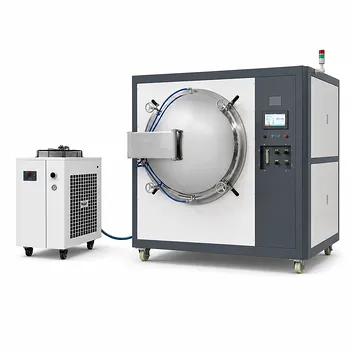
The vacuum hot pressing furnace acts as the primary forming environment for creating SiCf/TC17/TB8 composite plates. By simultaneously applying specific high temperature (880°C) and high pressure (40 MPa), it facilitates the plastic flow and diffusion bonding required to transform separate fiber, matrix, and cladding precursors into a single, densified component.
Core Takeaway: The furnace functions as a consolidation engine, using pressure to force the metal matrix into microscopic gaps between fibers while utilizing heat and vacuum to bond the matrix and cladding at an atomic level, ensuring a defect-free structure.
Driving Material Densification
The central challenge in creating these composites is eliminating voids between the fibers and the metal matrix.
Overcoming Deformation Resistance
The application of 40 MPa of pressure is not arbitrary; it is specifically calculated to overcome the natural deformation resistance of the TC17 metal matrix.
Eliminating Porosity
Under this pressure, the matrix undergoes plastic flow. It is forced to fill the interstitial gaps between the silicon carbide (SiC) fibers, effectively eliminating internal porosity.
Achieving High Density
This mechanical compression ensures the final material achieves near-theoretical density. Without this forced impregnation, the composite would suffer from structural weaknesses due to air pockets.
Ensuring Atomic-Level Bonding
Beyond simple compaction, the furnace must create a unified metallurgical bond between the different layers (SiC fibers, TC17 matrix, and TB8 cladding).
Facilitating Diffusion Bonding
The 880°C operating temperature provides the necessary thermal activation energy. When combined with the external pressure, this drives atomic diffusion across the contact interfaces.
The Critical Role of Vacuum
While pressure drives contact, the vacuum environment is essential for chemical integrity. It prevents the oxidation of the reactive titanium alloys at high temperatures.
Removing Interface Barriers
The vacuum actively removes residual gases and inhibits oxide film formation. This exposes fresh metal surfaces, allowing atoms to diffuse freely across the interface for a strong, cohesive bond.
Precision Geometry Control
The furnace does not just mash materials together; it molds them into a precise engineering shape.
Restricting Lateral Flow
The process utilizes high-strength, heat-resistant graphite molds to contain the layup. These molds restrict the materials from flowing sideways (lateral flow) under the immense pressure.
Defining Final Dimensions
By fixing the layup positions, the mold system ensures the final composite plate meets exact thickness specifications. This constraint is also responsible for achieving high surface flatness in the finished plate.
Critical Process Constraints
Understanding the limitations of this process is vital for consistent results.
Pressure-Temperature Balance
If the pressure drops below 40 MPa, the matrix will not fully penetrate the fiber bundles, resulting in voids. Conversely, insufficient temperature will fail to activate the atomic diffusion required for bonding the TB8 cladding to the matrix.
Vacuum Integrity
The vacuum level is a non-negotiable variable. Even minor leaks can introduce oxygen, creating brittle oxide layers that compromise the interface bonding, regardless of how much pressure is applied.
Making the Right Choice for Your Goal
To maximize the quality of SiCf/TC17/TB8 plates, focus your process control on the specific outcome you need most.
- If your primary focus is Structural Integrity: Prioritize the stability of the 40 MPa pressure application to ensure the TC17 matrix completely fills the gaps between SiC fibers.
- If your primary focus is Interface Strength: Ensure the vacuum environment is strictly maintained to prevent oxidation, allowing for maximum atomic diffusion between the matrix and cladding.
- If your primary focus is Dimensional Accuracy: Verify the rigidity and tolerance of the graphite mold system to effectively restrict lateral flow and guarantee surface flatness.
Success in this process relies on the precise synchronization of thermal activation, mechanical pressure, and environmental control.
Summary Table:
| Parameter | Process Role | Critical Outcome |
|---|---|---|
| Temperature (880°C) | Provides thermal activation energy | Facilitates atomic diffusion bonding |
| Pressure (40 MPa) | Overcomes deformation resistance | Eliminates porosity and fills gaps |
| Vacuum Environment | Prevents titanium oxidation | Ensures clean, high-strength interfaces |
| Graphite Molds | Restricts lateral material flow | Defines precise geometry and flatness |
Elevate Your Composite Manufacturing with KINTEK Precision
Mastering the complex interplay of pressure and temperature in SiCf/TC17/TB8 production requires equipment that never compromises on stability. KINTEK specializes in advanced vacuum hot pressing furnaces and high-temperature systems designed specifically for the rigorous demands of aerospace and materials research.
Our comprehensive portfolio—including vacuum, atmosphere, and induction melting furnaces, isostatic hydraulic presses, and high-purity ceramic crucibles—provides the reliability needed for atomic-level bonding and defect-free densification.
Ready to optimize your material performance? Contact our technical experts today to discover how KINTEK’s laboratory solutions can enhance your production efficiency and structural integrity.
Related Products
- Vacuum Hot Press Furnace Heated Vacuum Press Machine Tube Furnace
- 600T Vacuum Induction Hot Press Furnace for Heat Treat and Sintering
- Vacuum Hot Press Furnace Machine Heated Vacuum Press
- Vacuum Hot Press Furnace Machine for Lamination and Heating
- Vacuum Heat Treat and Pressure Sintering Furnace for High Temperature Applications
People Also Ask
- What advantages does a vacuum hot press furnace provide for LSLBO ceramic electrolytes? Achieve 94% Relative Density
- What role does a Vacuum Hot Press (VHP) furnace play in the densification of austenitic stainless steel 316 composites?
- What are the advantages of using a vacuum hot pressing furnace? Superior Densification for 2024Al/Gr/SiC Composites
- What are the advantages of a vacuum hot press furnace for LTPO solid electrolytes? Boost Density and Conductivity
- What core processing conditions does a vacuum hot press furnace provide? Achieve High-Density Cu-SiC/Diamond Composites