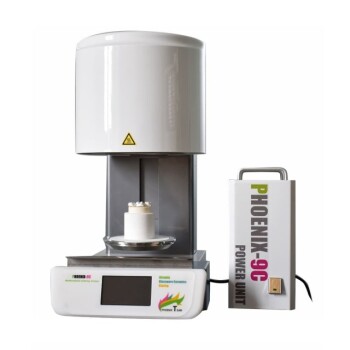
A high-temperature muffle furnace serves as the foundational processing tool for the solid-phase synthesis of lithium zirconate ceramics. Its primary function is to provide a rigorously controlled thermal environment, typically operating between 600°C and 1100°C, which is required to drive the chemical reaction between raw precursors. This precise application of heat is the only mechanism capable of transforming a mixture of Lithium Oxide ($LiO$) and Zirconium Dioxide ($ZrO_2$) into a unified, high-performance ceramic material.
The muffle furnace acts as the architect of the material's crystal structure. By sustaining specific temperatures for extended periods, it facilitates the atomic diffusion necessary to convert loose powders into a dense, single-phase monoclinic structure, thereby locking in the ceramic's mechanical and thermophysical properties.
Driving Phase Transformation
Initiating the Solid-Phase Reaction
The synthesis of lithium zirconate is a solid-state process, meaning the materials do not melt but react while remaining in a solid form. To overcome the energy barrier for this reaction, the muffle furnace must maintain temperatures up to 1100°C. This thermal energy forces the raw precursors to diffuse into one another, initiating the chemical changes required for synthesis.
Achieving Monoclinic Purity
The ultimate goal of this process is phase purity. Through controlled annealing, the furnace transitions the material from a chaotic mixed state (containing unreacted $LiO$ and $ZrO_2$) into a single-phase monoclinic $Li_2ZrO_3$ structure. This specific crystal arrangement is critical, as it defines the material's stability and functional characteristics.
Stabilizing the Lattice
Beyond simple heating, the furnace provides an oxidizing atmosphere necessary for stabilizing the ceramic lattice. By maintaining these conditions for several hours, the furnace ensures the resulting crystal structure is highly ordered (specifically within space groups like $P2_1/m$ or $C2/c$), eliminating structural defects that would compromise performance.
Enhancing Structural Integrity
Promoting Densification and Bonding
The muffle furnace is responsible for the physical densification of the ceramic. During the sintering phase, typically around 1000°C, the furnace heat promotes the formation of "necks" or bonds between individual powder particles. This recombination increases the sintering bond strength, transforming a pressed powder compact into a solid, cohesive ceramic body.
Eliminating Internal Stress
Ceramics are prone to internal structural deformations caused by the initial pressing process. The furnace mitigates this through precise thermal cycling. By controlling both the heating and cooling rates, the furnace relieves internal micro-stresses and stabilizes lattice parameters, significantly reducing lattice distortion.
Understanding the Trade-offs
The Risk of Thermal Variation
While the furnace is critical, improper temperature control leads to immediate failure. If the temperature is too low (below the solid-phase reaction threshold), the material remains a mixed-phase composite with poor properties. Conversely, excessive heat or uncontrolled duration can lead to exaggerated grain growth, which may degrade the mechanical strength of the final product.
Processing Time vs. Quality
Achieving a high-quality monoclinic structure is a time-intensive thermodynamic process. High-quality synthesis often requires multi-stage treatments, such as initial sintering at 1000°C for 5 hours followed by calcination at 700°C for 10 hours. Attempting to rush these dwell times prevents the complete diffusion of particles, resulting in a ceramic with lower structural order and density.
Making the Right Choice for Your Goal
To maximize the effectiveness of your synthesis, align your furnace protocols with your specific material objectives:
- If your primary focus is Phase Purity: Ensure your furnace creates a strictly oxidizing environment and maintains a steady 1100°C to drive the complete transition to the monoclinic $Li_2ZrO_3$ phase.
- If your primary focus is Mechanical Strength: Prioritize multi-stage heating protocols (sintering followed by calcination) to maximize particle bonding and eliminate pressing deformations.
- If your primary focus is Lattice Stability: strict management of cooling rates is essential to prevent the re-introduction of micro-stresses into the crystal lattice.
The precision of your thermal processing is the single most significant variable in determining whether your lithium zirconate ceramic succeeds or fails.
Summary Table:
| Process Goal | Required Temperature Range | Primary Function in Synthesis |
|---|---|---|
| Solid-Phase Reaction | 600°C - 1100°C | Initiates atomic diffusion between LiO and ZrO2 precursors. |
| Phase Transformation | Up to 1100°C | Achieves single-phase monoclinic Li2ZrO3 crystal structure. |
| Sintering & Bonding | ~1000°C | Promotes particle necking, densification, and mechanical strength. |
| Stress Relief | Controlled Cooling | Minimizes lattice distortion and internal micro-stresses. |
Elevate Your Ceramic Synthesis with KINTEK Precision
Achieving the perfect monoclinic lithium zirconate structure requires more than just heat—it requires the thermal precision that KINTEK delivers. As specialists in advanced laboratory equipment, we provide a comprehensive range of high-temperature muffle furnaces, vacuum systems, and crushing and milling tools specifically designed for demanding material science applications.
From high-performance muffle and tube furnaces to precision hydraulic pellet presses and crucibles, KINTEK ensures your research is backed by uniform heating and reliable durability. Let us help you eliminate phase impurities and structural defects in your next project.
Ready to optimize your solid-phase synthesis? Contact our laboratory specialists today to find the ideal furnace solution for your specific research goals.
References
- A.L. Kozlovskiy. FLUENCE OF PHASE FORMATION PROCESSES IN LITHIUM ZIRCONATECERAMICS ON STRENGTHAND THERMAL PROPERTIES. DOI: 10.31489/2022no2/13-18
This article is also based on technical information from Kintek Solution Knowledge Base .
Related Products
- 1200℃ Muffle Furnace Oven for Laboratory
- 1800℃ Muffle Oven Furnace for Laboratory
- 1700℃ Muffle Oven Furnace for Laboratory
- High Temperature Muffle Oven Furnace for Laboratory Debinding and Pre Sintering
- 1400℃ Muffle Oven Furnace for Laboratory
People Also Ask
- How does a muffle furnace ensure reliability in calcification roasting? Achieve Precision in Pellets Conversion
- Why is a laboratory high-temperature muffle furnace required for the post-annealing treatment of copper oxide?
- What role does a laboratory high-temperature muffle furnace play in iron-based composite phase structure development?
- How is a laboratory high-temperature muffle furnace utilized in sol-gel synthesis for perovskite catalysts?
- How does a muffle furnace influence 8YSZ ceramic densification? Master Precision Sintering at 1500°C