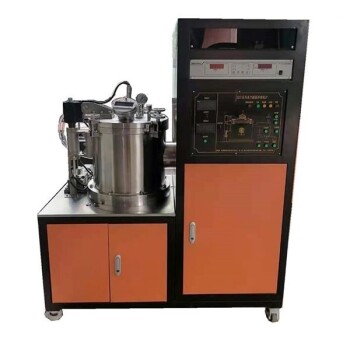
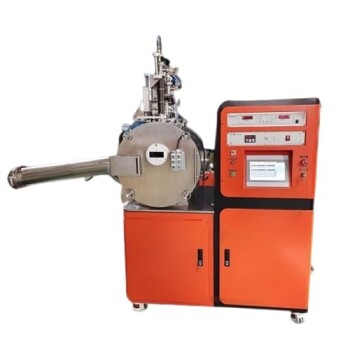
The primary function of a High Vacuum Induction Melting Furnace is to isolate reactive metals from atmospheric contaminants during the phase change from solid to liquid. For alloys like Fe-Cr-Al, this equipment provides a strictly controlled vacuum environment that prevents the rapid oxidation of aluminum (Al) and chromium (Cr). By eliminating interaction with air, the furnace ensures the resulting material maintains a precise chemical composition without the degradation caused by oxide formation.
By decoupling the melting process from the atmosphere, this technology enables the synthesis of high-purity master alloys, preventing the loss of active elements and minimizing the inclusion of detrimental interstitial impurities like oxygen and nitrogen.
The Chemistry of Containment
When working with reactive model alloys, the environment is just as critical as the raw materials.
Preventing Elemental Loss
Active elements, specifically aluminum and chromium, differ significantly from stable metals. They have a high affinity for oxygen and will oxidize rapidly if exposed to air at melting temperatures.
Blocking Interstitial Impurities
Beyond visible oxidation, atmospheric exposure introduces invisible threats. The vacuum environment minimizes the absorption of oxygen and nitrogen into the molten matrix. Reducing these interstitial impurities is vital for maintaining the mechanical and physical properties of the final experimental alloy.
Establishing Experimental Precision
For material scientists, this furnace serves as a baseline generator for valid research.
Guaranteeing Compositional Accuracy
If reactive elements oxidize during melting, they are effectively removed from the metallic solution. This alters the intended alloy ratio. Vacuum induction melting ensures that the chemical composition you calculated is exactly what you produce.
The Foundation for Further Refinement
The output of this furnace often serves as the "master alloy" or electrode. It creates the high-quality base material necessary for subsequent structural optimization processes, such as vacuum arc remelting.
Efficient Energy Transfer
The system utilizes medium-frequency induction heating to melt metals. This method provides fast heating speeds, which further limits the time window for any potential surface oxidation to occur, even within the vacuum.
Operational Considerations and Trade-offs
While essential for purity, vacuum induction melting introduces specific operational complexities.
Strict Environmental Monitoring
Unlike open-air smelting, this process relies on the integrity of the vacuum system. Operators must rely on over-pressure and under-pressure alarms to ensure the environment remains stable throughout the melt.
Equipment Complexity
The system requires high-efficiency vacuum pumps and specialized power supplies. The induction coil itself must be specially processed to resist deformation over time, as any failure inside the vacuum chamber can ruin the melt.
Making the Right Choice for Your Goal
To determine if this is the correct processing step for your alloy, consider your specific requirements:
- If your primary focus is compositional accuracy: This furnace is mandatory to prevent the loss of reactive elements like Al and Cr due to oxidation.
- If your primary focus is material cleanliness: Use this technology to minimize interstitial defects (oxygen/nitrogen) that compromise high-temperature performance.
This technology is the definitive gateway to producing high-quality, reproducible experimental alloys.
Summary Table:
| Feature | Benefit for Fe-Cr-Al Alloys |
|---|---|
| Vacuum Environment | Prevents rapid oxidation of Al and Cr elements |
| Impurity Control | Minimizes oxygen and nitrogen interstitial inclusions |
| Induction Heating | Rapid melting speeds to limit surface reaction time |
| Chemical Precision | Guarantees the final ratio matches the intended formula |
| Process Foundation | Creates high-purity master alloys for further refinement |
Elevate Your Material Research with KINTEK
Precision in alloy synthesis begins with a controlled environment. KINTEK specializes in advanced laboratory equipment, offering high-performance High Vacuum Induction Melting Furnaces designed to eliminate contamination and ensure the integrity of your reactive model alloys.
Whether you are developing Fe-Cr-Al alloys or exploring new metallic matrices, our comprehensive portfolio—including induction melting systems, vacuum furnaces, and specialized crucibles—provides the reliability your research demands.
Ready to achieve superior material purity? Contact our experts today to find the perfect melting solution for your laboratory needs.
References
- Indranil Roy, Andrew Hoffman. Understanding oxidation of Fe-Cr-Al alloys through explainable artificial intelligence. DOI: 10.1557/s43579-022-00315-0
This article is also based on technical information from Kintek Solution Knowledge Base .
Related Products
- Lab-Scale Vacuum Induction Melting Furnace
- Vacuum Heat Treat Furnace and Levitation Induction Melting Furnace
- Vacuum Arc Induction Melting Furnace
- Vacuum Induction Melting Spinning System Arc Melting Furnace
- 600T Vacuum Induction Hot Press Furnace for Heat Treat and Sintering
People Also Ask
- How do vacuum induction or arc melting furnaces facilitate the synthesis of U-Al-C MAX phases? Precision Heat & Purity
- What types of metals are typically processed in a vacuum induction melting furnace? High-Purity Alloys for Critical Applications
- What is the primary function of a vacuum induction melting furnace in Ni-Mo-Cr-Fe master alloy prep? Ensure High Purity
- Why use VIM for rare earth steel? Essential Precision for Melting Reactive Lanthanum and Cerium
- What are the advantages of a vacuum induction melting furnace? Achieve High-Purity Alloys with Precision VIM