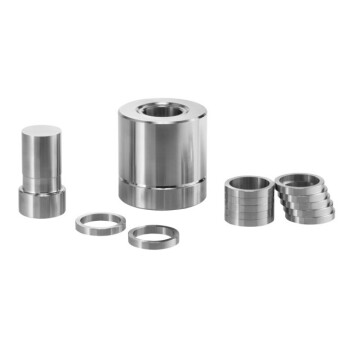
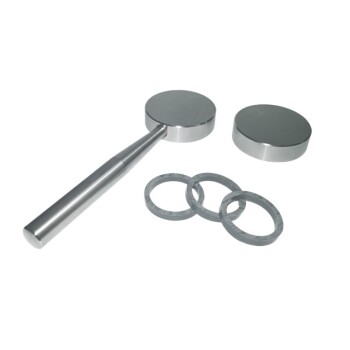
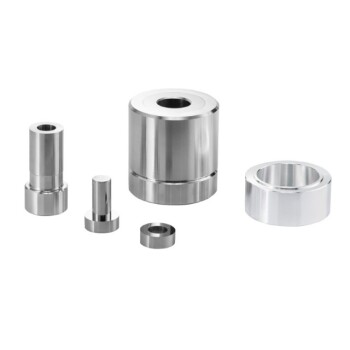
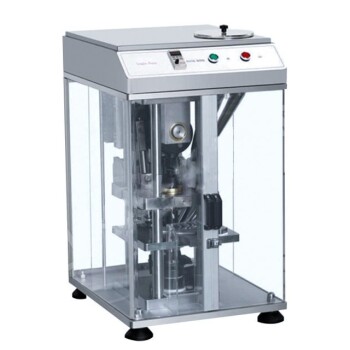
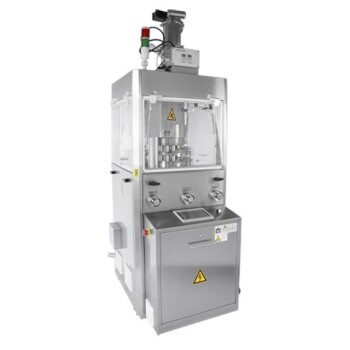
The pellet press serves as the primary densification agent in the pretreatment of wheat straw lignin for fuel. It applies intense mechanical pressure to compress loose lignin material into compact pellets of specific diameters, fundamentally altering the physical state of the biomass to prepare it for efficient energy conversion.
By transforming loose lignin into dense granules, the pellet press significantly enhances thermal conductivity and mechanical stability. This densification minimizes material fragmentation during combustion and fosters a more robust fuel structure for fluidized bed reactions.
Transforming Physical Properties
The immediate impact of the pellet press is physical. It changes the raw material from a loose, difficult-to-handle state into a uniform fuel source.
Increasing Density and Hardness
The press utilizes mechanical force to drastically increase the hardness and density of the fuel. This reduces the volume of the feedstock, making it more durable for transport and handling.
Enhancing Internal Contact
Compression forces the solid particles closer together. This leads to tighter internal solid contact within the pellet, which is the prerequisite for improved performance in subsequent processing stages.
Improving Thermal and Chemical Performance
Beyond simple shape changes, the pellet press alters how the fuel behaves under heat.
Optimizing Thermal Conductivity
Because the internal solids are packed tightly, heat travels through the pellet more efficiently. This improved thermal conductivity ensures that the fuel heats up uniformly during the energy conversion process.
Suppressing Primary Fragmentation
During the devolatilization stage—where volatile components are released—loose fuel often breaks apart too quickly. The pellet press creates a cohesive structure that suppresses this primary fragmentation, ensuring a more controlled reaction.
Ensuring Stability in Fluidized Beds
For systems using fluidized bed reactions, the structural integrity provided by the pellet press is non-negotiable.
Mechanical Stability
The fuel must withstand the physical turbulence of a fluidized bed. The pretreatment process imparts high mechanical stability, preventing the pellets from disintegrating prematurely due to physical attrition.
Formation of Stable Ash
The process contributes to the formation of a more stable ash structure. A consistent ash profile helps maintain system efficiency and reduces complications in residue management.
Critical Considerations for Efficiency
While the pellet press adds significant value, understanding the operational dynamics is essential for successful pretreatment.
The Necessity of Mechanical Pressure
The benefits of this process are entirely dependent on the application of sufficient mechanical pressure. Without adequate force, the pellets will lack the required density, negating improvements in thermal conductivity.
Granulation vs. Loose Material
The trade-off involves the energy required to compress the material versus the efficiency losses of using loose lignin. Loose material suffers from poor stability and rapid, uncontrolled fragmentation, making the mechanical energy expenditure of the press a necessary investment for process stability.
Making the Right Choice for Your Goal
To maximize the effectiveness of your fuel conversion process, align your pretreatment objectives with the specific benefits offered by the pellet press.
- If your primary focus is Thermal Efficiency: Prioritize high-density pelletization to maximize internal solid contact and thermal conductivity.
- If your primary focus is Process Stability: Ensure sufficient hardness to prevent primary fragmentation during the critical devolatilization stage.
- If your primary focus is Fluidized Bed Performance: Target specific diameters that offer the highest mechanical stability to withstand reactor turbulence.
The pellet press is not just a shaping tool; it is a critical engineering control that stabilizes lignin for reliable energy generation.
Summary Table:
| Feature | Impact of Pellet Press on Lignin | Benefit for Fuel Pretreatment |
|---|---|---|
| Physical State | From loose biomass to compact granules | Easier handling and reduced storage volume |
| Material Density | Significant increase in hardness and density | Enhanced durability during transport and handling |
| Internal Contact | Tighter solid-to-solid contact | Improved thermal conductivity and uniform heating |
| Structural Integrity | High mechanical stability | Prevents fragmentation in fluidized bed reactions |
| Combustion Control | Suppressed primary fragmentation | More controlled and stable devolatilization process |
Optimize Your Biomass Research with KINTEK Precision
Maximize the energy potential of your lignin and biomass feedstocks with KINTEK’s high-performance pellet presses. Whether you are developing renewable fuels or advancing material science, our comprehensive range of manual and automated hydraulic presses (pellet, hot, and isostatic) ensures the density and mechanical stability required for superior thermal performance.
Beyond pelletization, KINTEK supports your entire laboratory workflow with crushing and milling systems, high-temperature furnaces (muffle, vacuum, and tube) for devolatilization studies, and specialized high-temperature high-pressure reactors. Partner with KINTEK for durable equipment that delivers consistent results in energy research.
Contact KINTEK today to find the perfect pelletizing solution for your lab!
References
- Juraj Priščák, Hermann Hofbauer. Investigation of the Formation of Coherent Ash Residues during Fluidized Bed Gasification of Wheat Straw Lignin. DOI: 10.3390/en13153935
This article is also based on technical information from Kintek Solution Knowledge Base .
Related Products
- kbr pellet press 2t
- Laboratory Hydraulic Pellet Press for XRF KBR FTIR Lab Applications
- Automatic Laboratory Hydraulic Pellet Press Machine for Lab Use
- Laboratory Manual Hydraulic Pellet Press for Lab Use
- Automatic Laboratory Hydraulic Press for XRF & KBR Pellet Press
People Also Ask
- How do you prepare samples for IR spectroscopy? A Step-by-Step Guide for Solids, Liquids, and Gases
- What measurement methods are commonly used for powder samples in infrared spectroscopy? Optimize Your FTIR Analysis
- Why KBr is used in IR spectrophotometry? A Key to Transparent Sample Analysis
- How are a KBr pellet press and mortar utilized in FTIR analysis of activated carbon? Expert Sample Prep Guide
- How do you prepare KBr pellets for FTIR analysis? Master the Technique for High-Quality IR Spectra