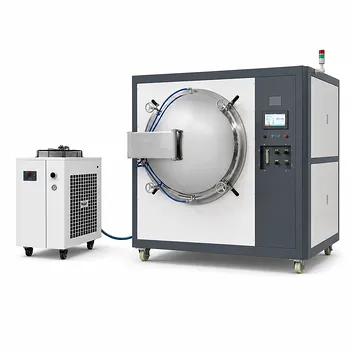
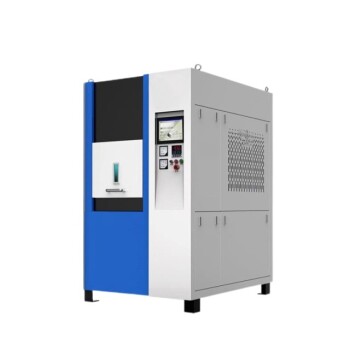
The critical role of a vacuum hot pressing sintering furnace is to enable the consolidation of SiC/Al-Zn-Mg-Cu composites into fully dense ingots without degrading the material's chemistry. By operating in a vacuum, the furnace prevents the rapid oxidation of highly reactive aluminum and magnesium powders, while simultaneously applying axial pressure to force densification at temperatures below the alloy's melting point. This synergy allows the material to achieve nearly 100% of its theoretical density, a feat impossible with conventional sintering alone.
Core Takeaway The furnace acts as a dual-function control system: the vacuum environment preserves the purity of reactive elements (Al, Mg) by minimizing oxygen partial pressure, while the mechanical pressure overcomes the natural resistance of solid particles to bond, eliminating porosity and ensuring structural integrity.
Preserving Chemical Integrity
Preventing Matrix Oxidation
The Al-Zn-Mg-Cu alloy system contains aluminum and magnesium, both of which are highly active metals with a strong affinity for oxygen.
If processed in air or standard atmospheres, these metals would instantly form oxide layers. The vacuum environment is essential to maintain a low oxygen partial pressure, effectively preventing this oxidation and ensuring the metallic matrix remains pure.
Removing Adsorbed Gases
Beyond preventing new oxidation, the vacuum plays an active role in cleaning the powder surfaces.
It facilitates the removal of gases previously adsorbed in the interstices (gaps) between powder particles. Eliminating these volatiles is necessary to prevent gas pockets from forming inside the material during the heating phase, which would otherwise lead to internal defects.
Mechanisms of Densification
Simultaneous Heat and Pressure
The primary reference highlights that this process occurs at temperatures below the melting point of the matrix alloy.
Because the metal does not fully liquefy, thermal energy alone is insufficient for full consolidation. The furnace compensates for this by applying high uniaxial mechanical pressure, which physically forces the particles together.
Plastic Deformation and Pore Elimination
The applied pressure promotes plastic deformation and rearrangement of the powder particles.
This mechanical force crushes the voids and pores that naturally exist between loose powder particles. Consequently, the material can reach nearly 100% of its theoretical density, resulting in a solid, void-free ingot.
Improving Interfacial Bonding
A critical challenge in SiC-reinforced composites is achieving a strong bond between the ceramic (SiC) and the metal (Al-alloy).
The combination of a clean, oxide-free surface (thanks to the vacuum) and high pressure significantly improves the wettability between the SiC particles and the aluminum matrix. This facilitates atomistic diffusion and ensures robust metallurgical bonding, which is vital for the composite's mechanical performance.
Understanding the Trade-offs
Geometry Limitations
While vacuum hot pressing achieves superior density, it relies on uniaxial pressure.
This generally limits the production to simple shapes, such as plates or cylinders. Producing complex, near-net-shape components is difficult because the pressure is not applied isostatically (from all directions).
Process Throughput
This is inherently a batch process involving heat-up, holding, and cooling cycles under vacuum.
Compared to continuous casting or atmospheric sintering, the cycle times are longer and the production volume is lower. It is a high-precision method reserved for high-performance materials where quality outweighs production speed.
Making the Right Choice for Your Goal
To maximize the utility of a vacuum hot pressing sintering furnace for SiC/Al-Zn-Mg-Cu composites, align your processing parameters with your specific material requirements:
- If your primary focus is Maximum Density: Prioritize the magnitude of the axial pressure to ensure complete plastic deformation and the closing of all internal micropores.
- If your primary focus is Interfacial Strength: Focus on the quality of the vacuum level to ensure maximum removal of adsorbed gases and prevention of oxides, which inhibit the bonding between SiC and the alloy.
Success in this process is defined by balancing the protection of the vacuum with the brute force of the press to create a flawless, high-performance composite.
Summary Table:
| Feature | Function in Composite Preparation | Benefit to SiC/Al-Zn-Mg-Cu |
|---|---|---|
| High Vacuum | Prevents Al/Mg oxidation & removes gases | Ensures chemical purity & eliminates gas pockets |
| Uniaxial Pressure | Drives plastic deformation & pore closure | Achieves ~100% theoretical density |
| Sub-Solidus Heat | Facilitates bonding below melting point | Maintains structural integrity & material chemistry |
| Synergistic Action | Enhances ceramic-to-metal wettability | Creates robust metallurgical bonding at interfaces |
Elevate Your Material Science with KINTEK
Precision matters when processing highly reactive SiC/Al-Zn-Mg-Cu composites. KINTEK specializes in advanced laboratory equipment, providing state-of-the-art vacuum hot pressing sintering furnaces designed to deliver the exact synergy of high-vacuum environments and precise mechanical pressure your research demands.
Beyond sintering, our comprehensive portfolio includes:
- High-Temperature Furnaces: Muffle, tube, and atmosphere furnaces for every thermal profile.
- Preparation Tools: Crushing and milling systems, hydraulic pellet presses, and isostatic presses for superior sample density.
- Advanced Reactors: High-temperature high-pressure reactors and autoclaves for extreme environments.
- Specialized Labware: High-purity ceramics, crucibles, and PTFE products to maintain sample integrity.
Ready to achieve void-free, high-performance composites? Contact our technical experts today to find the perfect solution for your powder metallurgy and material synthesis needs.
Related Products
- 600T Vacuum Induction Hot Press Furnace for Heat Treat and Sintering
- Vacuum Heat Treat and Sintering Furnace with 9MPa Air Pressure
- Vacuum Heat Treat and Pressure Sintering Furnace for High Temperature Applications
- 2200 ℃ Tungsten Vacuum Heat Treat and Sintering Furnace
- Vacuum Hot Press Furnace Heated Vacuum Press Machine Tube Furnace
People Also Ask
- What role does an induction vacuum hot pressing furnace play in sintering? Achieve 98% Density in Carbide Blocks
- What advantages does a vacuum hot press furnace provide for LSLBO ceramic electrolytes? Achieve 94% Relative Density
- What role does a Vacuum Hot Press (VHP) furnace play in the densification of austenitic stainless steel 316 composites?
- What are the advantages of a vacuum hot press furnace for W-50%Cu? Achieve 99.6% Density at Lower Temperatures
- What role does mechanical pressure play during the vacuum diffusion bonding of tungsten and copper? Keys to Solid Bonding