Knowledge muffle furnace What is the difference between a muffle furnace and a box furnace? A Guide to Choosing the Right Lab Furnace
Author avatar

Tech Team · Kintek Solution

Updated 2 months ago

What is the difference between a muffle furnace and a box furnace? A Guide to Choosing the Right Lab Furnace


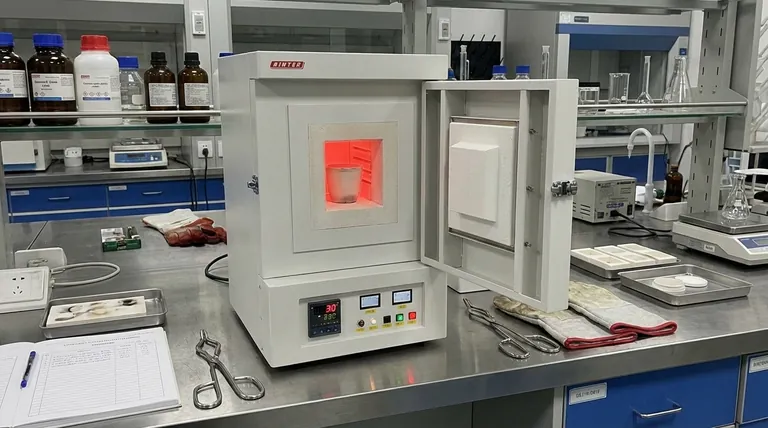
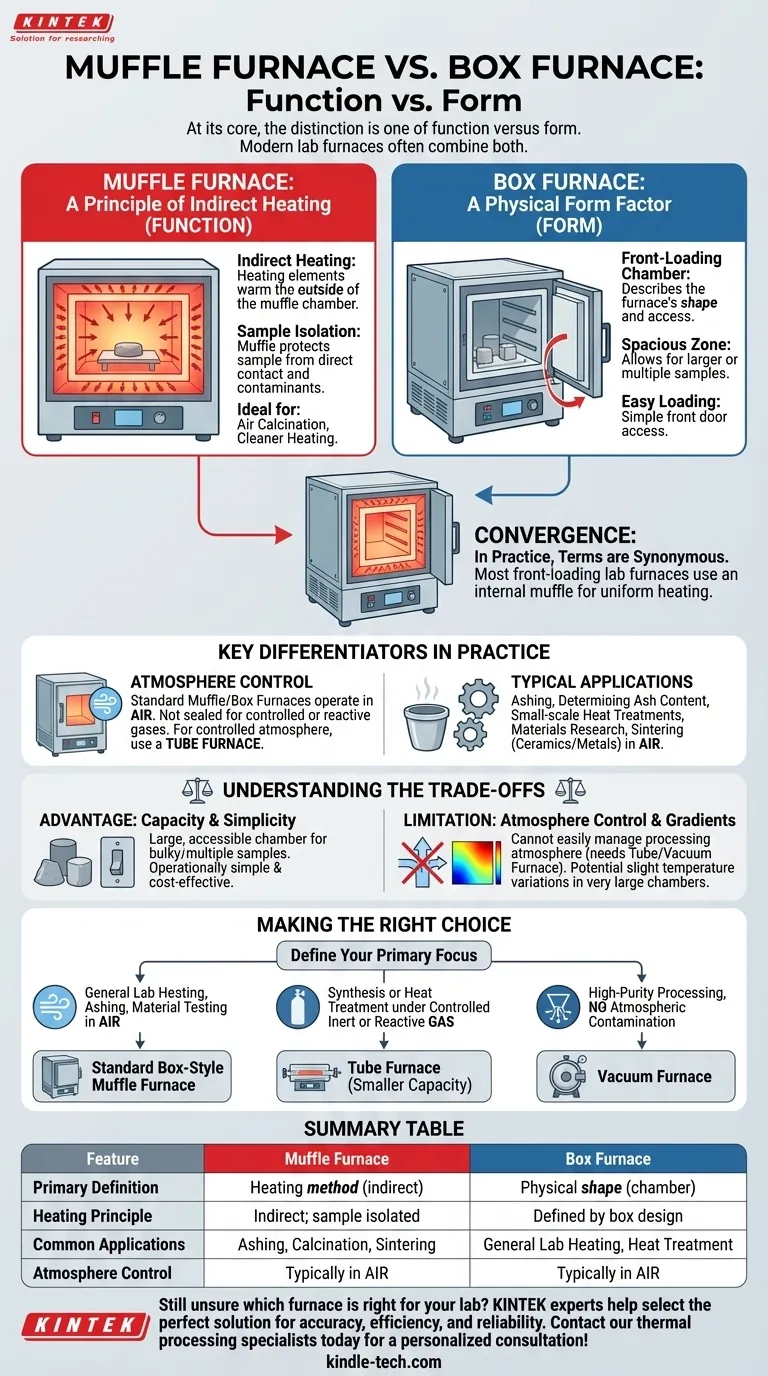
At its core, the distinction is one of function versus form. A "muffle furnace" describes how a sample is heated—indirectly, inside a protective chamber. A "box furnace" describes the physical shape of the equipment—a front-loading chamber. In modern practice, these terms are often used interchangeably because most laboratory box furnaces are, by design, muffle furnaces.

The critical takeaway is that "muffle" refers to the internal heating method (isolating the sample), while "box" refers to the furnace's external shape (a chamber). Because these two concepts are almost always combined in a single piece of equipment, the terms "box furnace" and "muffle furnace" usually describe the same device.
What is the difference between a muffle furnace and a box furnace? A Guide to Choosing the Right Lab Furnace

Defining the Core Concepts

To make an informed decision, you must understand the principle behind each term. The confusion arises because one term describes a component, and the other describes a chassis.

The Muffle: A Principle of Indirect Heating

A muffle is an internal, box-like chamber made of a high-temperature-resistant material.

Heating elements warm the outside of this muffle. The muffle then radiates heat uniformly to the sample placed inside it.

This indirect heating method protects the sample from direct contact with the heating elements and any contaminants from combustion, ensuring a cleaner heating environment. It is ideal for processes like air calcination.

The Box Furnace: A Physical Form Factor

A box furnace simply refers to a furnace with a front-loading door and a chamber (or "box") where samples are placed.

This design is valued for its spacious heating zone and the ease with which operators can place and remove samples. Its shape is what distinguishes it from other forms, like a tube furnace or a bottom-loading furnace.

Where the Terms Converge

Most standard, front-loading laboratory furnaces are built with an internal muffle to provide the uniform, protected heating environment described above.

Therefore, when someone refers to a "box furnace," they are almost always talking about a furnace that uses the muffle principle. The terms have become synonymous in common lab parlance.

Key Differentiators in Practice

While the terms often overlap, understanding their distinct applications and limitations is crucial for selecting the right equipment for your process.

Atmosphere Control

A standard muffle or box furnace is designed to operate in an air atmosphere.

These furnaces are not inherently sealed for processing under a controlled inert gas (like argon or nitrogen) or a reactive atmosphere. For that specific requirement, a tube furnace is the appropriate tool.

Typical Applications

Due to their simple design and ability to heat in air, box-style muffle furnaces excel at specific tasks.

Common applications include ashing materials, determining ash content, performing small-scale heat treatments, materials research, and the sintering of ceramics and metals.

Understanding the Trade-offs

Every equipment choice involves balancing advantages and limitations. The box-style muffle furnace is a workhorse, but it is not the solution for every thermal processing need.

Advantage: Capacity and Simplicity

The primary benefit of a box furnace is its large, accessible chamber. This allows for the processing of bulky samples or multiple samples at once, something that is difficult in a narrow tube furnace. They are also operationally simple and generally more cost-effective.

Limitation: Lack of Atmosphere Control

The most significant limitation is the inability to easily manage the processing atmosphere. Heating in anything other than air requires a different type of furnace, such as a tube or vacuum furnace, which is specifically designed for gas flow or evacuation.

Limitation: Potential for Temperature Gradients

While the muffle design promotes uniformity, very large chambers can sometimes exhibit slight temperature variations from the center to the corners. For applications requiring extreme temperature precision across the entire sample, this must be considered.

Making the Right Choice for Your Application

Selecting the correct furnace depends entirely on your specific material, process, and desired outcome.

  • If your primary focus is general lab heating, ashing, or material testing in air: A standard box-style muffle furnace is the most practical and cost-effective choice.
  • If your primary focus is synthesis or heat treatment under a controlled inert or reactive gas atmosphere: A tube furnace is the necessary tool, despite its smaller sample capacity.
  • If your primary focus is high-purity processing without any atmospheric contamination: A vacuum furnace is required to remove air and other gases entirely.

Understanding this distinction between heating method and physical form empowers you to select the precise tool for your scientific or industrial goal.

Summary Table:

Feature Muffle Furnace Box Furnace
Primary Definition A heating method (indirect, via a chamber) A physical shape (front-loading chamber)
Heating Principle Indirect; sample is isolated in a muffle Defined by the furnace's box-like chamber design
Common Applications Ashing, calcination, sintering in air General lab heating, heat treatment in air
Atmosphere Control Typically operates in air Typically operates in air
Key Takeaway Terms are often used interchangeably for modern lab furnaces.

Still unsure which furnace is right for your lab's needs?

KINTEK specializes in providing the precise lab equipment for your application. Whether you require a standard muffle furnace for ashing or a specialized tube furnace for atmosphere control, our experts can help you select the perfect solution to ensure accuracy, efficiency, and reliable results.

Contact our thermal processing specialists today for a personalized consultation!

Visual Guide
What is the difference between a muffle furnace and a box furnace? A Guide to Choosing the Right Lab Furnace Visual Guide

Related Products

People Also Ask

Related Products

1200℃ Muffle Furnace Oven for Laboratory

1200℃ Muffle Furnace Oven for Laboratory

Upgrade your lab with our 1200℃ Muffle Furnace. Achieve fast, precise heating with Japan alumina fibers and Molybdenum coils. Features TFT touch screen controller for easy programming and data analysis. Order now!

1800℃ Muffle Oven Furnace for Laboratory

1800℃ Muffle Oven Furnace for Laboratory

KT-18 muffle furnace with Japan Al2O3 polycrystalline fibe and Silicon Molybdenum heating element, up to 1900℃, PID temperature control and 7" smart touch screen. Compact design, low heat loss, and high energy efficiency. Safety interlock system and versatile functions.

1400℃ Muffle Oven Furnace for Laboratory

1400℃ Muffle Oven Furnace for Laboratory

Get precise high-temperature control up to 1500℃ with KT-14M Muffle furnace. Equipped with a smart touch screen controller and advanced insulation materials.

1700℃ Muffle Oven Furnace for Laboratory

1700℃ Muffle Oven Furnace for Laboratory

Get superior heat control with our 1700℃ Muffle Furnace. Equipped with intelligent temperature microprocessor, TFT touch screen controller & advanced insulation materials for precise heating up to 1700C. Order now!

High Temperature Muffle Oven Furnace for Laboratory Debinding and Pre Sintering

High Temperature Muffle Oven Furnace for Laboratory Debinding and Pre Sintering

KT-MD High temperature debinding and pre-sintering furnace for ceramic materials with various molding processes. Ideal for electronic components such as MLCC and NFC.

Laboratory Muffle Oven Furnace Bottom Lifting Muffle Furnace

Laboratory Muffle Oven Furnace Bottom Lifting Muffle Furnace

Efficiently produce batches with excellent temperature uniformity using our Bottom Lifting Furnace. Features two electric lifting stages and advanced temperature control up to 1600℃.

Molybdenum Vacuum Heat Treat Furnace

Molybdenum Vacuum Heat Treat Furnace

Discover the benefits of a high-configuration molybdenum vacuum furnace with heat shield insulation. Ideal for high-purity, vacuum environments like sapphire crystal growth and heat treatment.

Multi-zone Laboratory Tube Furnace

Multi-zone Laboratory Tube Furnace

Experience precise, efficient thermal testing with our Multi Zone Tube Furnace. Independent heating zones and temperature sensors allow for controlled high-temperature gradient heating fields. Order now for advanced thermal analysis!

Ultra-High Temperature Graphite Vacuum Graphitization Furnace

Ultra-High Temperature Graphite Vacuum Graphitization Furnace

The ultra-high temperature graphitization furnace utilizes medium frequency induction heating in a vacuum or inert gas environment. The induction coil generates an alternating magnetic field, inducing eddy currents in the graphite crucible, which heats up and radiates heat to the workpiece, bringing it to the desired temperature. This furnace is primarily used for graphitization and sintering of carbon materials, carbon fiber materials, and other composite materials.

Vacuum Hot Press Furnace Machine Heated Vacuum Press

Vacuum Hot Press Furnace Machine Heated Vacuum Press

Discover the advantages of Vacuum Hot Press Furnace! Manufacture dense refractory metals & compounds, ceramics, and composites under high temp and pressure.

Vacuum Heat Treat and Molybdenum Wire Sintering Furnace for Vacuum Sintering

Vacuum Heat Treat and Molybdenum Wire Sintering Furnace for Vacuum Sintering

A vacuum molybdenum wire sintering furnace is a vertical or bedroom structure, which is suitable for withdrawal, brazing, sintering and degassing of metal materials under high vacuum and high temperature conditions. It is also suitable for dehydroxylation treatment of quartz materials.

Multi Heating Zones CVD Tube Furnace Machine Chemical Vapor Deposition Chamber System Equipment

Multi Heating Zones CVD Tube Furnace Machine Chemical Vapor Deposition Chamber System Equipment

KT-CTF14 Multi Heating Zones CVD Furnace - Precise Temperature Control and Gas Flow for Advanced Applications. Max temp up to 1200℃, 4 channels MFC mass flow meter, and 7" TFT touch screen controller.

Graphite Vacuum Furnace High Thermal Conductivity Film Graphitization Furnace

Graphite Vacuum Furnace High Thermal Conductivity Film Graphitization Furnace

The high thermal conductivity film graphitization furnace has uniform temperature, low energy consumption and can operate continuously.

600T Vacuum Induction Hot Press Furnace for Heat Treat and Sintering

600T Vacuum Induction Hot Press Furnace for Heat Treat and Sintering

Discover the 600T Vacuum Induction Hot Press Furnace, designed for high-temperature sintering experiments in vacuum or protected atmospheres. Its precise temperature and pressure control, adjustable working pressure, and advanced safety features make it ideal for nonmetal materials, carbon composites, ceramics, and metal powders.

Lab-Scale Vacuum Induction Melting Furnace

Lab-Scale Vacuum Induction Melting Furnace

Get precise alloy composition with our Vacuum Induction Melting Furnace. Ideal for aerospace, nuclear energy, and electronic industries. Order now for effective smelting and casting of metals and alloys.

Mesh belt controlled atmosphere furnace

Mesh belt controlled atmosphere furnace

Discover our KT-MB mesh belt sintering furnace - perfect for high-temperature sintering of electronic components & glass insulators. Available for open air or controlled atmosphere environments.

Horizontal High Temperature Graphite Vacuum Graphitization Furnace

Horizontal High Temperature Graphite Vacuum Graphitization Furnace

Horizontal Graphitization Furnace: This type of furnace is designed with the heating elements placed horizontally, allowing for uniform heating of the sample. It's well-suited for graphitizing large or bulky samples that require precise temperature control and uniformity.

Vacuum Heat Treat and Pressure Sintering Furnace for High Temperature Applications

Vacuum Heat Treat and Pressure Sintering Furnace for High Temperature Applications

Vacuum pressure sintering furnaces are designed for high temperature hot pressing applications in metal and ceramic sintering. Its advanced features ensure precise temperature control, reliable pressure maintenance, and a robust design for seamless operation.

Vacuum Sealed Continuous Working Rotary Tube Furnace Rotating Tube Furnace

Vacuum Sealed Continuous Working Rotary Tube Furnace Rotating Tube Furnace

Experience efficient material processing with our vacuum-sealed rotary tube furnace. Perfect for experiments or industrial production, equipped with optional features for controlled feeding and optimized results. Order now.

1200℃ Controlled Atmosphere Furnace Nitrogen Inert Atmosphere Furnace

1200℃ Controlled Atmosphere Furnace Nitrogen Inert Atmosphere Furnace

Discover our KT-12A Pro Controlled atmosphere furnace - high precision, heavy duty vacuum chamber, versatile smart touch screen controller, and excellent temperature uniformity up to 1200C. Ideal for both laboratory and industrial application.


Leave Your Message



















