Knowledge Vacuum Furnace What is the difference between annealing and process annealing? A Guide to Choosing the Right Heat Treatment
Author avatar

Tech Team · Kintek Solution

Updated 2 months ago

What is the difference between annealing and process annealing? A Guide to Choosing the Right Heat Treatment


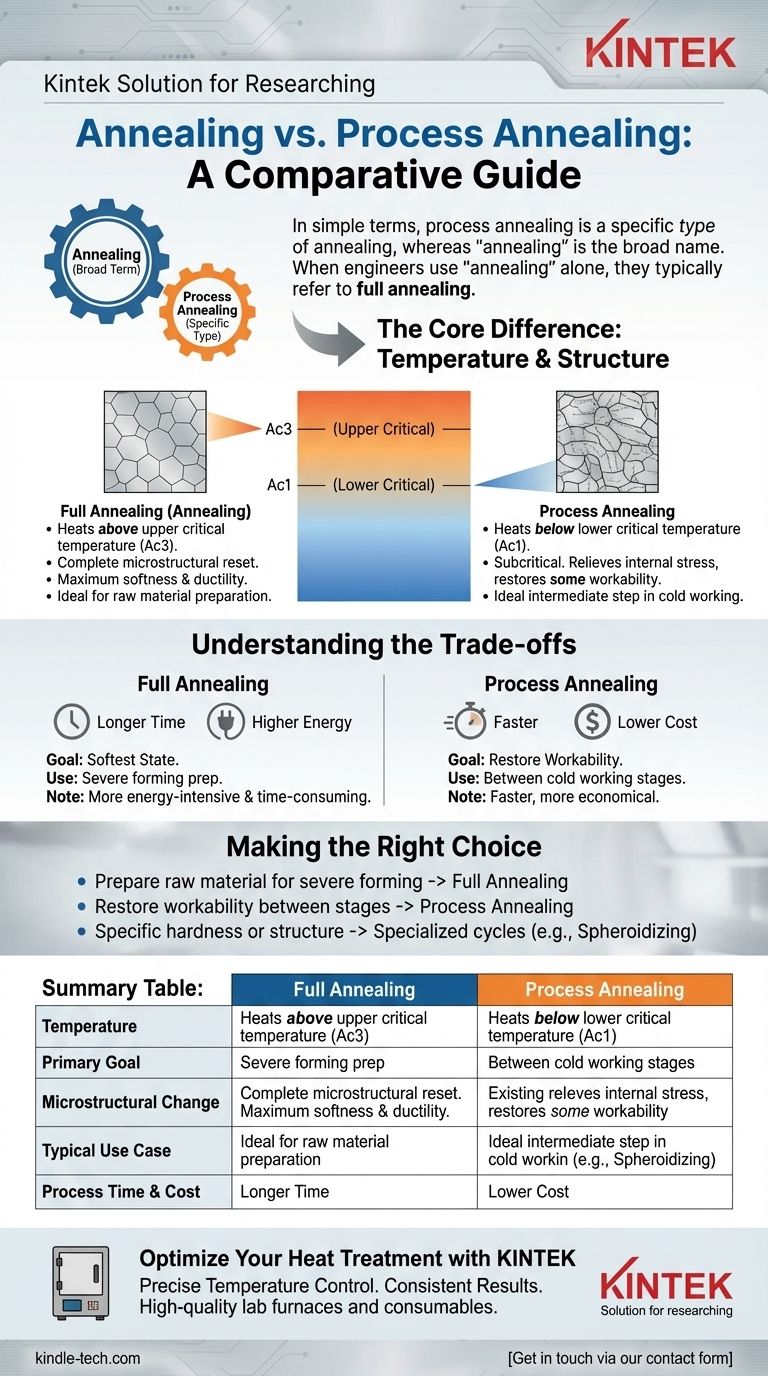
In simple terms, process annealing is a specific type of annealing, whereas "annealing" is the broad name for a family of heat treatment processes. When engineers use the term "annealing" without any other qualifier, they are typically referring to full annealing, which involves higher temperatures and creates a more profound change in the metal's structure than process annealing does.

The core difference comes down to the target temperature relative to the metal's critical transformation points. Full annealing heats the metal above its critical temperature to completely reset its internal structure, while process annealing heats it below that point just enough to relieve stress and restore some workability.
What is the difference between annealing and process annealing? A Guide to Choosing the Right Heat Treatment

The Fundamental Principle: What is Annealing?

The Goal: Relieving Stress and Increasing Ductility

Annealing is a heat treatment process that alters the microstructure of a material. Its primary purpose is to increase ductility (the ability to be stretched or drawn) and reduce hardness.

This makes the material easier to work with, improving its formability and machinability for subsequent manufacturing steps.

The "Why": Recrystallization

The process involves three stages: heating the metal to a specific target temperature, holding it there for a period, and then slowly cooling it.

This controlled cycle allows the internal crystal structure, which may have been stressed or deformed by previous work, to repair itself and reform in a more orderly, low-stress state.

The Critical Difference: Temperature Defines the Process

The key distinction between different types of annealing lies in the peak temperature used during the heating stage. This temperature is always determined relative to a material's lower (Ac1) and upper (Ac3) critical temperatures, which mark the points where its internal crystal structure begins to transform.

"Annealing" as Full Annealing

When not otherwise specified, "annealing" implies full annealing. This is a high-temperature process that heats the steel to above its upper critical temperature (Ac3).

Heating above this point completely transforms the crystalline grain structure into a new, uniform state. The slow cooling that follows produces a material with maximum softness and ductility.

Process Annealing: The Subcritical Approach

Process annealing is a form of subcritical annealing. This means the material is heated to a temperature below the lower critical temperature (Ac1).

Because it never crosses that critical transformation threshold, process annealing does not fully change the grain structure. Instead, it simply relieves the internal stresses built up during cold working, restoring a significant amount of ductility without making the material fully soft.

Understanding the Trade-offs

Choosing between full annealing and process annealing is a practical decision based on manufacturing needs, cost, and time.

When to Use Full Annealing

Full annealing is used when the goal is to achieve the softest possible state. It is often performed on raw material before any significant forming operations begin.

However, because it requires higher temperatures and often longer cooling cycles, it is more energy-intensive and time-consuming than process annealing.

The Role of Process Annealing

Process annealing is most valuable as an intermediate step in a multi-stage manufacturing process, such as wire drawing or sheet metal rolling.

After a certain amount of cold work, the material becomes hard and brittle (a state known as work-hardening). Process annealing quickly restores enough ductility to allow for further work without risking fracture. It is faster and more economical than a full anneal.

Making the Right Choice for Your Goal

Selecting the correct heat treatment is essential for manufacturing efficiency and final product quality. Your decision should be guided by the material's current state and the next step in its journey.

  • If your primary focus is to prepare a raw material for severe forming: Full annealing will provide the maximum softness and ductility required.
  • If your primary focus is to restore workability between cold working stages: Process annealing is the faster, more cost-effective choice to relieve stress without a full microstructural reset.
  • If your primary focus is achieving a very specific hardness or grain structure: You must look beyond these two options to more specialized cycles like spheroidizing or isothermal annealing.

Ultimately, understanding the precise relationship between temperature and crystal structure is the key to mastering your material's properties.

Summary Table:

Feature Full Annealing Process Annealing
Temperature Heated above upper critical temperature (Ac3) Heated below lower critical temperature (Ac1)
Primary Goal Achieve maximum softness and ductility Relieve internal stress, restore workability
Microstructural Change Complete grain structure transformation No full transformation; stress relief only
Typical Use Case Initial preparation of raw material for severe forming Intermediate step during multi-stage cold working
Process Time & Cost Longer cycle, higher energy consumption Faster, more economical

Optimize Your Heat Treatment Processes with KINTEK

Choosing the right annealing process is critical for your material's performance and your manufacturing efficiency. Whether you require the full softness achieved by full annealing or the rapid stress relief of process annealing, having the right laboratory equipment is essential for precise temperature control and consistent results.

KINTEK specializes in high-quality lab furnaces and consumables designed to meet the exacting demands of heat treatment applications. Our equipment ensures the accuracy and repeatability you need to master your material's properties.

Contact us today to discuss your specific needs, and let our experts help you select the perfect solution for your laboratory. Get in touch via our contact form to learn more.

Visual Guide
What is the difference between annealing and process annealing? A Guide to Choosing the Right Heat Treatment Visual Guide

Related Products

People Also Ask

Related Products

Controlled Nitrogen Inert Hydrogen Atmosphere Furnace

Controlled Nitrogen Inert Hydrogen Atmosphere Furnace

KT-AH Hydrogen atmosphere furnace - induction gas furnace for sintering/annealing with built-in safety features, dual housing design, and energy-saving efficiency. Ideal for lab and industrial use.

Vacuum Heat Treat Furnace with Ceramic Fiber Liner

Vacuum Heat Treat Furnace with Ceramic Fiber Liner

Vacuum furnace with polycrystalline ceramic fiber insulation liner for excellent heat insulation and uniform temperature field. Choose from 1200℃ or 1700℃ max. working temperature with high vacuum performance and precise temperature control.

High Temperature Muffle Oven Furnace for Laboratory Debinding and Pre Sintering

High Temperature Muffle Oven Furnace for Laboratory Debinding and Pre Sintering

KT-MD High temperature debinding and pre-sintering furnace for ceramic materials with various molding processes. Ideal for electronic components such as MLCC and NFC.

Laboratory Muffle Oven Furnace Bottom Lifting Muffle Furnace

Laboratory Muffle Oven Furnace Bottom Lifting Muffle Furnace

Efficiently produce batches with excellent temperature uniformity using our Bottom Lifting Furnace. Features two electric lifting stages and advanced temperature control up to 1600℃.

Graphite Vacuum Furnace High Thermal Conductivity Film Graphitization Furnace

Graphite Vacuum Furnace High Thermal Conductivity Film Graphitization Furnace

The high thermal conductivity film graphitization furnace has uniform temperature, low energy consumption and can operate continuously.

Non Consumable Vacuum Arc Induction Melting Furnace

Non Consumable Vacuum Arc Induction Melting Furnace

Explore the benefits of Non-Consumable Vacuum Arc Furnace with high melting point electrodes. Small, easy to operate & eco-friendly. Ideal for laboratory research on refractory metals & carbides.

Vertical High Temperature Graphite Vacuum Graphitization Furnace

Vertical High Temperature Graphite Vacuum Graphitization Furnace

Vertical high temperature graphitization furnace for carbonization and graphitization of carbon materials up to 3100℃.Suitable for shaped graphitization of carbon fiber filaments and other materials sintered in a carbon environment.Applications in metallurgy, electronics, and aerospace for producing high-quality graphite products like electrodes and crucibles.

1200℃ Controlled Atmosphere Furnace Nitrogen Inert Atmosphere Furnace

1200℃ Controlled Atmosphere Furnace Nitrogen Inert Atmosphere Furnace

Discover our KT-12A Pro Controlled atmosphere furnace - high precision, heavy duty vacuum chamber, versatile smart touch screen controller, and excellent temperature uniformity up to 1200C. Ideal for both laboratory and industrial application.

Horizontal High Temperature Graphite Vacuum Graphitization Furnace

Horizontal High Temperature Graphite Vacuum Graphitization Furnace

Horizontal Graphitization Furnace: This type of furnace is designed with the heating elements placed horizontally, allowing for uniform heating of the sample. It's well-suited for graphitizing large or bulky samples that require precise temperature control and uniformity.

1700℃ Controlled Atmosphere Furnace Nitrogen Inert Atmosphere Furnace

1700℃ Controlled Atmosphere Furnace Nitrogen Inert Atmosphere Furnace

KT-17A Controlled atmosphere furnace: 1700℃ heating, vacuum sealing technology, PID temperature control, and versatile TFT smart touch screen controller for laboratory and industrial use.

Dental Porcelain Zirconia Sintering Ceramic Furnace Chairside with Transformer

Dental Porcelain Zirconia Sintering Ceramic Furnace Chairside with Transformer

Experience top-notch sintering with Chairside Sintering Furnace with Transformer. Easy to operate, noise-free pallet, and automatic temperature calibration. Order now!

Ultra-High Temperature Graphite Vacuum Graphitization Furnace

Ultra-High Temperature Graphite Vacuum Graphitization Furnace

The ultra-high temperature graphitization furnace utilizes medium frequency induction heating in a vacuum or inert gas environment. The induction coil generates an alternating magnetic field, inducing eddy currents in the graphite crucible, which heats up and radiates heat to the workpiece, bringing it to the desired temperature. This furnace is primarily used for graphitization and sintering of carbon materials, carbon fiber materials, and other composite materials.

Mesh belt controlled atmosphere furnace

Mesh belt controlled atmosphere furnace

Discover our KT-MB mesh belt sintering furnace - perfect for high-temperature sintering of electronic components & glass insulators. Available for open air or controlled atmosphere environments.

1400℃ Controlled Atmosphere Furnace with Nitrogen and Inert Atmosphere

1400℃ Controlled Atmosphere Furnace with Nitrogen and Inert Atmosphere

Achieve precise heat treatment with KT-14A controlled atmosphere furnace. Vacuum sealed with a smart controller, it's ideal for lab and industrial use up to 1400℃.

Vacuum Heat Treat and Pressure Sintering Furnace for High Temperature Applications

Vacuum Heat Treat and Pressure Sintering Furnace for High Temperature Applications

Vacuum pressure sintering furnaces are designed for high temperature hot pressing applications in metal and ceramic sintering. Its advanced features ensure precise temperature control, reliable pressure maintenance, and a robust design for seamless operation.

Graphite Vacuum Furnace Bottom Discharge Graphitization Furnace for Carbon Materials

Graphite Vacuum Furnace Bottom Discharge Graphitization Furnace for Carbon Materials

Bottom-out graphitization furnace for carbon materials, ultra-high temperature furnace up to 3100°C, suitable for graphitization and sintering of carbon rods and carbon blocks. Vertical design, bottom discharging, convenient feeding and discharging, high temperature uniformity, low energy consumption, good stability, hydraulic lifting system, convenient loading and unloading.

Large Vertical Graphite Vacuum Graphitization Furnace

Large Vertical Graphite Vacuum Graphitization Furnace

A large vertical high-temperature graphitization furnace is a type of industrial furnace used for the graphitization of carbon materials, such as carbon fiber and carbon black. It is a high-temperature furnace that can reach temperatures of up to 3100°C.

Graphite Vacuum Continuous Graphitization Furnace

Graphite Vacuum Continuous Graphitization Furnace

High-temperature graphitization furnace is a professional equipment for graphitization treatment of carbon materials. It is a key equipment for the production of high-quality graphite products. It has high temperature, high efficiency and uniform heating. It is suitable for various high-temperature treatments and graphitization treatments. It is widely used in metallurgy, electronics, aerospace, etc. industry.

Vacuum Arc Induction Melting Furnace

Vacuum Arc Induction Melting Furnace

Discover the power of Vacuum Arc Furnace for melting active & refractory metals. High-speed, remarkable degassing effect, and free of contamination. Learn more now!

Vertical Laboratory Tube Furnace

Vertical Laboratory Tube Furnace

Elevate your experiments with our Vertical Tube Furnace. Versatile design allows for operation under various environments and heat treatment applications. Order now for precise results!


Leave Your Message



















