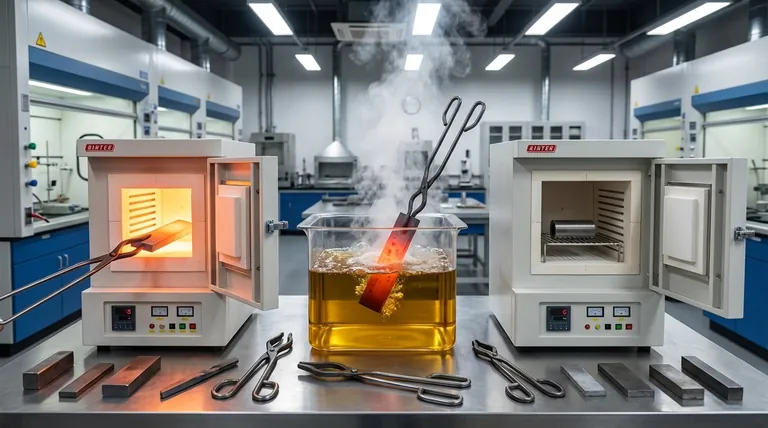
At its core, hardening, quenching, and tempering are three distinct but sequential stages of a single heat treatment process. Hardening involves heating steel to a high temperature to alter its internal structure. Quenching is the rapid cooling that locks in that structure, creating extreme hardness. Tempering is a subsequent, lower-temperature heating that reduces brittleness and adds toughness, making the steel useful.
Heat treatment is a transformative process, not a simple choice between options. Hardening sets the potential for hardness, quenching achieves it, and tempering refines it into a balance of hardness and toughness suitable for a specific task.
The Three Stages of Heat Treatment
To understand the difference, it's best to view them as the three essential steps in a single procedure designed to control the final properties of steel.
Step 1: Hardening (Austenitizing) - Setting the Stage
The first step, properly called austenitizing, involves heating the steel to a specific critical temperature (typically above 1450°F or 790°C, depending on the alloy).
Holding the steel at this high temperature dissolves the carbon and other alloying elements into a uniform solid solution called austenite.
Think of this like dissolving sugar in hot water. The heat allows the carbon (the sugar) to distribute evenly throughout the iron's crystal structure (the water), creating the potential for a new, hardened state.
Step 2: Quenching - Locking in Hardness
Immediately after the steel becomes fully austenitic, it must be cooled rapidly. This rapid cooling is called quenching.
Quenching is done by plunging the hot steel into a medium like water, brine, oil, or even forced air. The goal is to cool the steel so quickly that the dissolved carbon atoms are trapped.
This process prevents the steel from reverting to its softer, pre-heated state. Instead, it forces the formation of a new, highly strained, and extremely hard crystal structure known as martensite. The steel is now at its maximum hardness but is also very brittle, like glass.
Step 3: Tempering - Refining for Toughness
A steel part in its as-quenched, martensitic state is too brittle for nearly all practical applications. Any sharp impact could cause it to shatter.
Tempering is the solution. The hardened part is re-heated to a much lower, carefully controlled temperature (e.g., 400-1100°F or 205-595°C) and held for a specific time.
This gentle reheating relieves the internal stresses from quenching and allows the microstructure to transform from brittle martensite into tempered martensite, which is far tougher. This process reduces some hardness but dramatically increases the steel's resistance to fracture.
Understanding the Relationship
It's a mistake to think of these as competing processes. They are a team, each with a specific role in the sequence.
Quenching is the Mechanism of Hardening
The term "hardening" often refers to the entire process of heating and quenching. Quenching is not a separate choice; it is the cooling method required to achieve a martensitic, hardened structure.
Without a rapid quench, the steel would cool slowly and form softer, non-hardened structures like pearlite or bainite.
Tempering is the Essential Follow-Up
A quenched-only part is a liability. Tempering is what makes a hardened steel part functional and safe. The process is always: heat (harden), cool rapidly (quench), then reheat gently (temper).
The Critical Trade-off: Hardness vs. Toughness
The entire purpose of this three-stage process is to manage the fundamental trade-off between hardness and toughness.
The Brittleness Problem
An untempered tool, like a chisel or knife, would be incredibly hard and hold a sharp edge, but the edge would chip or the tool would snap on its first real use. The internal stresses make it fragile and unreliable.
The Tempering Spectrum
The final properties are "dialed in" by the tempering temperature. This is where the true craft lies.
- A low tempering temperature results in minimal hardness loss and is used for tools that need maximum hardness and wear resistance, like files or razor blades.
- A high tempering temperature sacrifices significant hardness to gain maximum toughness, ideal for parts that must absorb impact, like springs and structural bolts.
Making the Right Choice for Your Goal
The tempering temperature you select is determined entirely by the intended use of the steel component.
- If your primary focus is extreme edge retention or wear resistance (e.g., a file): You will use a low tempering temperature to retain as much hardness as possible.
- If your primary focus is impact resistance and durability (e.g., a hammer or an axe): You will use a higher tempering temperature to trade hardness for crucial toughness.
- If your primary focus is a balanced tool (e.g., a general-purpose knife or chisel): You will select a mid-range tempering temperature for a good combination of edge-holding and chip resistance.
Mastering this three-step sequence is the key to unlocking the full potential of steel, transforming it from a raw material into a tool perfectly suited for its intended task.
Summary Table:
| Process Stage | Purpose | Key Action | Resulting Microstructure |
|---|---|---|---|
| Hardening (Austenitizing) | Dissolve carbon for potential hardness | Heat to critical temperature (>1450°F / 790°C) | Austenite |
| Quenching | Achieve maximum hardness | Rapidly cool in water, oil, or air | Martensite (Hard but Brittle) |
| Tempering | Increase toughness, reduce brittleness | Reheat to controlled lower temperature (400-1100°F / 205-595°C) | Tempered Martensite (Balanced Properties) |
Need precise control over your material's properties? The hardening, quenching, and tempering process is fundamental to creating durable, high-performance tools and components. KINTEK specializes in supplying the reliable lab furnaces and equipment needed to execute these critical heat treatment stages with accuracy. Whether you're developing cutting tools, springs, or structural parts, our solutions help you achieve the perfect balance of hardness and toughness for your application. Contact our experts today to discuss your laboratory's heat treatment needs!
Visual Guide

Related Products
- 1800℃ Muffle Oven Furnace for Laboratory
- 1700℃ Muffle Oven Furnace for Laboratory
- Laboratory Muffle Oven Furnace Bottom Lifting Muffle Furnace
- 1400℃ Muffle Oven Furnace for Laboratory
- Vertical Laboratory Quartz Tube Furnace Tubular Furnace
People Also Ask
- What are the disadvantages of a muffle furnace? Understanding the Trade-offs for Your Lab
- What is the difference between muffle furnace and air oven? Choose the Right Tool for Your Thermal Process
- What are the conditions for a muffle furnace? Ensure Safety, Performance, and Longevity
- How is the ash content determined in a muffle furnace? Master the Gravimetric Analysis Method
- How accurate is the muffle furnace? Achieve ±1°C Control and ±2°C Uniformity