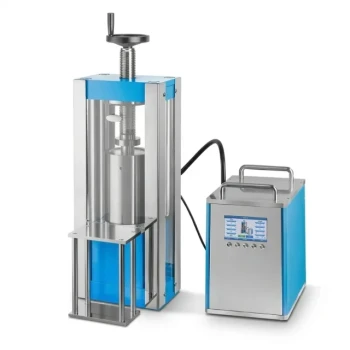
Knowledge universal laboratory press What is the difference between hydraulic and mechanical press machine? Choose the Right Press for Your Application
Author avatar

Tech Team · Kintek Solution

Updated 2 months ago

What is the difference between hydraulic and mechanical press machine? Choose the Right Press for Your Application


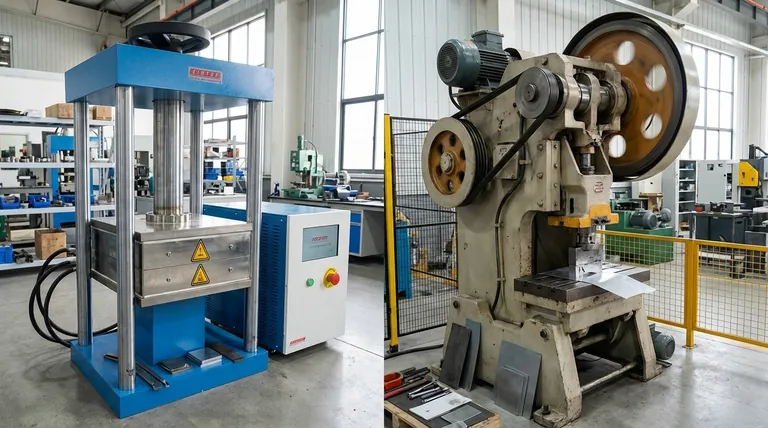
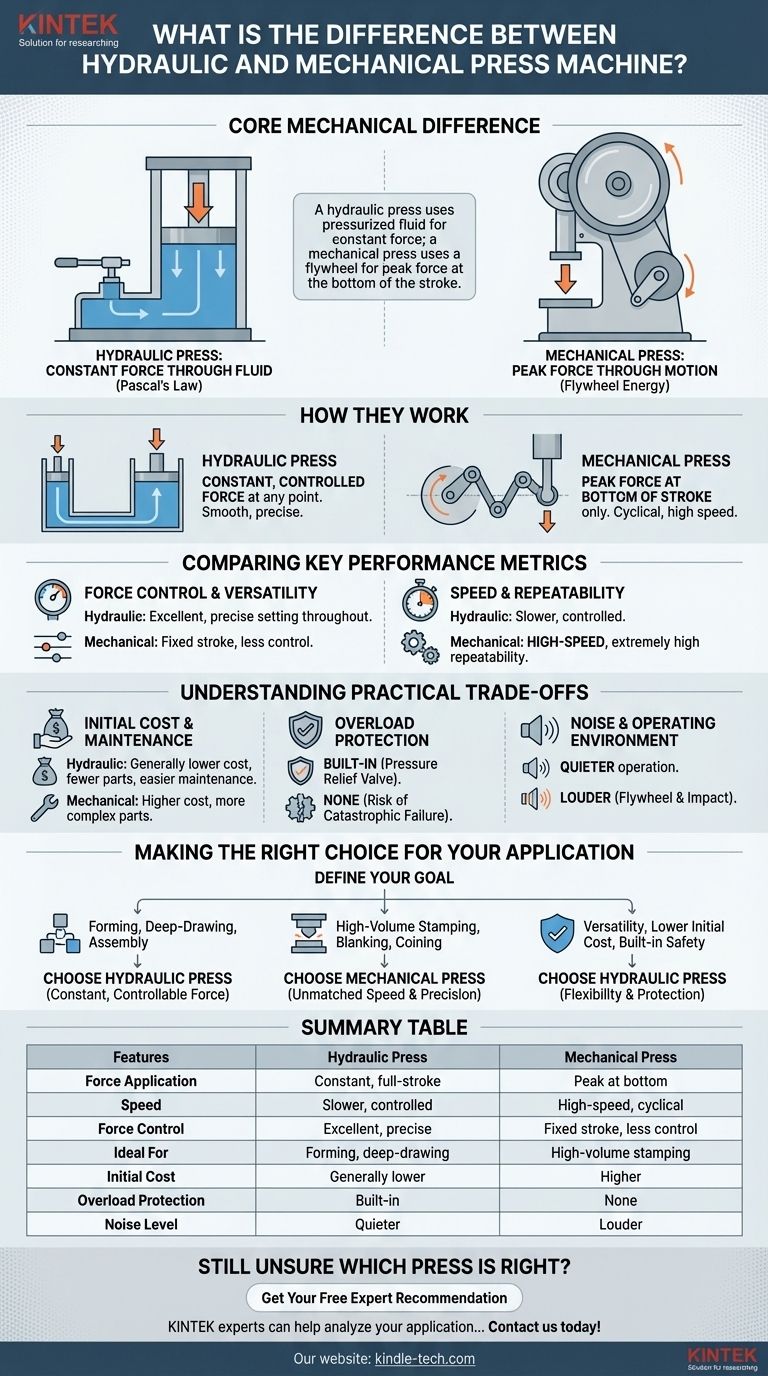
At their core, the difference between a hydraulic and a mechanical press lies in how they generate force. A hydraulic press uses pressurized fluid (typically oil) to move a piston and exert a constant force, while a mechanical press uses a motor-driven flywheel to store energy that is transferred through a crank or eccentric gear system. This fundamental distinction dictates their performance, cost, and ideal applications.

The choice between a hydraulic and mechanical press is not about which is "better," but which is right for the job. Hydraulic presses excel in force control and versatility, while mechanical presses dominate in speed and high-volume precision.
What is the difference between hydraulic and mechanical press machine? Choose the Right Press for Your Application

How They Work: The Core Mechanical Difference

Understanding the mechanism behind each press is the key to understanding their respective strengths and weaknesses. Each design is purpose-built for different types of work.

The Hydraulic Press: Constant Force Through Fluid

A hydraulic press operates on the principle of Pascal's Law. A pump moves hydraulic fluid into a cylinder, pushing against a piston.

This design allows the press to generate its full rated force at any point in the piston's stroke. The force is smooth, controlled, and constant from the top to the bottom of the press action.

The Mechanical Press: Peak Force Through Motion

A mechanical press uses a motor to spin a large, heavy flywheel, which stores kinetic energy. When the press is activated, a clutch connects the flywheel to a crankshaft that drives the ram up and down.

Crucially, a mechanical press only achieves its maximum rated tonnage at the very bottom of its stroke. The force is not constant, but instead follows a curve as the crank rotates.

Comparing Key Performance Metrics

The differing mechanics of each press type lead to significant differences in how they perform under real-world conditions.

Force Control & Versatility

Hydraulic presses offer superior force control. The pressure can be precisely set and maintained throughout the entire stroke, which is ideal for deep-drawing, forming, and molding operations where consistent pressure is critical.

Mechanical presses have a fixed stroke length determined by the crankshaft. While some adjustments are possible, they lack the full-stroke force and variable stroke length inherent to hydraulic designs.

Speed & Repeatability

Mechanical presses are built for speed. Their cyclical motion is much faster than a hydraulic system, making them the standard for high-volume, repetitive tasks like blanking, punching, and coining.

The precision of the mechanical linkage also ensures extremely high repeatability, with the ram returning to the exact same position at the bottom of every stroke.

Understanding the Practical Trade-offs

Beyond raw performance, the day-to-day realities of cost, safety, and maintenance are critical factors in your decision.

Initial Cost & Maintenance

Hydraulic presses are generally less expensive to purchase. Their design is simpler, with fewer moving parts, which also makes them easier and cheaper to maintain over time.

Fewer components directly translates to fewer potential points of failure, contributing to their reputation for durability.

Overload Protection

This is a major advantage for hydraulic presses. They are equipped with pressure relief valves, providing inherent overload protection. The press will simply not exert more force than its set limit, protecting the machine and expensive tooling.

Mechanical presses have no built-in overload protection. If an operator attempts to apply too much force or uses the wrong material thickness, it can lead to catastrophic failure, breaking the frame or dies.

Noise and Operating Environment

The smooth action of a hydraulic system results in significantly quieter operation. The primary noise comes from the motor and pump.

Mechanical presses, with their large rotating flywheels and stamping impact, are inherently much louder and generate more vibration.

Making the Right Choice for Your Application

To select the correct press, you must first define your primary goal.

  • If your primary focus is forming, deep-drawing, or assembly: Choose a hydraulic press for its constant, controllable force throughout the entire stroke.
  • If your primary focus is high-volume stamping, blanking, or coining: Choose a mechanical press for its unmatched speed and precision repeatability.
  • If your primary focus is versatility, lower initial cost, and built-in safety: Choose a hydraulic press for its flexibility and inherent overload protection.

Ultimately, understanding these fundamental differences empowers you to select the press that functions as a true solution for your specific manufacturing goal.

Summary Table:

Feature Hydraulic Press Mechanical Press
Force Application Constant, full-stroke force Peak force at bottom of stroke only
Speed Slower, controlled High-speed, cyclical
Force Control Excellent, precise pressure setting Fixed stroke, less control
Ideal For Forming, deep-drawing, molding High-volume stamping, blanking, coining
Initial Cost Generally lower Higher
Overload Protection Built-in (pressure relief valve) None (risk of catastrophic failure)
Noise Level Quieter Louder (flywheel and impact noise)

Still Unsure Which Press is Right for Your Lab or Production Line?

KINTEK specializes in lab equipment and consumables, serving laboratory needs. Our experts can help you analyze your specific application—whether it's precision forming, high-volume stamping, or material testing—to recommend the perfect hydraulic or mechanical press.

Contact us today for a personalized consultation and discover how the right press can enhance your efficiency, safety, and bottom line.

Get Your Free Expert Recommendation

Visual Guide
What is the difference between hydraulic and mechanical press machine? Choose the Right Press for Your Application Visual Guide

Related Products

People Also Ask

Related Products

Automatic Laboratory Heat Press Machine

Automatic Laboratory Heat Press Machine

Precision automatic heat press machines for labs—ideal for material testing, composites, and R&D. Customizable, safe, and efficient. Contact KINTEK today!

Automatic High Temperature Heated Hydraulic Press Machine with Heated Plates for Lab

Automatic High Temperature Heated Hydraulic Press Machine with Heated Plates for Lab

The High Temperature Hot Press is a machine specifically designed for pressing, sintering and processing materials in a high temperature environment. It is capable of operating in the range of hundreds of degrees Celsius to thousands of degrees Celsius for a variety of high temperature process requirements.

30T 40T Split Automatic Heated Hydraulic Press Machine with Heated Plates for Laboratory Hot Press

30T 40T Split Automatic Heated Hydraulic Press Machine with Heated Plates for Laboratory Hot Press

Discover our split automatic heated lab press 30T/40T for precise sample preparation in material research, pharmacy, ceramics, and electronics industries. With a small footprint and heating up to 300°C, it's perfect for processing under vacuum environment.

Heated Hydraulic Press Machine with Heated Plates for Vacuum Box Laboratory Hot Press

Heated Hydraulic Press Machine with Heated Plates for Vacuum Box Laboratory Hot Press

Enhance your lab's precision with our lab press for vacuum box. Press pills and powders with ease and precision in a vacuum environment, reducing oxidation and improving consistency. Compact and easy to use with a digital pressure gauge.

Cold Isostatic Pressing Machine CIP for Small Workpiece Production 400Mpa

Cold Isostatic Pressing Machine CIP for Small Workpiece Production 400Mpa

Produce uniformly high-density materials with our Cold Isostatic Press. Ideal for compacting small workpieces in production settings. Widely used in powder metallurgy, ceramics, and biopharmaceutical fields for high-pressure sterilization and protein activation.

Laboratory Hydraulic Press Lab Pellet Press Machine for Glove Box

Laboratory Hydraulic Press Lab Pellet Press Machine for Glove Box

Controlled environment lab press machine for glove box. Specialized equipment for material pressing and shaping with high precision digital pressure gauge.

Single Punch Manual Tablet Press Machine TDP Tablet Punching Machine

Single Punch Manual Tablet Press Machine TDP Tablet Punching Machine

Single punch manual tablet punching machine can press various granular, crystal or powdery raw materials with good fluidity into disc-shaped, cylindrical, spherical, convex, concave and other various geometric shapes (such as square, triangle, ellipse, capsule shape, etc.), and can also press products with text and patterns.

Lab Scale Rotary Single Punch Tablet Press Machine TDP Tablet Punching Machine

Lab Scale Rotary Single Punch Tablet Press Machine TDP Tablet Punching Machine

This machine is a single-pressure automatic rotating, continuous tableting machine that compresses granular raw materials into various tablets. It is mainly used for tablet production in the pharmaceutical industry, and is also suitable for chemical, food, electronics and other industrial sectors.

Automatic Heated Hydraulic Press Machine with Heated Plates for Laboratory Hot Press

Automatic Heated Hydraulic Press Machine with Heated Plates for Laboratory Hot Press

The Automatic High Temperature Heat Press is a sophisticated hydraulic hot press designed for efficient temperature control and product quality processing.

Single Punch Electric Tablet Press Machine TDP Tablet Punching Machine

Single Punch Electric Tablet Press Machine TDP Tablet Punching Machine

The electric tablet punching machine is a laboratory equipment designed for pressing various granular and powdery raw materials into discs and other geometric shapes. It is commonly used in pharmaceutical, healthcare products, food, and other industries for small batch production and processing. The machine is compact, lightweight, and easy to operate, making it suitable for use in clinics, schools, laboratories, and research units.

Heated Hydraulic Press Machine with Heated Plates for Vacuum Box Laboratory Hot Press

Heated Hydraulic Press Machine with Heated Plates for Vacuum Box Laboratory Hot Press

The lab press for vacuum box is a specialized piece of equipment designed for laboratory use. Its main purpose is to press pills and powders according to specific requirements.

Automatic Laboratory Hydraulic Pellet Press Machine for Lab Use

Automatic Laboratory Hydraulic Pellet Press Machine for Lab Use

Experience efficient sample preparation with our Automatic Lab Press Machine. Ideal for material research, pharmacy, ceramics, and more. Features a compact size and hydraulic press functionality with heating plates. Available in various sizes.

Manual Heated Hydraulic Press Machine with Heated Plates for Laboratory Hot Press

Manual Heated Hydraulic Press Machine with Heated Plates for Laboratory Hot Press

The Manual Heat Press is a versatile piece of equipment suitable for a variety of applications, operated by a manual hydraulic system that applies controlled pressure and heat to the material placed on the piston.

Manual Cold Isostatic Pressing Machine CIP Pellet Press

Manual Cold Isostatic Pressing Machine CIP Pellet Press

Lab Manual Isostatic Press is a high-efficient equipment for sample preparation widely used in material research, pharmacy, ceramics, and electronic industries. It allows for precision control of the pressing process and can work in a vacuum environment.

Automatic Lab Cold Isostatic Press CIP Machine Cold Isostatic Pressing

Automatic Lab Cold Isostatic Press CIP Machine Cold Isostatic Pressing

Efficiently prepare samples with our Automatic Lab Cold Isostatic Press. Widely used in material research, pharmacy, and electronic industries. Provides greater flexibility and control compared to electric CIPs.

Electric Lab Cold Isostatic Press CIP Machine for Cold Isostatic Pressing

Electric Lab Cold Isostatic Press CIP Machine for Cold Isostatic Pressing

Produce dense, uniform parts with improved mechanical properties with our Electric Lab Cold Isostatic Press. Widely used in material research, pharmacy, and electronic industries. Efficient, compact, and vacuum-compatible.

Electric Split Lab Cold Isostatic Press CIP Machine for Cold Isostatic Pressing

Electric Split Lab Cold Isostatic Press CIP Machine for Cold Isostatic Pressing

Split cold isostatic presses are capable of providing higher pressures, making them suitable for testing applications that require high pressure levels.

Manual button battery sealing machine (digital display)

Manual button battery sealing machine (digital display)

The manual button battery sealing machine is a small device specially used for button battery packaging. It is easy to operate and suitable for laboratories and small batch production to ensure that the battery is firmly sealed and improve production efficiency.

kbr pellet press 2t

kbr pellet press 2t

Introducing the KINTEK KBR Press - a handheld laboratory hydraulic press designed for entry-level users.

Automatic Laboratory Hydraulic Press for XRF & KBR Pellet Press

Automatic Laboratory Hydraulic Press for XRF & KBR Pellet Press

Fast and easy xrf sample pellet preparation with KinTek Automatic Lab Pellet Press. Versatile and accurate results for X-ray fluorescence analysis.


Leave Your Message