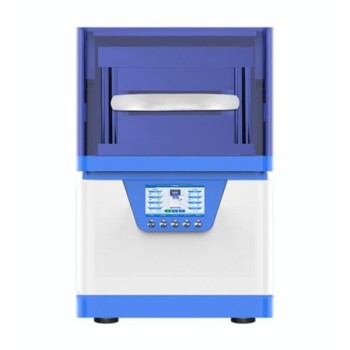
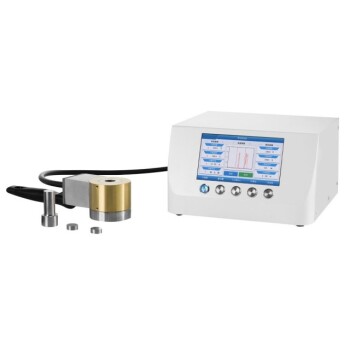
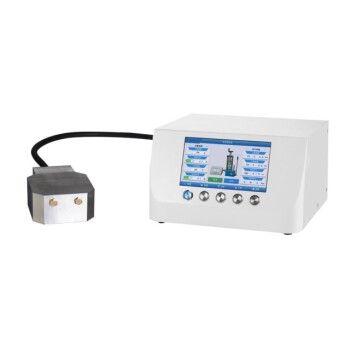
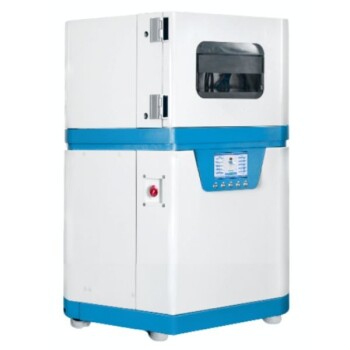
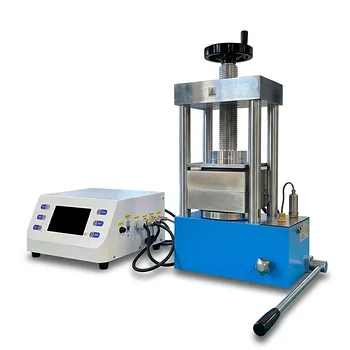
A laboratory hot press functions as the critical consolidation tool in the fabrication of Polyaniline/Wollastonite/Colemanite composites. By applying simultaneous heat and pressure, it achieves high-density molding that ensures the uniform distribution of conductive fillers required for effective electromagnetic shielding.
Core Takeaway While mixing combines the ingredients, the hot press dictates the final performance by transforming loose powders into a dense, unified matrix. Its ability to create a continuous conductive network is the primary driver of the material's electromagnetic shielding effectiveness.
Mechanisms of Property Enhancement
Achieving High-Density Molding
The primary function of the hot press is to eliminate porosity. By applying pressure while the material is heated, the machine forces particles into a tighter arrangement than is possible with cold pressing.
This simultaneous treatment expels air trapped between the powder particles. The result is a compact material with significantly improved structural integrity and green density.
Optimizing the Conductive Network
For a composite to shield against electromagnetic interference (EMI), it requires an electrical pathway. Polyaniline serves as this conductive filler.
The hot press ensures these conductive particles are distributed uniformly rather than clumping together. This uniformity builds a continuous conductive network throughout the insulating matrix of Wollastonite and Colemanite.
Enhancing Interfacial Bonding
Mere physical contact is often insufficient for high-performance composites. The heat and pressure promote diffusion and chemical reactions at the particle interfaces.
This reduces the sintering temperature required and inhibits excessive grain growth. The outcome is a composite with strong adhesion between the organic polymer and inorganic minerals at the nanometer scale.
Understanding the Trade-offs
The Risk of Pore Defects
While the hot press is designed to increase density, improper operation can lead to internal defects. If the initial air expulsion is incomplete, or if the pressure application is uneven, lamination (layer separation) can occur.
To mitigate this, a pre-pressing stage is often necessary to remove air before the final hot press cycle.
Thermal Sensitivity
There is a delicate balance between densification and degradation. While heat aids in sintering and molding, Polyaniline is a polymer and has a lower thermal threshold than the mineral fillers (Wollastonite/Colemanite).
Excessive heat intended to sinter the ceramics could degrade the conductive polymer, destroying the shielding network you are trying to create.
Making the Right Choice for Your Goal
To maximize the potential of your Polyaniline/Wollastonite/Colemanite composite, align your processing parameters with your specific performance targets:
- If your primary focus is Electromagnetic Shielding: Prioritize temperature and pressure settings that maximize uniform filler distribution, ensuring the conductive network remains unbroken.
- If your primary focus is Mechanical Strength: Focus on the pre-pressing and air expulsion phases to minimize internal pores and prevent lamination defects.
Success lies in using the hot press not just to shape the material, but to engineer its internal microstructure.
Summary Table:
| Feature | Function in Composite Fabrication | Impact on Shielding Performance |
|---|---|---|
| High-Density Molding | Eliminates porosity and expels trapped air | Increases structural integrity and green density |
| Conductive Network | Ensures uniform distribution of Polyaniline | Creates continuous pathways for EMI attenuation |
| Interfacial Bonding | Promotes diffusion at particle interfaces | Enhances adhesion between polymer and mineral fillers |
| Thermal Control | Balances sintering vs. polymer degradation | Preserves the integrity of heat-sensitive components |
Precision Engineering for Your Composite Research
Unlock the full potential of your shielding materials with KINTEK’s high-performance laboratory equipment. Whether you are fabricating advanced Polyaniline composites or specialized ceramics, our hydraulic hot presses, pellet presses, and isostatic systems provide the precise pressure and temperature control necessary to eliminate defects and ensure a continuous conductive network.
From high-temperature furnaces and crushing systems to specialized PTFE and ceramic consumables, KINTEK delivers the comprehensive tools required for rigorous material science.
Ready to enhance your lab's efficiency and material performance? Contact our technical experts today to find the perfect solution for your research goals.
References
- Ethem İlhan Şahin, Mehriban Emek. Wollastanit/PANI/Kolemanit Kompozitlerin Elektromanyetik Kalkanlama Etkinliği. DOI: 10.31590/ejosat.816145
This article is also based on technical information from Kintek Solution Knowledge Base .
Related Products
- 30T 40T Split Automatic Heated Hydraulic Press Machine with Heated Plates for Laboratory Hot Press
- Heated Hydraulic Press Machine with Heated Plates Split Manual Laboratory Hot Press
- Automatic Heated Hydraulic Press Machine with Heated Plates for Laboratory Hot Press
- Automatic Laboratory Heat Press Machine
- 24T 30T 60T Heated Hydraulic Press Machine with Heated Plates for Laboratory Hot Press
People Also Ask
- What are the advantages of using a laboratory hydraulic press for hot pressing? Achieve Peak Nano-Composite Density
- What are the core advantages of using a laboratory hot press to produce Bi2Se3? Achieve 93% Density & High Conductivity
- Why is a laboratory hydraulic hot press essential for high-density, additive-free Silicon Carbide? Unlock Pure SiC.
- How does a laboratory hydraulic hot press ensure the quality of PHBV/natural fiber composites? Expert Guide
- What is the function of a laboratory hydraulic hot press in the assembly of solid-state photoelectrochemical cells?