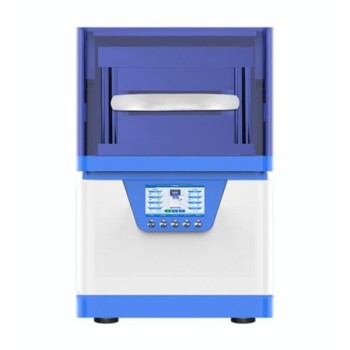
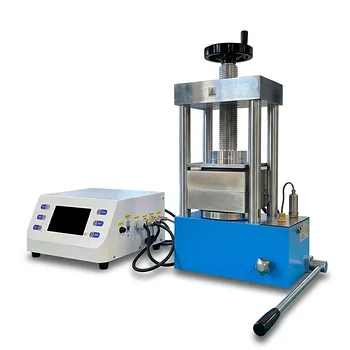
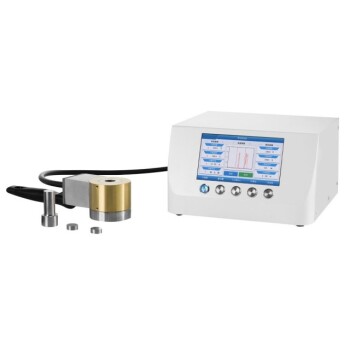
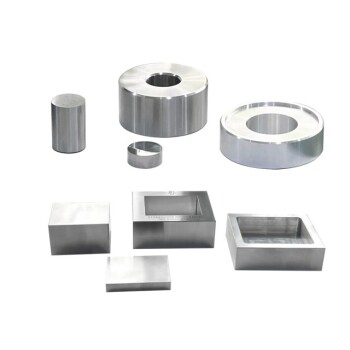
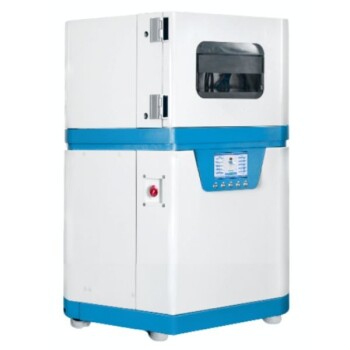
The primary advantage of using a laboratory hot press for PEO/LLZTO composites is the capability to achieve solvent-free dry film formation. By leveraging the thermoplasticity of Polyethylene Oxide (PEO), the equipment applies precise heat (e.g., 70°C) and pressure (e.g., 10 MPa) to convert mixed powders directly into a dense, flexible film with controllable thickness (typically 70-100 μm). This method circumvents the electrochemical degradation often caused by residual solvents inherent in traditional solution casting.
Core Takeaway The laboratory hot press moves beyond simple shaping; it densifies the composite at a microstructural level. By eliminating the need for solvents, it creates a mechanically superior, void-free electrolyte membrane where the polymer matrix creates an optimal interface with ceramic fillers, directly enhancing ionic conductivity.
The Shift to Solvent-Free Processing
Eliminating Residual Solvent Risks
Traditional casting methods require solvents to dissolve the polymer. Even after drying, trace amounts of solvent often remain. These residuals can react with lithium anodes or degrade the electrochemical stability window of the battery.
Leveraging Thermoplasticity
PEO is a thermoplastic polymer. The hot press utilizes this property effectively. Under controlled heat, the PEO creates a flow state that binds with the LLZTO ceramic particles without requiring a liquid carrier.
Mechanical Integrity
Films produced via hot pressing exhibit significantly higher mechanical strength compared to solution-cast films. This strength is critical for suppressing dendrite growth, a common failure mode in solid-state batteries.
Optimizing Microstructure and Density
Eradicating Microscopic Voids
Solvent evaporation in casting processes leaves behind microscopic voids and pores. The simultaneous application of pressure (up to 10 MPa or higher) and heat in a hot press collapses these voids, resulting in a dense, pore-free structure.
Molecular-Level Bonding
The process forces the softened PEO matrix to flow around the LLZTO particles. This facilitates molecular-level bonding, ensuring a cohesive three-dimensional network rather than a loose aggregate of particles.
Dimensional Precision
The hot press allows for rigorous control over the film thickness, typically in the 70-100 μm range. Uniform thickness is vital for ensuring consistent current density distribution across the battery cell.
Enhancing Interfacial Performance
Improving Ionic Pathways
Ionic conductivity relies on the continuity of the conductive medium. By maximizing the density of the composite, the hot press reduces grain boundary resistance and creates continuous pathways for lithium ions to travel through both the polymer and ceramic phases.
Optimizing the Polymer-Ceramic Interface
The key to a PEO/LLZTO composite is the contact between the organic polymer and the inorganic ceramic. The hot press compacts these materials together, optimizing the interfacial contact and ensuring the ceramic filler is fully integrated into the polymer matrix.
Understanding the Trade-offs
Parameter Sensitivity
Success relies heavily on precise temperature control. If the temperature is too low, the PEO will not flow sufficiently to eliminate voids; if too high, the polymer may degrade or lose mechanical stability.
Equipment Requirements
Unlike simple casting, which requires minimal equipment, hot pressing requires hydraulic systems capable of maintaining stable pressure and uniform heating platens. Inconsistencies in platen temperature can lead to density gradients within a single film.
Making the Right Choice for Your Goal
When integrating a laboratory hot press into your PEO/LLZTO fabrication workflow, tailor your parameters to your specific performance target:
- If your primary focus is Ionic Conductivity: Prioritize higher pressure settings to maximize density and eliminate all microscopic voids that impede ion transport.
- If your primary focus is Mechanical Stability: Focus on the precise temperature window that allows PEO flow without degradation, ensuring the strongest possible physical bond between the polymer and the LLZTO filler.
The laboratory hot press is not just a forming tool; it is a microstructural engineering instrument that unlocks the full potential of composite electrolytes.
Summary Table:
| Feature | Solvent-Free Hot Pressing | Traditional Solution Casting |
|---|---|---|
| Processing Method | Thermoplastic flow via heat & pressure | Solvent dissolution & evaporation |
| Film Density | High (pore-free structure) | Lower (subject to microscopic voids) |
| Residuals | Zero solvent residue | Risk of trace solvent degradation |
| Mechanical Strength | Superior (dendrite resistant) | Moderate |
| Thickness Control | High precision (70-100 μm) | Variable based on evaporation |
| Interface Quality | Molecular-level bonding | Interfacial gaps common |
Elevate Your Solid-State Battery Research with KINTEK
Precision engineering starts with the right equipment. KINTEK specializes in advanced laboratory hydraulic presses (pellet, hot, and isostatic) designed specifically for demanding material science applications like PEO/LLZTO composite forming.
Our high-performance hot presses provide the uniform heating and stable pressure required to eliminate microscopic voids, ensuring your electrolyte membranes achieve maximum density and ionic conductivity. Beyond pressing, KINTEK offers a comprehensive ecosystem for battery research, including high-temperature furnaces, vacuum systems, and specialized consumables.
Ready to achieve superior film integrity? Contact our technical experts today to find the perfect pressing solution for your lab’s unique requirements.
Related Products
- 30T 40T Split Automatic Heated Hydraulic Press Machine with Heated Plates for Laboratory Hot Press
- Automatic Heated Hydraulic Press Machine with Heated Plates for Laboratory Hot Press
- Heated Hydraulic Press Machine with Heated Plates Split Manual Laboratory Hot Press
- Automatic Laboratory Heat Press Machine
- 24T 30T 60T Heated Hydraulic Press Machine with Heated Plates for Laboratory Hot Press
People Also Ask
- What are the advantages of using a laboratory hydraulic press for hot pressing? Achieve Peak Nano-Composite Density
- What are the core advantages of using a laboratory hot press to produce Bi2Se3? Achieve 93% Density & High Conductivity
- Why is a laboratory hydraulic hot press essential for high-density, additive-free Silicon Carbide? Unlock Pure SiC.
- How does a laboratory hydraulic hot press ensure the quality of PHBV/natural fiber composites? Expert Guide
- What is the function of a laboratory hydraulic hot press in the assembly of solid-state photoelectrochemical cells?