Knowledge vacuum induction melting furnace What is the efficiency of an aluminum melting furnace? Unlock High Thermal Performance for Your Foundry
Author avatar

Tech Team · Kintek Solution

Updated 2 months ago

What is the efficiency of an aluminum melting furnace? Unlock High Thermal Performance for Your Foundry


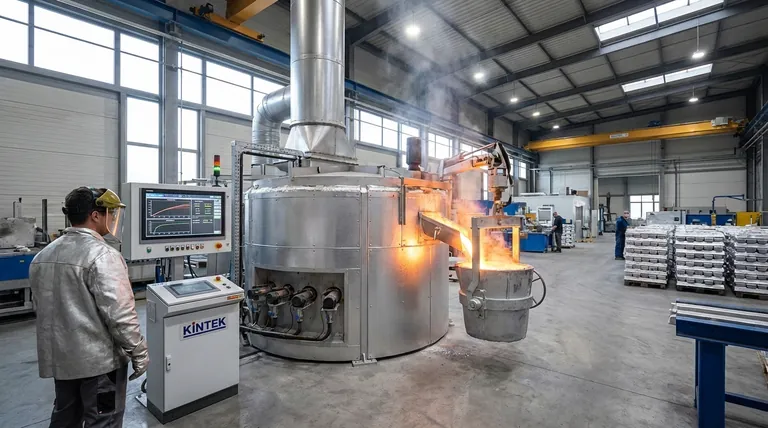
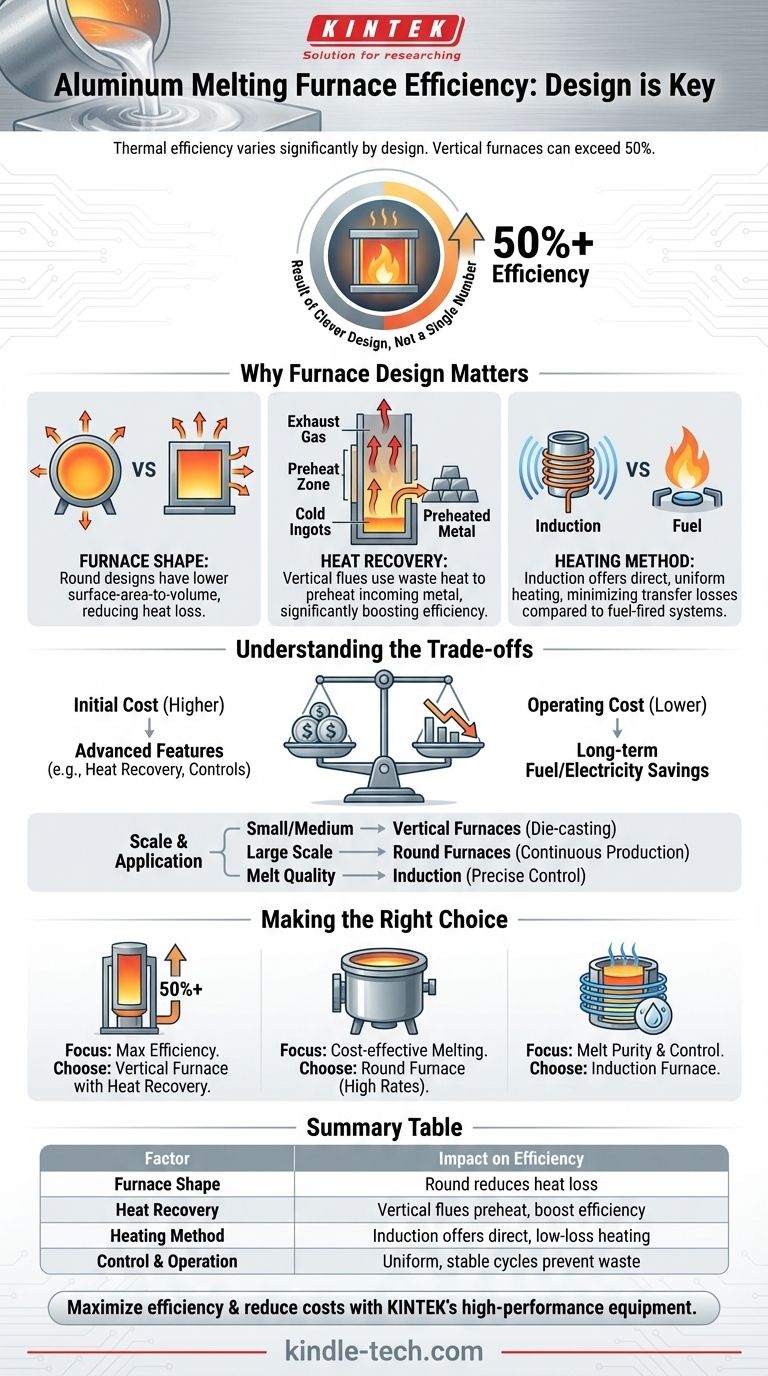
In short, the thermal efficiency of an aluminum melting furnace varies significantly by design, but certain types can achieve high performance. A vertical aluminum melting furnace, for example, often exceeds 50% thermal efficiency due to its ability to use hot exhaust gas to preheat the incoming metal. However, this figure is not universal, as efficiency is fundamentally determined by the furnace's shape, heating method, and heat recovery systems.

The central takeaway is that furnace efficiency is not a single number but a direct result of its design. The most efficient furnaces are those engineered to maximize heat transfer to the aluminum while minimizing energy loss to the surrounding environment, often through clever heat recovery and optimized shapes.
What is the efficiency of an aluminum melting furnace? Unlock High Thermal Performance for Your Foundry

Why Furnace Design is the Key to Efficiency

Understanding what makes a furnace efficient requires looking beyond a single percentage. The core engineering principles focus on generating heat and ensuring as much of that heat as possible is absorbed by the aluminum charge.

The Impact of Furnace Shape

The physical geometry of the furnace is a primary factor in preventing heat loss. A round furnace generally offers superior efficiency compared to a rectangular one.

This is because a circular design has a lower surface-area-to-volume ratio, which reduces the area through which heat can escape. It also facilitates more uniform heat distribution and makes it easier to achieve a proper seal, further reducing energy waste.

The Power of Heat Recovery

The single biggest opportunity for improving efficiency is heat recovery. In many furnace designs, a significant amount of energy is lost through hot exhaust gases.

A vertical melting furnace is a prime example of efficient design. It uses a tall flue where hot gases from the burners at the bottom rise and preheat the cold aluminum ingots being added from the top. This process of recycling waste heat is why these furnaces can consistently achieve efficiencies exceeding 50%.

Heating Method and Control

The method of applying heat and the precision of temperature control also play a critical role. Furnaces that provide uniform heating and stable operation prevent energy waste from overheating or inefficient melting cycles.

Different technologies, such as induction furnaces, use electromagnetic fields to heat the metal directly. This method can be highly efficient as it generates heat within the aluminum itself, minimizing the heat transfer losses common in fuel-fired furnaces.

Understanding the Trade-offs

Selecting a furnace is not just about choosing the highest possible efficiency rating. Practical considerations and operational needs create important trade-offs.

Initial Cost vs. Operating Cost

Furnaces with advanced features like flue gas heat recovery systems or sophisticated controls typically have a higher upfront investment.

However, their higher thermal efficiency translates directly into lower fuel or electricity consumption, leading to significant long-term operational savings that can offset the initial cost.

Scale of Operation and Application

The best furnace design is dependent on the production scale. Vertical furnaces are highly effective and common in the die-casting industry and for small to medium-sized enterprises.

For large-scale, continuous production, large round furnaces are often preferred due to their high melting rates and structural efficiency benefits. The choice must align with the required output.

Melt Quality vs. Throughput

While a high melting rate is desirable, it cannot come at the expense of metal quality. Precise temperature control is essential for producing specific alloys and preventing the formation of dross.

Some designs may prioritize raw melting speed, while others, like induction furnaces, offer superior control over the melt, which may be the more critical factor for a given application.

Making the Right Choice for Your Goal

The optimal furnace is the one that best aligns with your specific operational priorities.

  • If your primary focus is maximizing thermal efficiency: A vertical furnace with an integrated heat recovery system is a leading choice, capable of converting over 50% of its energy into useful heat.
  • If your primary focus is large-scale, cost-effective melting: A well-designed round furnace offers significant efficiency advantages over older rectangular models due to superior heat retention and distribution.
  • If your primary focus is precise temperature control and melt purity: An induction furnace should be a strong consideration, as its direct heating method provides excellent control and can be very energy efficient.

Ultimately, choosing the right aluminum melting technology is about matching the engineering of the furnace to the demands of your application.

Summary Table:

Factor Impact on Efficiency
Furnace Shape Round designs reduce heat loss vs. rectangular ones
Heat Recovery Systems like vertical flues preheat metal, boosting efficiency
Heating Method Induction furnaces offer direct heating with minimal loss
Control & Operation Uniform heating and stable cycles prevent energy waste

Ready to maximize your aluminum melting efficiency and reduce operational costs? KINTEK specializes in high-performance lab and foundry equipment, including advanced aluminum melting furnaces designed for superior thermal efficiency and precise control. Whether you need a vertical furnace for optimal heat recovery or an induction system for melt purity, our experts can help you select the perfect solution for your production scale and quality requirements. Contact us today to discuss your needs and discover how KINTEK can enhance your melting operations!

Visual Guide
What is the efficiency of an aluminum melting furnace? Unlock High Thermal Performance for Your Foundry Visual Guide

Related Products

People Also Ask

Related Products

High Temperature Alumina (Al2O3) Furnace Tube for Engineering Advanced Fine Ceramics

High Temperature Alumina (Al2O3) Furnace Tube for Engineering Advanced Fine Ceramics

High temperature alumina furnace tube combines the advantages of high hardness of alumina, good chemical inertness and steel, and has excellent wear resistance, thermal shock resistance and mechanical shock resistance.

1400℃ Laboratory High Temperature Tube Furnace with Alumina Tube

1400℃ Laboratory High Temperature Tube Furnace with Alumina Tube

Looking for a tube furnace for high-temperature applications? Our 1400℃ Tube Furnace with Alumina Tube is perfect for research and industrial use.

1700℃ Laboratory High Temperature Tube Furnace with Alumina Tube

1700℃ Laboratory High Temperature Tube Furnace with Alumina Tube

Looking for a high-temperature tube furnace? Check out our 1700℃ Tube Furnace with Alumina Tube. Perfect for research and industrial applications up to 1700C.

Engineering Advanced Fine Alumina Al2O3 Ceramic Crucible for Laboratory Muffle Furnace

Engineering Advanced Fine Alumina Al2O3 Ceramic Crucible for Laboratory Muffle Furnace

Alumina ceramic crucibles are used in some materials and metal melting tools, and flat-bottomed crucibles are suitable for melting and processing larger batches of materials with better stability and uniformity.

Non Consumable Vacuum Arc Induction Melting Furnace

Non Consumable Vacuum Arc Induction Melting Furnace

Explore the benefits of Non-Consumable Vacuum Arc Furnace with high melting point electrodes. Small, easy to operate & eco-friendly. Ideal for laboratory research on refractory metals & carbides.

Lab-Scale Vacuum Induction Melting Furnace

Lab-Scale Vacuum Induction Melting Furnace

Get precise alloy composition with our Vacuum Induction Melting Furnace. Ideal for aerospace, nuclear energy, and electronic industries. Order now for effective smelting and casting of metals and alloys.

Vacuum Arc Induction Melting Furnace

Vacuum Arc Induction Melting Furnace

Discover the power of Vacuum Arc Furnace for melting active & refractory metals. High-speed, remarkable degassing effect, and free of contamination. Learn more now!

Vacuum Heat Treat Furnace and Levitation Induction Melting Furnace

Vacuum Heat Treat Furnace and Levitation Induction Melting Furnace

Experience precise melting with our Vacuum Levitation Melting Furnace. Ideal for high melting point metals or alloys, with advanced technology for effective smelting. Order now for high-quality results.

2200 ℃ Tungsten Vacuum Heat Treat and Sintering Furnace

2200 ℃ Tungsten Vacuum Heat Treat and Sintering Furnace

Experience the ultimate refractory metal furnace with our Tungsten vacuum furnace. Capable of reaching 2200℃, perfect for sintering advanced ceramics and refractory metals. Order now for high-quality results.

High Temperature Muffle Oven Furnace for Laboratory Debinding and Pre Sintering

High Temperature Muffle Oven Furnace for Laboratory Debinding and Pre Sintering

KT-MD High temperature debinding and pre-sintering furnace for ceramic materials with various molding processes. Ideal for electronic components such as MLCC and NFC.

Vacuum Heat Treat and Molybdenum Wire Sintering Furnace for Vacuum Sintering

Vacuum Heat Treat and Molybdenum Wire Sintering Furnace for Vacuum Sintering

A vacuum molybdenum wire sintering furnace is a vertical or bedroom structure, which is suitable for withdrawal, brazing, sintering and degassing of metal materials under high vacuum and high temperature conditions. It is also suitable for dehydroxylation treatment of quartz materials.

Molybdenum Vacuum Heat Treat Furnace

Molybdenum Vacuum Heat Treat Furnace

Discover the benefits of a high-configuration molybdenum vacuum furnace with heat shield insulation. Ideal for high-purity, vacuum environments like sapphire crystal growth and heat treatment.

600T Vacuum Induction Hot Press Furnace for Heat Treat and Sintering

600T Vacuum Induction Hot Press Furnace for Heat Treat and Sintering

Discover the 600T Vacuum Induction Hot Press Furnace, designed for high-temperature sintering experiments in vacuum or protected atmospheres. Its precise temperature and pressure control, adjustable working pressure, and advanced safety features make it ideal for nonmetal materials, carbon composites, ceramics, and metal powders.

Ultra-High Temperature Graphite Vacuum Graphitization Furnace

Ultra-High Temperature Graphite Vacuum Graphitization Furnace

The ultra-high temperature graphitization furnace utilizes medium frequency induction heating in a vacuum or inert gas environment. The induction coil generates an alternating magnetic field, inducing eddy currents in the graphite crucible, which heats up and radiates heat to the workpiece, bringing it to the desired temperature. This furnace is primarily used for graphitization and sintering of carbon materials, carbon fiber materials, and other composite materials.

Laboratory Muffle Oven Furnace Bottom Lifting Muffle Furnace

Laboratory Muffle Oven Furnace Bottom Lifting Muffle Furnace

Efficiently produce batches with excellent temperature uniformity using our Bottom Lifting Furnace. Features two electric lifting stages and advanced temperature control up to 1600℃.

Vacuum Heat Treat and Pressure Sintering Furnace for High Temperature Applications

Vacuum Heat Treat and Pressure Sintering Furnace for High Temperature Applications

Vacuum pressure sintering furnaces are designed for high temperature hot pressing applications in metal and ceramic sintering. Its advanced features ensure precise temperature control, reliable pressure maintenance, and a robust design for seamless operation.

1200℃ Muffle Furnace Oven for Laboratory

1200℃ Muffle Furnace Oven for Laboratory

Upgrade your lab with our 1200℃ Muffle Furnace. Achieve fast, precise heating with Japan alumina fibers and Molybdenum coils. Features TFT touch screen controller for easy programming and data analysis. Order now!

Horizontal High Temperature Graphite Vacuum Graphitization Furnace

Horizontal High Temperature Graphite Vacuum Graphitization Furnace

Horizontal Graphitization Furnace: This type of furnace is designed with the heating elements placed horizontally, allowing for uniform heating of the sample. It's well-suited for graphitizing large or bulky samples that require precise temperature control and uniformity.

1700℃ Muffle Oven Furnace for Laboratory

1700℃ Muffle Oven Furnace for Laboratory

Get superior heat control with our 1700℃ Muffle Furnace. Equipped with intelligent temperature microprocessor, TFT touch screen controller & advanced insulation materials for precise heating up to 1700C. Order now!

Graphite Vacuum Furnace Bottom Discharge Graphitization Furnace for Carbon Materials

Graphite Vacuum Furnace Bottom Discharge Graphitization Furnace for Carbon Materials

Bottom-out graphitization furnace for carbon materials, ultra-high temperature furnace up to 3100°C, suitable for graphitization and sintering of carbon rods and carbon blocks. Vertical design, bottom discharging, convenient feeding and discharging, high temperature uniformity, low energy consumption, good stability, hydraulic lifting system, convenient loading and unloading.


Leave Your Message