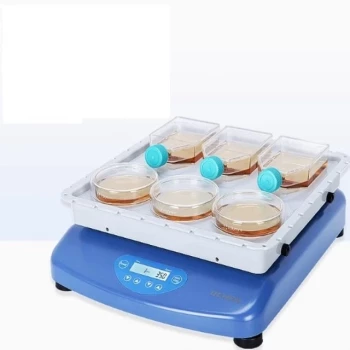
The primary function of a benchtop shaker is to apply continuous, uniform mechanical force to mix two distinct liquid phases—the organic extractant and the aqueous metal salt solution. By generating vigorous oscillation, the device overcomes the natural separation of these liquids to maximize the physical contact area between them.
The shaker acts as a mechanical catalyst for mass transfer, enabling the chemical extractant (TOA) to capture zirconium ions efficiently. This agitation compresses the separation process into a rapid 3-to-5-minute window.
The Mechanics of Phase Interaction
Overcoming Liquid Separation
In this extraction process, you are dealing with an organic phase and an aqueous phase (high-concentration sulfuric acid). These liquids are naturally immiscible and resist mixing.
Creating Uniform Oscillation
The benchtop shaker provides the continuous mechanical force necessary to disrupt this separation. It ensures the mixing is not random, but uniform throughout the vessel.
Maximizing Mass Transfer Area
Vigorous oscillation disperses one liquid into the other, drastically increasing the surface area where the two phases touch. This "interface" is the critical zone where the actual chemical extraction occurs.
Accelerating Chemical Equilibrium
Facilitating Ion Capture
The expanded surface area allows trioctylamine (TOA) molecules in the organic phase to physically encounter zirconium ions in the acid solution.
Reducing Process Time
Without mechanical aid, this transfer would rely on slow, passive diffusion. The shaker forces high-frequency contact, allowing the system to reach chemical extraction equilibrium rapidly.
The 3-to-5 Minute Window
Because of this intense agitation, the reaction does not require long soak times. The primary reference indicates that complete equilibrium is typically achieved within just 3 to 5 minutes.
Operational Criticalities and Trade-offs
The Necessity of Vigorous Force
Standard or gentle mixing is often insufficient for high-concentration sulfuric acid solutions. The shaker must provide vigorous oscillation; otherwise, the mass transfer area remains too small for effective extraction.
Precision vs. Duration
While the shaker speeds up the process, it requires adherence to the specific time window. Operating for less than 3 minutes may result in incomplete extraction, as equilibrium has not yet been reached.
Making the Right Choice for Your Goal
To optimize your zirconium extraction process, consider how the shaker's settings align with your specific objectives.
- If your primary focus is Process Efficiency: Ensure your shaker is set to a frequency high enough to reach equilibrium within the target 3-to-5 minute range.
- If your primary focus is Extraction Yield: Prioritize uniformity in the mechanical force to ensure no "dead zones" exist where phase mixing is poor.
The benchtop shaker is not just a mixer; it is the fundamental driver of mass transfer efficiency in this chemical system.
Summary Table:
| Feature | Function in Zirconium Extraction | Impact on Process |
|---|---|---|
| Mechanical Oscillation | Disrupts immiscible liquid phases (Organic vs. Aqueous) | Overcomes natural phase separation |
| Interfacial Agitation | Maximizes contact surface area between TOA and Zr ions | Accelerates mass transfer rate |
| Equilibrium Speed | Reaches chemical balance within 3-5 minutes | Significantly reduces processing time |
| Uniform Force | Eliminates "dead zones" in the reaction vessel | Ensures high extraction yield and consistency |
Optimize Your Chemical Extractions with KINTEK Precision
Maximize your laboratory efficiency and extraction yields with KINTEK’s high-performance benchtop shakers and homogenizers. Designed to handle demanding applications like zirconium extraction from high-concentration acids, our equipment ensures the vigorous oscillation and uniform mechanical force required for rapid chemical equilibrium.
Beyond mixing solutions, KINTEK specializes in a comprehensive range of advanced laboratory equipment, including:
- High-Temperature Furnaces: Muffle, tube, vacuum, and CVD systems for material synthesis.
- Sample Processing: Crushing, milling, and hydraulic presses (pellet, hot, isostatic) for precise sample prep.
- Advanced Reactors: High-temperature high-pressure reactors and autoclaves for complex chemical reactions.
- Battery & Electrochemistry: Electrolytic cells, electrodes, and specialized research tools.
- Cooling & Preservation: ULT freezers, freeze dryers, and cold traps.
Ready to elevate your research outcomes? Contact KINTEK today to discover how our specialized laboratory consumables and equipment can streamline your workflow and deliver superior results.
References
- Shuo Tian, Tao Qi. Selective Extraction of Zirconium from Sulfuric Acid Solutions at High Concentration with Trioctylamine (TOA). DOI: 10.3390/met15050468
This article is also based on technical information from Kintek Solution Knowledge Base .
Related Products
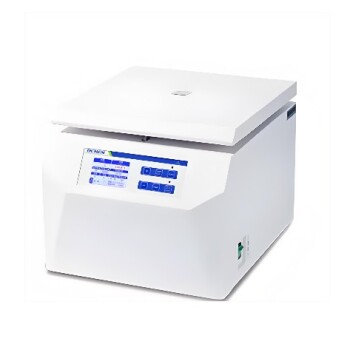
- Benchtop High Speed Small Lab Centrifuge for Serum Separation and Low Temperature Dehydration
- Laboratory Single Horizontal Jar Mill
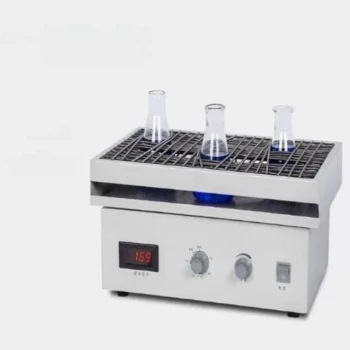
- Laboratory Multifunctional Small Speed-Adjustable Horizontal Mechanical Shaker for Lab
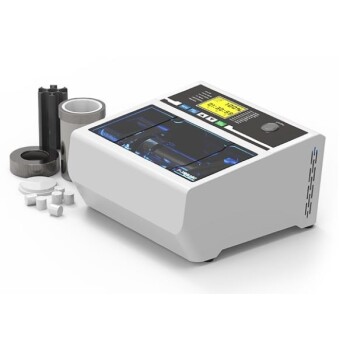
- Laboratory Micro Horizontal Jar Mill for Precision Sample Preparation in Research and Analysis
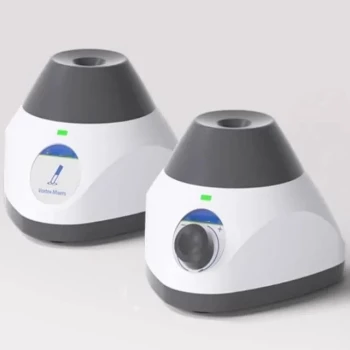
- Laboratory Vortex Mixer Orbital Shaker Multifunctional Rotation Oscillation Mixer
People Also Ask
- How is a benchtop laboratory centrifuge used in the desorption and regeneration of composite adsorbent beads?
- What is the primary function of a laboratory centrifuge? Master PAAMP-b-PVK Block Copolymer Purification
- What role does a Laboratory Centrifuge play in the production of succinic acid? Critical Solid-Liquid Separation Guide
- What are the advantages and disadvantages of a centrifuge? Weighing Speed Against Cost and Risk
- How does a centrifuge work and for what purpose? Unlock the Power of Rapid Sample Separation