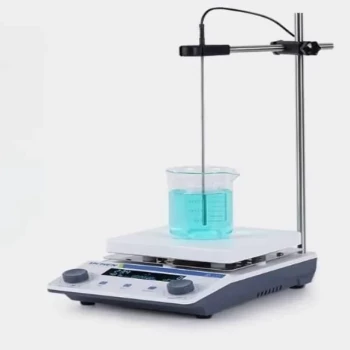
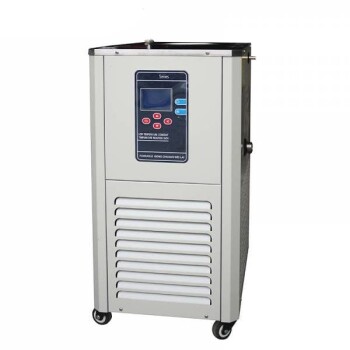
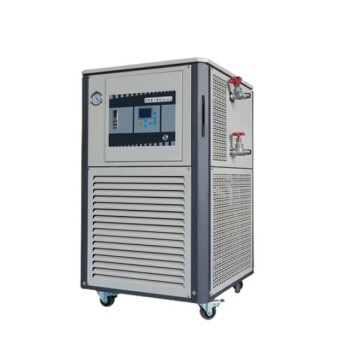
In the synthesis of SO3H-functionalized ionic liquid catalysts, the constant temperature magnetic stirrer functions as the primary control unit for reaction kinetics and thermodynamics. Specifically, during the production of catalysts like [TEAPS][HSO4], it provides the precise thermal regulation and uniform mechanical shear force necessary to drive the ring-opening reaction between triethylamine and 1,3-propane sultone, ensuring high-purity conversion.
By synchronizing precise temperature maintenance with continuous kinetic agitation, this apparatus eliminates local concentration gradients and thermal spikes, which are the primary causes of low yields and impure by-products in ionic liquid synthesis.
The Mechanics of Synthesis Control
To understand the necessity of this equipment, one must look at the specific chemical stages involved in creating SO3H-functionalized ionic liquids.
Facilitating Ring-Opening Reactions
The synthesis often begins with a ring-opening reaction, such as combining triethylamine with 1,3-propane sultone in an acetonitrile solvent.
A magnetic stirrer generates uniform mechanical shear force. This force is critical for creating thorough contact between the reactants, ensuring the ring-opening process occurs efficiently and uniformly across the entire solution volume.
Managing Acidification
A critical phase involves the addition of strong acids, such as sulfuric acid, to intermediate products.
The stirrer ensures the instantaneous and uniform mixing of the strong acid. Without this rapid dissipation, local areas of high acid concentration could form, leading to uneven reaction rates or degradation of the intermediate product.
Ensuring High-Purity Conversion
The ultimate goal of using this dual-function equipment is purity.
By maintaining a homogeneous mixture during the sulfuric acid addition, the system facilitates high-purity catalyst conversion. It prevents the formation of side products that often result from poor mixing or uncontrolled reaction pockets.
The Role of Precise Temperature Control
While mechanical stirring handles mass transfer, the "constant temperature" aspect handles the thermodynamic stability of the reaction.
Stabilizing Reaction Nodes
Chemical syntheses often require specific "temperature nodes" to proceed correctly.
Just as Graphene Oxide synthesis requires distinct temperatures for different oxidation phases, ionic liquid synthesis relies on a stable thermal environment to maintain the correct reaction pathway. Deviations can stall the reaction or trigger unwanted side mechanisms.
Preventing Runaway Reactions
Acid-base reactions and sulfonations can be exothermic.
The constant temperature bath acts as a thermal buffer. It absorbs excess heat generated during the addition of sulfuric acid, preventing thermal runaway and ensuring the reaction remains within the safe, optimal window for product formation.
Common Pitfalls to Avoid
Understanding what happens when this equipment is misused helps clarify its value.
The Danger of Local Hotspots
If the stirring speed is insufficient, the reaction mixture develops concentration gradients.
In the context of acid addition, this means some parts of the mixture become highly acidic and hot, while others remain unreacted. This inconsistency leads to a final product with a broad, unpredictable particle size distribution or incomplete functionalization.
The Risk of Thermal Fluctuation
Relying on ambient temperature or unregulated heating sources introduces variables that are fatal to high-precision synthesis.
Fluctuating temperatures can disrupt the nucleation and growth processes of the catalyst particles. In precise chemical engineering, even minor thermal variance can alter the morphology and efficiency of the final ionic liquid.
Making the Right Choice for Your Goal
When configuring your synthesis setup, prioritize the function that aligns most closely with your specific quality metrics.
- If your primary focus is Purity: Prioritize high-intensity mechanical shear to ensure molecular-level mixing during the acidification phase, preventing side reactions.
- If your primary focus is Yield: Prioritize strict thermal regulation to maintain the reaction at its optimal thermodynamic node, ensuring maximum conversion efficiency.
Ultimately, the constant temperature magnetic stirrer is not just a mixing tool, but the regulator that enforces consistency on the chaotic molecular interactions of catalyst synthesis.
Summary Table:
| Function | Mechanism | Impact on Catalyst Synthesis |
|---|---|---|
| Thermal Regulation | Constant temperature bath & thermal buffering | Prevents thermal runaway and stabilizes reaction nodes |
| Mass Transfer | Uniform mechanical shear force | Facilitates ring-opening and eliminates concentration gradients |
| Mixing Control | Instantaneous acid dissipation | Ensures high-purity conversion and prevents by-product formation |
| Consistency | Homogeneous agitation | Ensures predictable morphology and uniform particle size |
Elevate Your Catalyst Research with KINTEK Precision
Consistency is the backbone of high-performance chemical synthesis. KINTEK specializes in advanced laboratory equipment designed to meet the rigorous demands of ionic liquid and catalyst production. From high-precision constant temperature magnetic stirrers and shakers to high-temperature reactors and autoclaves, we provide the tools necessary to eliminate thermal spikes and ensure molecular-level mixing.
Whether you are performing complex ring-opening reactions or large-scale acidification, our comprehensive portfolio—including PTFE consumables, crushing and milling systems, and cooling solutions—is engineered for reliability and high-purity yields.
Ready to optimize your lab's synthesis workflow? Contact KINTEK today for expert guidance and specialized equipment solutions!
References
- Hong Zhang, Yuanhai Su. Process Intensification of 2,2′-(4-Nitrophenyl) Dipyrromethane Synthesis with a SO3H-Functionalized Ionic Liquid Catalyst in Pickering-Emulsion-Based Packed-Bed Microreactors. DOI: 10.3390/mi12070796
This article is also based on technical information from Kintek Solution Knowledge Base .
Related Products
- Laboratory Small Constant Temperature Heated Magnetic Stirrer Heater and Stirrer
- Custom PTFE Teflon Parts Manufacturer for Magnetic Stirring Bar
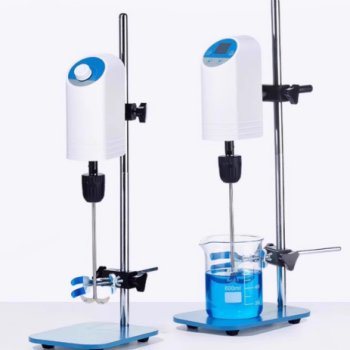
- High Performance Laboratory Stirrers for Diverse Applications
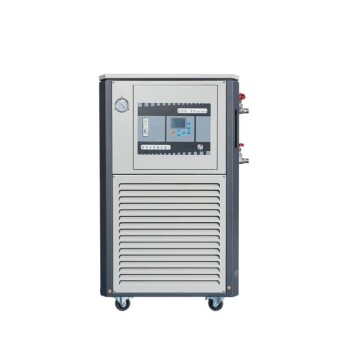
- High Temperature Constant Temperature Heating Circulator Water Bath Chiller Circulator for Reaction Bath
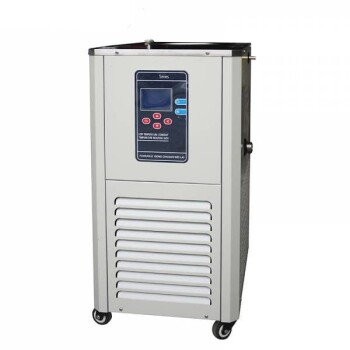
- 50L Chiller Water Bath Cooling Circulator Low Temperature Constant Temperature Reaction Bath
People Also Ask
- What role does a magnetic stirrer with heating play in ZnO nanoparticle synthesis? Precision Control for Quality Results
- What role does a constant temperature heating magnetic stirrer play in MFC-HAp synthesis? Achieve Material Homogeneity
- What is the function of a laboratory magnetic stirrer in Ni–Cr–P electrodeposition? Optimize Ion Transport & Coating
- Why is a laboratory magnetic stirrer required for benzoic acid esters? Boost Reaction Speed & Yield with High RPM
- What role does a laboratory magnetic stirrer play in TiO2 and TiO2-Ag sol preparation? Master Chemical Kinetics