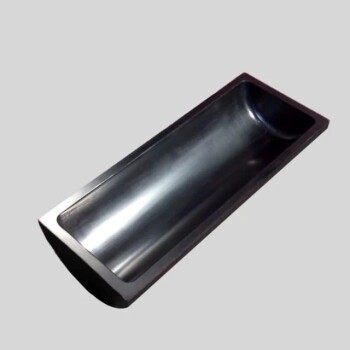
The use of a high-purity graphite box or plate is essential for controlling the chemical and thermal environment during selenization. Its primary function is to create a quasi-closed micro-reaction chamber that maintains a saturated selenium vapor pressure and ensures uniform heat distribution across the sample. This setup prevents the excessive loss of volatile selenium and facilitates the growth of high-quality, large-grained crystalline thin films.
A graphite box acts as a localized atmosphere stabilizer and thermal buffer. By containing selenium vapor and evening out temperature gradients, it transforms a standard tube furnace into a precision reactor capable of producing dense, defect-free semiconductor layers.
Maintaining the Vapor Pressure Microenvironment
Limiting Volatility and Selenium Loss
Selenium is highly volatile at the temperatures required for selenization. A high-purity graphite box provides a confined space that traps selenium vapor, preventing it from being swept away by the furnace's carrier gas.
Sustaining Saturated Vapor Pressure
By limiting the escape of vapor, the graphite box maintains a saturated vapor pressure directly at the sample surface. This high local concentration is critical for driving the chemical reaction to completion and ensuring the selenium atoms fully penetrate the precursor film.
Preventing Tin and Component Loss
In specific processes like CZTSSe fabrication, the graphite box also prevents the loss of other volatile elements, such as tin (Sn). This localized stability is vital for maintaining the correct stoichiometry (elemental balance) of the resulting thin film.
Thermal Management and Structural Integrity
Enhancing Temperature Uniformity
Graphite possesses superior thermal conductivity, which allows it to absorb and redistribute heat more evenly than the surrounding furnace atmosphere. This minimizes "cold spots" and ensures that the entire sample area reaches the reaction temperature simultaneously.
Reducing Structural Defects
By eliminating sharp thermal gradients, the graphite plate reduces thermal stress on the substrate. This uniform heating environment significantly lowers the density of structural defects and prevents cracking or peeling of the film during the transition from nanometer to micrometer grain sizes.
Promoting Large Grain Growth
The combination of stable vapor pressure and uniform heat facilitates the transition of grains into a high-performance absorption layer. This environment allows for the growth of large, high-quality crystalline grains, which are essential for efficient energy conversion in solar cells.
Chemical Stability and Equipment Longevity
Preventing Furnace Contamination
Without a graphite box, selenium vapor can react with or deposit on the internal components of the furnace tube. The box acts as a secondary containment vessel, protecting the quartz or ceramic tube and extending the operational life of the equipment.
High-Temperature Chemical Inertia
High-purity graphite is chosen because it remains chemically stable in reducing atmospheres and does not react with the sample or the selenium source. This ensures that no unwanted impurities are introduced into the film, preserving its purity and electrical properties.
Understanding the Trade-offs
While graphite boxes are highly effective, they introduce certain complexities to the process. The thermal mass of a heavy graphite box can increase the time required for both heating and cooling cycles, potentially slowing down high-throughput production.
Furthermore, the "quasi-closed" nature of the box means that the exact concentration of selenium vapor is highly dependent on the mechanical fit of the lid. If the seal is too tight, pressure may build up; if too loose, the saturated atmosphere is lost, leading to inconsistent results between different batches.
How to Apply This to Your Project
Making the Right Choice for Your Goal
- If your primary focus is maximizing grain size: Utilize a deep graphite box with a precision-machined lid to ensure the highest possible concentration of selenium vapor during the growth phase.
- If your primary focus is high-throughput testing: Use a thin graphite plate or a low-mass box to minimize thermal lag and allow for faster ramping of furnace temperatures.
- If your primary focus is film purity: Invest in the highest grade of "semiconductor-grade" high-purity graphite to prevent the outgassing of trace metals at temperatures exceeding 500°C.
Integrating a high-purity graphite environment is the most effective way to bridge the gap between a basic thermal treatment and a controlled chemical synthesis.
Summary Table:
| Function | Key Mechanism | Impact on Thin Film |
|---|---|---|
| Vapor Control | Maintains saturated Se vapor pressure | Prevents Se/Sn loss; ensures correct stoichiometry |
| Thermal Management | High thermal conductivity & distribution | Reduces defects; promotes large crystalline grain growth |
| Contamination Control | Acts as a secondary containment vessel | Prevents furnace tube corrosion; ensures high material purity |
| Structural Integrity | Minimizes sharp thermal gradients | Reduces thermal stress; prevents film cracking or peeling |
Elevate Your Semiconductor Research with KINTEK
Achieving the perfect crystalline structure requires more than just heat—it requires a precision-controlled environment. KINTEK specializes in high-performance laboratory equipment designed for advanced material synthesis.
From our precision tube and atmosphere furnaces to our ultra-high-purity graphite boxes, crucibles, and ceramic consumables, we provide the tools you need to maintain saturated vapor pressures and superior thermal uniformity. Whether you are developing CZTSSe solar cells or advanced thin films, our solutions minimize defects and maximize grain size.
Ready to optimize your selenization process? Contact KINTEK Experts Today to explore our range of furnaces and high-purity consumables tailored to your specific research goals.
References
- Xiao Xu, Qingbo Meng. Controlling Selenization Equilibrium Enables High-Quality Kesterite Absorbers for Efficient Solar Cells. DOI: 10.1038/s41467-023-42460-7
This article is also based on technical information from Kintek Solution Knowledge Base .
Related Products
- High Purity Pure Graphite Crucible for Evaporation
- High Purity Pure Graphite Crucible for Electron Beam Evaporation
- Ultra-High Temperature Graphite Vacuum Graphitization Furnace
- Horizontal High Temperature Graphite Vacuum Graphitization Furnace
- Vertical High Temperature Graphite Vacuum Graphitization Furnace
People Also Ask
- Why are high-purity graphite crucibles preferred for sulfide solid electrolytes? Achieve Superior Material Purity
- Why is a high-purity graphite crucible required for Chromel-TaC composites? Ensure Peak Purity at 1400°C
- What role do high-purity graphite crucibles play in molten salt corrosion research? Ensure Reactor-Grade Precision
- Why are high-purity graphite crucibles used for magnesium distillation? Ensure 3N8 Purity & Thermal Stability
- Why is a high-purity graphite crucible ideal for nitrogen-doped graphene at 1500 °C? Maximize Purity and Stability