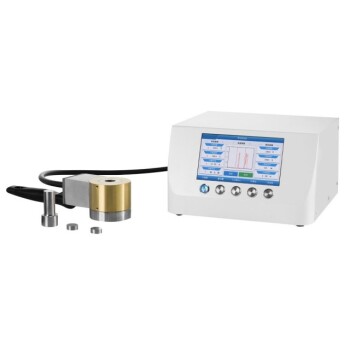
A laboratory hot press functions as a precision densification instrument in the fabrication of solvent-free polymer electrolyte (SPE) films. It applies simultaneous heat and mechanical pressure to transform a raw mixture of polymer and salt powders into a cohesive, transparent film without utilizing volatile liquid solvents.
The hot press eliminates the reliance on hazardous solvents, addressing safety concerns while significantly improving the film's physical structure. Its primary value lies in forcing the polymer to flow and densify, creating a uniform, pore-free material essential for high-performance solid-state batteries.
The Mechanics of Solvent-Free Preparation
Thermal Softening and Flow
The core function of the hot press is to induce a phase change in the polymer material. By applying specific temperatures (such as 100°C to 110°C), the heating plates soften the polymer and salt mixture.
This thermal energy causes the material to melt and flow. This transition allows the solid components to merge effectively without the need for a liquid medium to dissolve them.
Densification via Axial Pressure
While the material is softened, the press applies significant axial pressure (e.g., 8 MPa). This mechanical force is critical for densification, a process that compacts the material at a microscopic level.
This pressure eliminates internal pores and voids that naturally occur in powder mixtures. The result is a solid, continuous structure rather than a loosely packed aggregate.
Creation of Self-Supporting Films
The combination of heat and pressure transforms the mixed powder directly into a film. Unlike solution casting, which requires drying time, this method produces a self-supporting polymer electrolyte film immediately upon cooling.
These films are typically transparent and possess the structural integrity required to be handled and integrated into battery assemblies.
Enhancing Material Properties
Achieving Uniformity
A primary challenge in electrolyte preparation is maintaining consistent thickness and composition. The laboratory hot press ensures uniformity across the entire surface area of the film.
By applying force evenly between two flat plates, the machine guarantees that the resulting film has a consistent thickness, which is vital for predictable electrical performance.
Improving Mechanical Strength
Solvent-based methods can sometimes leave microscopic defects or residues that weaken the film. The hot press method enhances mechanical strength by physically fusing the polymer chains and salts together under pressure.
This results in a robust material that can better withstand the physical stresses within a battery cell.
Critical Process Parameters
While the hot press method offers significant advantages, it relies entirely on the precision of control. The equipment must maintain exact temperature and pressure levels to succeed.
If the temperature is too low, the polymer will not flow sufficiently to encapsulate the salts. Conversely, if the pressure is uneven, the film will suffer from density gradients, leading to potential failure points in the final electrolyte.
Making the Right Choice for Your Goal
The laboratory hot press is the preferred tool when safety and structural density are paramount.
- If your primary focus is Safety and Purity: Choose this method to eliminate volatile organic solvents and ensure the film is free of chemical residues.
- If your primary focus is Structural Integrity: Rely on the hot press to eliminate internal pores and maximize the mechanical strength of the electrolyte film through high-pressure densification.
The laboratory hot press transforms the electrolyte fabrication process from a chemical dissolution task into a precise thermo-mechanical operation, yielding safer and stronger solid-state materials.
Summary Table:
| Function | Mechanism | Benefit for SPE Films |
|---|---|---|
| Thermal Softening | Controlled heating plates (100°C+) | Melts polymer/salt mixtures without hazardous solvents |
| Densification | Axial pressure (e.g., 8 MPa) | Eliminates internal pores for a continuous, void-free structure |
| Film Formation | Simultaneous heat & pressure | Produces robust, self-supporting films ready for immediate use |
| Uniformity Control | Precision flat-plate compression | Ensures consistent film thickness and predictable electrical performance |
Elevate Your Solid-State Battery Research with KINTEK
Precision is the key to high-performance electrolyte fabrication. At KINTEK, we specialize in providing advanced laboratory hydraulic presses (pellet, hot, and isostatic) designed to meet the rigorous demands of SPE film production.
Our thermal and mechanical solutions ensure your research benefits from:
- Superior Densification: Eliminate voids for maximum ionic conductivity.
- Enhanced Safety: Shift to solvent-free workflows with reliable heating systems.
- Unmatched Uniformity: Achieve consistent film thickness with precision-engineered plates.
Beyond hot presses, KINTEK offers a comprehensive range of crushing systems, muffle furnaces, and high-temperature reactors to support your entire material synthesis lifecycle.
Ready to optimize your lab's output? Contact KINTEK today for a consultation and custom quote!
Related Products
- 30T 40T Split Automatic Heated Hydraulic Press Machine with Heated Plates for Laboratory Hot Press
- Heated Hydraulic Press Machine with Heated Plates Split Manual Laboratory Hot Press
- Automatic Heated Hydraulic Press Machine with Heated Plates for Laboratory Hot Press
- Automatic Laboratory Heat Press Machine
- 24T 30T 60T Heated Hydraulic Press Machine with Heated Plates for Laboratory Hot Press
People Also Ask
- What are the advantages of using a laboratory hydraulic press for hot pressing? Achieve Peak Nano-Composite Density
- What are the core advantages of using a laboratory hot press to produce Bi2Se3? Achieve 93% Density & High Conductivity
- Why is a laboratory hydraulic hot press essential for high-density, additive-free Silicon Carbide? Unlock Pure SiC.
- How does a laboratory hydraulic hot press ensure the quality of PHBV/natural fiber composites? Expert Guide
- What is the function of a laboratory hydraulic hot press in the assembly of solid-state photoelectrochemical cells?