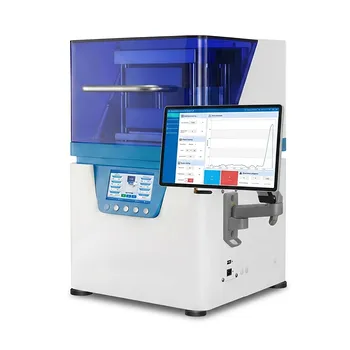
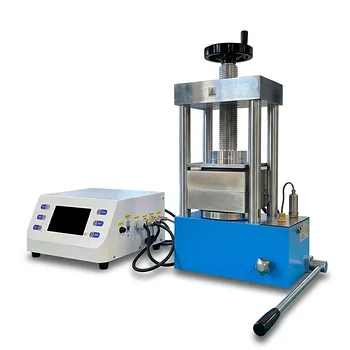
The laboratory hydraulic press functions as a precision molding instrument that applies high uniaxial pressure to transform loose semi-coke particles into a cohesive green ball. By delivering specific pressures, such as 93.63 MPa, the press forces particles to overcome displacement friction and rearrange into a dense, structurally sound "green body." This process ensures the material has sufficient mechanical strength and particle-to-particle contact for subsequent mineralization and high-temperature consolidation.
Core Takeaway: The laboratory hydraulic press is essential for overcoming internal friction and forcing semi-coke particles into a tightly packed arrangement. This mechanical compaction creates the necessary physical foundation and structural integrity required for the specimen to survive further thermal processing.
The Mechanism of Particle Consolidation
Overcoming Displacement Friction
In their loose state, semi-coke particles resist movement due to displacement friction. The hydraulic press applies a controlled axial force that overcomes this resistance, allowing individual particles to slide and shift.
Facilitating Particle Rearrangement
As the pressure increases, the particles undergo rearrangement, filling the voids between them. This shift results in a more efficient packing structure, which is the first step toward creating a solid mass from powder.
Achieving Geometric Precision
The press works in tandem with specialized molds to produce green balls with defined geometric shapes. This standardization is critical for ensuring uniform results during high-precision measurements or subsequent industrial testing.
Enhancing Structural Integrity and Density
Bonding Through Binder Interaction
The high-pressure environment of the press ensures that semi-coke particles bond tightly under the influence of a binder. This interaction creates a green body with the mechanical strength necessary for handling without the risk of crumbling.
Reducing Inter-particle Distance
By minimizing the physical distance between particles, the press enhances inter-particle contact. This proximity is vital for facilitating diffusion-controlled solid-state chemical reactions during later stages of heating.
Increasing Packing Density
Precision compaction significantly increases the packing density of the green ball. Higher initial density reduces the amount of volume shrinkage that occurs during high-pressure consolidation or sintering, preserving the final specimen’s dimensions.
Understanding the Trade-offs
The Risk of Non-Uniform Density
Applying pressure uniaxially can sometimes lead to density gradients within the green ball. If the pressure is not distributed evenly, certain areas may be denser than others, potentially leading to warping or cracking during the sintering process.
Pressure Limits and Material Deformation
While high pressure is necessary for strength, exceeding the material's limits can cause particle fracture or air entrapment. Conversely, insufficient pressure results in a fragile green body that lacks the structural prototype needed for further densification.
How to Apply This to Your Project
When utilizing a laboratory hydraulic press for semi-coke preparation, your approach should vary based on your specific research or production objectives.
- If your primary focus is subsequent high-temperature sintering: Ensure you apply sufficient pressure to maximize particle contact, as this directly influences the efficiency of solid-state chemical reactions.
- If your primary focus is structural testing or handling: Prioritize the use of a binder and precise pressure control to achieve the mechanical strength required to prevent deformation.
- If your primary focus is high-precision measurement (e.g., dilatometry): Use precision molds and slow pressure release to ensure a uniform internal density and a regular geometric shape.
The laboratory hydraulic press is the foundational tool that bridges the gap between loose raw powders and a viable, structurally intact specimen ready for advanced thermal analysis.
Summary Table:
| Key Mechanism | Action of the Press | Benefit to Specimen |
|---|---|---|
| Friction Overcoming | Applies high uniaxial pressure (e.g., 93.63 MPa) | Allows particles to slide and rearrange efficiently |
| Particle Rearrangement | Forces particles into voids and tight packing | Maximizes initial density for thermal processing |
| Binder Interaction | Promotes tight bonding between particles | Increases mechanical strength and prevents crumbling |
| Geometric Molding | Uses specialized dies and molds | Ensures uniform shape and size for precision testing |
| Inter-particle Contact | Minimizes physical distance between particles | Facilitates solid-state reactions during sintering |
Elevate Your Material Research with KINTEK Precision
Maximize the structural integrity and density of your specimens with KINTEK’s advanced laboratory hydraulic presses. Our range of pellet, hot, and isostatic presses is engineered to deliver the precise uniaxial force required for semi-coke preparation, ensuring uniform density and superior mechanical strength for your research.
As a leader in laboratory equipment, KINTEK offers a comprehensive portfolio beyond compaction, including:
- High-Temperature Furnaces: Muffle, tube, vacuum, and CVD systems.
- Sample Preparation: Crushing, milling, and sieving equipment.
- Specialized Reactors: High-temperature high-pressure reactors and autoclaves.
- Lab Consumables: High-quality ceramics, crucibles, and PTFE products.
Whether you are focusing on high-precision measurements or industrial-scale testing, KINTEK provides the reliability and technical support you need. Contact our experts today to discover how our high-performance solutions can streamline your laboratory workflow!
References
- Zhengqi Guo, Siwei Li. Clean Preparation of Formed Coke from Semi-coke by the Carbonated Consolidation Process. DOI: 10.1021/acsomega.3c02519
This article is also based on technical information from Kintek Solution Knowledge Base .
Related Products
- Ball Press Mold for Lab
- Fully Automatic Heated Hydraulic Lab Press for Materials Sintering and Sample Preparation
- Laboratory Hydraulic Press Split Electric Lab Pellet Press
- Automatic Laboratory Hydraulic Press for XRF & KBR Pellet Press
- Manual Lab Heat Press
People Also Ask
- What are the advantages of using a laboratory hydraulic press for hot pressing? Achieve Peak Nano-Composite Density
- How to use a press mold? Master the Art of Creating Consistent Ceramic Forms
- What is the press mould method? A Guide to Consistent, Detailed Ceramic Forms
- What is the purpose of specialized pressure devices in sulfide solid-state batteries? Ensure Chemo-Mechanical Stability
- Why are pressure molds with non-conductive resin inner walls required for battery testing? Ensure Data Accuracy