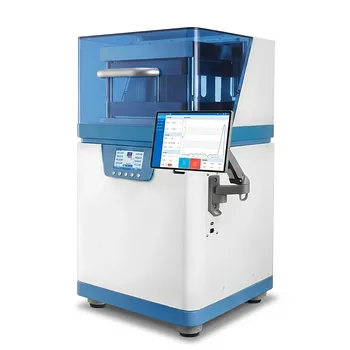
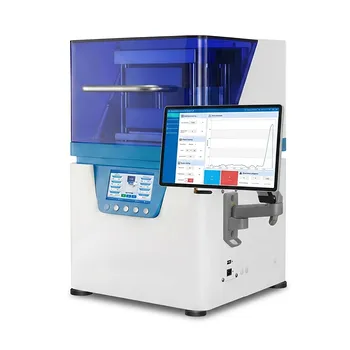
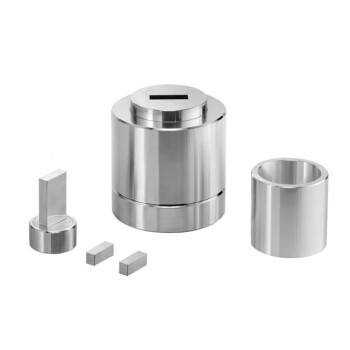
The laboratory manual hydraulic press is the essential tool for transforming loose metallurgical powders into dense, reactive briquettes. By applying precise axial pressure—typically around 20 MPa—this equipment compresses mixtures of blast furnace dust and iron concentrate into specific geometric dimensions. This mechanical densification is a prerequisite for subsequent high-temperature processing, as it ensures the structural and chemical readiness of the material.
The central takeaway is that hydraulic compaction maximizes the contact area between raw materials, reductants, and fluxes. This physical proximity is the primary driver for efficient solid-phase reactions and the effective removal of harmful elements during the reduction process.
Enhancing Chemical Reactivity through Densification
Reducing Inter-particle Porosity
Loose powders contain significant air gaps that act as thermal and chemical barriers. The hydraulic press applies quasi-static pressure to force particle rearrangement, effectively eliminating these voids.
This reduction in porosity creates a "green compact" with a much higher volumetric density than the starting material. By minimizing the distance between particles, the press prepares the briquette for efficient heat transfer.
Maximizing the Contact Area for Reduction
For solid-phase reactions to occur, the iron concentrate must be in direct contact with reductants and fluxes. The press ensures that these different components are mechanically bonded and tightly packed.
Increased contact area directly accelerates the high-temperature reduction process. This is critical for the chemical transformation of iron oxides into metallic iron within a furnace environment.
Structural Integrity and Physical Properties
Achieving Uniform Green Density
A manual hydraulic press allows researchers to control the dwell time and pressure load precisely. This control is vital for achieving a uniform internal density across the entire briquette.
Consistent density prevents the formation of internal gradients, which could lead to cracks or total structural failure during subsequent sintering. A stable briquette maintains its shape even under the intense thermal stress of a blast furnace.
Facilitating the Removal of Volatile Impurities
Blast furnace dust often contains harmful elements that must be removed to protect the quality of the final metal. The dense structure created by the press promotes the removal efficiency of these impurities during heating.
By optimizing the particle-to-particle contact, the chemical reactions that volatilize these harmful elements can proceed more completely. This results in a cleaner refined product and better industrial yields.
Understanding the Trade-offs and Limitations
The Risk of Over-Pressurization
Applying pressure beyond the optimal threshold (such as exceeding 20-30 MPa unnecessarily) can lead to pressure cracking or "capping." This occurs when trapped air or elastic recovery causes the briquette to delaminate upon release from the mold.
Finding the specific balance between density and structural integrity is a key part of the laboratory phase. Every material blend has a "saturation point" where additional pressure no longer improves performance.
Limitations of Manual Operation
While manual presses offer high precision for small-scale testing, they are limited by low throughput. The data gathered is used to establish parameters like forming pressure and holding time for industrial-scale equipment.
Manual systems also rely on the operator to maintain consistent dwell times. Variations in how long the pressure is held can lead to slight discrepancies in the mechanical strength of the resulting briquettes.
How to Apply This to Your Project
The use of a manual hydraulic press should be tailored to the specific metallurgical goals of your research or pilot program.
- If your primary focus is maximizing reaction kinetics: Prioritize achieving the highest density possible without causing structural cracks to ensure maximum particle contact.
- If your primary focus is removing harmful volatile elements: Focus on the precise blend of fluxes and use the press to ensure these fluxes are perfectly dispersed and in contact with the dust particles.
- If your primary focus is industrial scaling: Use the manual press to identify the exact minimum pressure required to achieve structural stability, which will reduce energy costs in full-scale production.
By mastering the pressure parameters of the laboratory hydraulic press, you create the necessary physical foundation for successful metallurgical reduction and waste recycling.
Summary Table:
| Key Function | Technical Benefit | Impact on Metallurgical Process |
|---|---|---|
| Densification | Reduces inter-particle porosity | Enhances thermal conductivity and heat transfer |
| Contact Maximization | Increases surface contact area | Accelerates solid-phase reactions and reduction |
| Structural Integrity | Achieves uniform green density | Prevents cracking and failure during high-temp sintering |
| Impurity Volatilization | Optimizes chemical proximity | Improves the removal efficiency of harmful elements |
Precision Compaction for Your Metallurgical Research
At KINTEK, we understand that the quality of your research depends on the precision of your equipment. Our high-performance laboratory manual and pellet hydraulic presses are engineered to provide the exact pressure control—up to and beyond 20 MPa—needed to create dense, stable briquettes from metallurgical powders.
Beyond compaction, KINTEK offers a comprehensive ecosystem for material science, including:
- High-Temperature Furnaces: Muffle, tube, and vacuum furnaces for reduction studies.
- Preparation Tools: Crushing, milling, and sieving systems for perfect powder consistency.
- Essential Consumables: High-purity ceramics, crucibles, and PTFE products.
Ready to enhance your lab’s efficiency and achieve superior material reactivity? Contact KINTEK today for a customized solution!
References
- Guiqing Zhao, Jian Zu. Removal behavior of Zn and alkalis from blast furnace dust in pre-reduction sinter process. DOI: 10.1515/gps-2023-0045
This article is also based on technical information from Kintek Solution Knowledge Base .
Related Products
- Automatic Laboratory Hot Press 400x400 mm with Programmable High Temperature and Hydraulic Force Control
- Fully Automatic Heated Hydraulic Lab Press for Materials Sintering and Sample Preparation
- Laboratory Manual Hydraulic Pellet Press for Lab Use
- Laboratory Manual Hydraulic Pellet Press for Lab Use
- Manual Lab Heat Press
People Also Ask
- What is the primary function of a laboratory hot press in MEA assembly? Optimize Fuel Cell Bonding & Performance
- What specific conditions does a laboratory hot press provide for the assembly of fuel cell MEA? Expert Bond Tips.
- How do a laboratory hydraulic hot press and standardized steel molds ensure the quality of WPC test specimens?
- What are the core advantages of using a laboratory hot press to produce Bi2Se3? Achieve 93% Density & High Conductivity
- How does a laboratory heating hydraulic press contribute to the preparation of recycled graphite green bodies? - Optimize Density.