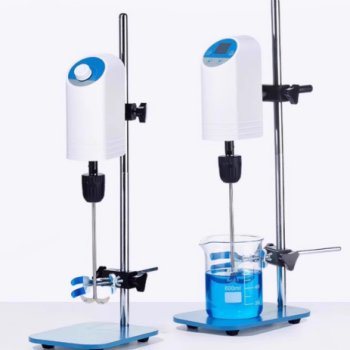
A mechanical stirrer functions as a catalyst for mass transfer. It actively forces the circulation of fishmeal wastewater, driving organic pollutants directly toward the anode surface. By disrupting stagnant fluid layers, it ensures pollutants are continuously exposed to the electrode's active sites, directly boosting the removal of Total Organic Carbon (TOC).
Core Takeaway: Mechanical stirring overcomes the limitations of natural diffusion by physically transporting reactants to the electrode interface. This active circulation disrupts the concentration polarization layer, leading to a potential improvement in TOC removal efficiency of approximately 10% compared to static or manual methods.
Mechanisms of Enhanced Oxidation
To understand why stirring is effective, you must look at how the pollutants physically interact with the electrode.
Increasing Mass Transfer Rates
The fundamental limitation in many electrochemical processes is not the reaction speed, but the delivery speed.
In a static system, pollutants must rely on slow diffusion to reach the electrode. A mechanical stirrer provides forced circulation. This physically pushes the fishmeal wastewater components toward the anode much faster than they would move naturally.
Maximizing Active Site Contact
Electro-oxidation is a surface-dependent process. The reaction only happens when the organic pollutant touches the active sites on the electrode.
Mechanical stirring ensures that fresh, untreated wastewater constantly replaces the treated water at the anode's surface. This keeps the active sites fully utilized and prevents the process from stalling due to a lack of reactants.
Disrupting the Polarization Layer
The most critical technical function of the stirrer is the disruption of chemical barriers that form during operation.
The Problem of Stagnation
Without agitation, a phenomenon known as the concentration polarization layer develops.
This is a thin zone of liquid immediately next to the anode where the concentration of pollutants drops significantly because they have already been oxidized. This depleted layer acts as a buffer, preventing new pollutants from reaching the electrode.
Breaking the Barrier
Mechanical agitation continuously disrupts this polarization layer.
By homogenizing the solution, the stirrer prevents the formation of a depleted zone. It ensures that the concentration of organic pollutants near the anode remains high, maintaining the driving force necessary for efficient oxidation.
Understanding the Operational Trade-offs
While the benefits are clear, introducing mechanical components requires a balanced view of the system's complexity.
Energy Input vs. Removal Gains
Implementing a mechanical stirrer yields an efficiency improvement of roughly 10% or more.
However, this comes at the cost of additional energy consumption to power the motor. You are essentially trading a small amount of mechanical energy for a significant gain in electrochemical efficiency.
Mechanical Complexity
Compared to static or manual stirring methods, a mechanical system introduces moving parts.
While this automates the process and ensures consistency, it introduces a component that requires maintenance. In contrast, static systems are simpler but suffer from the mass transfer limitations described above.
Making the Right Choice for Your Goal
Deciding whether to implement mechanical stirring depends on your specific efficiency targets for treating fishmeal wastewater.
- If your primary focus is maximizing oxidation efficiency: Implement mechanical stirring to break the polarization layer and achieve the potential ~10% increase in TOC removal.
- If your primary focus is process consistency: Use mechanical stirring to ensure uniform mass transfer, eliminating the variability inherent in manual stirring methods.
By converting a static environment into a dynamic one, you ensure the electrochemical cell operates at its full potential rather than being limited by how fast fluid can move.
Summary Table:
| Feature | Static System | Mechanical Stirring |
|---|---|---|
| Mass Transfer | Slow (Natural Diffusion) | Rapid (Forced Circulation) |
| Polarization Layer | Thick/Stagnant | Constantly Disrupted |
| TOC Removal Efficiency | Baseline | ~10% Improvement |
| Consistency | Low/Variable | High/Automated |
| Active Site Utilization | Limited by Delivery | Maximized Replacement |
Optimize Your Electrochemical Wastewater Treatment with KINTEK
Are you looking to maximize TOC removal efficiency and ensure consistent results in your wastewater treatment processes? KINTEK specializes in precision laboratory equipment and consumables designed for high-performance research and industrial applications.
From high-quality electrolytic cells and electrodes to essential magnetic and mechanical stirring solutions, we provide the tools needed to overcome mass transfer limitations and achieve superior oxidation rates. Our extensive portfolio also includes high-temperature furnaces, high-pressure reactors, and battery research tools, ensuring your lab is equipped for every challenge.
Ready to enhance your process efficiency by 10% or more? Contact KINTEK today to discover how our expert solutions can streamline your laboratory operations and deliver precise, repeatable results.
References
- Raju Meganathan, Rajagopalan Varadarajan. Electro-oxidation of fish meal industry wastewater in a stirred batch reactor using a Ti/RuO2 anode. DOI: 10.2166/wpt.2021.087
This article is also based on technical information from Kintek Solution Knowledge Base .
Related Products
- High Performance Laboratory Stirrers for Diverse Applications
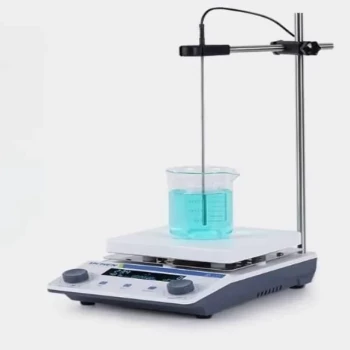
- Laboratory Small Constant Temperature Heated Magnetic Stirrer Heater and Stirrer
- Custom PTFE Teflon Parts Manufacturer for Magnetic Stirring Bar
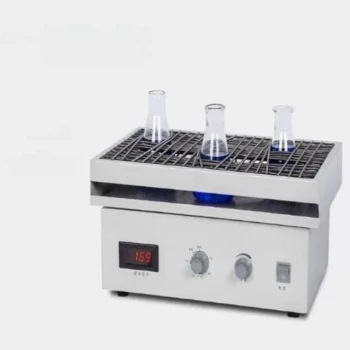
- Laboratory Multifunctional Small Speed-Adjustable Horizontal Mechanical Shaker for Lab
People Also Ask
- How does a laboratory stirrer influence MOF product quality? Master Precision in Non-Solvothermal Synthesis
- What critical role does a Laboratory Stirrer play during leaching? Enhance Titanium-Magnesium Waste Recovery
- What is the primary function of laboratory stirring equipment in the preparation of compost leachate? Optimize Extraction
- What is a laboratory mixer? A Guide to Achieving Perfect Sample Homogeneity
- What is a laboratory mixer used for? Choose the Right Tool for Liquids or Solids