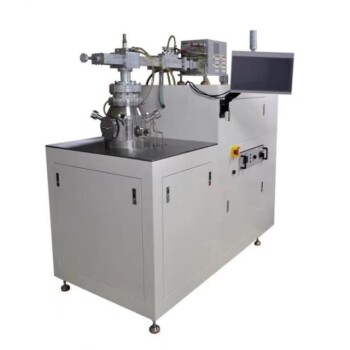
The function of a Microwave Plasma Enhanced Chemical Vapor Deposition (CVD) system in this context is to act as a high-precision reactor that facilitates the direct growth of Diamond Nanospikes (DNS). By exciting a specific gas mixture of methane, hydrogen, and nitrogen into a high-energy plasma, the system creates a controlled environment that synthesizes extremely dense, needle-like nanostructures in a single step, eliminating the need for complex, multi-stage micro-fabrication.
Core Takeaway The MW-CVD system does not merely coat a surface; it actively manipulates the geometry of crystal growth. By introducing nitrogen into the plasma environment, the system biases the growth direction of diamond grains, forcing them to grow vertically rather than spreading horizontally, resulting in sharp, high-aspect-ratio spikes.
Creating the Plasma Environment
Microwave Excitation
The core mechanism of the MW-CVD system involves directing microwaves into a reaction chamber to create a glow discharge.
This high-frequency microwave field intensifies electron vibrations within the gas mixture. As electron activity increases, collisions between gas atoms and molecules accelerate, resulting in a high ionization rate.
Chemical Decomposition
The intense environment within the furnace facilitates the chemical decomposition of precursor gases.
Typically, methane serves as the carbon source, while hydrogen creates the necessary reducing environment. The system creates a stable, high-temperature setting that ensures atomic-level bonding and the purity of the diamond phase.
The Role of Atomic Hydrogen
The plasma generates a high concentration of dissociated atomic hydrogen.
This component is critical for quality control during synthesis. Atomic hydrogen effectively etches away non-diamond phases (such as graphite) as they form, ensuring that the resulting film or structure maintains the high quality and chemical inertness associated with pure diamond.
Controlling Morphology via Chemistry
The Critical Role of Nitrogen
While methane and hydrogen create the diamond material, nitrogen is the architect of the "nanospike" shape.
The MW-CVD system introduces high levels of nitrogen to regulate the growth direction of the diamond grains. Nitrogen atoms induce oriented preferential growth from nucleation points.
Vertical vs. Circumferential Growth
The presence of nitrogen ensures that the vertical growth rate significantly exceeds the circumferential (horizontal) growth rate.
Instead of merging into a smooth, continuous film, the diamond crystals grow upward rapidly. This differential growth rate is what physically produces the sharp, needle-like nanospike structures required for applications like bactericidal surfaces.
One-Step Synthesis Efficiency
The MW-CVD system allows for a "one-step" synthesis process.
Traditional methods for creating topography-mediated surfaces often require complex micro-nanofabrication steps, such as lithography or post-growth etching. The MW-CVD system achieves the final high-aspect-ratio topography directly through the precise adjustment of deposition parameters, streamlining production.
Understanding the Operational Requirements
Sensitivity of Parameters
The synthesis of Diamond Nanospikes is highly sensitive to the "precise adjustment" of deposition parameters.
Success relies on maintaining the exact balance of gas ratios (specifically nitrogen) and plasma energy. A deviation in the reaction environment could revert the growth mechanism to a standard film deposition, losing the unique nanospike topography.
Energy and Environment
The process requires a high-energy plasma and a stable high-temperature environment.
While effective, this requires robust equipment capable of sustaining extreme conditions to ensure the purity and structural integrity of the diamond phase.
Making the Right Choice for Your Goal
The MW-CVD system is a versatile tool, but its application depends on how you manipulate the gas chemistry.
- If your primary focus is creating bactericidal or high-surface-area interfaces: Prioritize high nitrogen concentrations to induce the preferential vertical growth necessary for sharp nanospikes.
- If your primary focus is protective coating or electrical insulation: Minimize nitrogen to favor standard Nanocrystalline Diamond (NCD) film growth, which prioritizes a smooth, continuous barrier over topographic features.
Ultimately, the MW-CVD system empowers you to switch between growing flat protective films and complex 3D nanostructures simply by tuning the chemical composition of the plasma.
Summary Table:
| Feature | Microwave PECVD Function | Benefit for Diamond Nanospikes |
|---|---|---|
| Plasma Source | Microwave excitation of $CH_4$, $H_2$, $N_2$ | High ionization for rapid chemical decomposition |
| Growth Control | Nitrogen-induced preferential growth | Forces vertical spikes over horizontal film formation |
| Phase Purity | Atomic hydrogen etching | Removes graphite to ensure pure diamond phase |
| Process Efficiency | One-step direct synthesis | Eliminates complex lithography or post-growth etching |
| Morphology | High-aspect-ratio tuning | Creates sharp, needle-like bactericidal surfaces |
Elevate your materials research with KINTEK’s advanced CVD technology. Whether you are synthesizing sharp diamond nanospikes for bactericidal surfaces or high-purity nanocrystalline films, KINTEK specializes in high-performance laboratory equipment including high-temperature CVD/PECVD systems, MPCVD reactors, and vacuum furnaces. Our precision-engineered systems provide the stable plasma environments and sensitive parameter control required for cutting-edge nanostructure synthesis. Consult with a KINTEK specialist today to find the perfect reactor, milling system, or high-pressure solution for your laboratory’s unique requirements.
References
- William F. Paxton, Muhammad Zain Akram. A scalable approach to topographically mediated antimicrobial surfaces based on diamond. DOI: 10.1186/s12951-021-01218-3
This article is also based on technical information from Kintek Solution Knowledge Base .
Related Products
- 915MHz MPCVD Diamond Machine Microwave Plasma Chemical Vapor Deposition System Reactor
- Microwave Plasma Chemical Vapor Deposition MPCVD Machine System Reactor for Lab and Diamond Growth
- Cylindrical Resonator MPCVD Machine System Reactor for Microwave Plasma Chemical Vapor Deposition and Lab Diamond Growth
- Chemical Vapor Deposition CVD Equipment System Chamber Slide PECVD Tube Furnace with Liquid Gasifier PECVD Machine
- RF PECVD System Radio Frequency Plasma-Enhanced Chemical Vapor Deposition RF PECVD
People Also Ask
- How does a microwave plasma reactor facilitate the synthesis of diamond? Master MPCVD with Precision Technology
- What are the advantages of a Microwave Plasma CVD reactor for MCD/NCD coatings? Precision Multilayer Diamond Engineering
- How do vacuum pumps and valves collaborate in MPCVD? Achieve Precise Pressure Control for Superior CNT Synthesis
- What are the primary advantages of the CVD method for growing diamonds? Engineering High-Purity Gems and Components
- How is a diamond formed from CVD? The Science of Growing Diamonds Atom by Atom