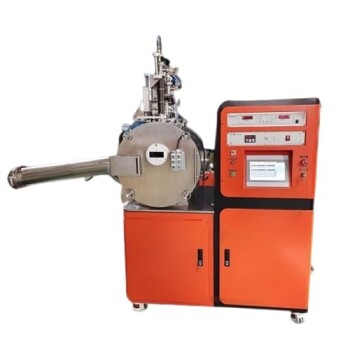
The primary function of a vacuum arc melting furnace in preparing Alx(CrFeNi)1-x alloys is to create a chemically homogeneous, contamination-free ingot from constituent metals with vastly different physical properties.
By utilizing a high-energy electric arc, the furnace generates the extreme heat necessary to rapidly melt and mix iron, chromium, nickel, and aluminum powders at the atomic level. Simultaneously, it maintains a strictly controlled vacuum or inert gas environment to prevent the oxidation of reactive elements like aluminum and chromium, ensuring the final alloy retains its intended single-phase FCC or BCC structure.
Core Insight: The vacuum arc melting furnace is not merely a heating device; it is a compositional stabilizer. Its ability to prevent oxidation while melting elements with disparate melting points is the only way to guarantee the precise stoichiometry required for the "cocktail effect" central to high-entropy alloy performance.
Achieving Atomic-Level Homogeneity
Overcoming Melting Point Disparities
High-entropy alloys (HEAs) like Alx(CrFeNi)1-x combine elements with significantly different melting points. Aluminum melts at roughly 660°C, while Chromium melts at over 1900°C.
The furnace uses a high-energy electric arc to generate localized temperatures intense enough to melt the refractory components (Cr, Fe, Ni) rapidly. This ensures that the lower-melting-point aluminum is fully integrated into the solution rather than separating or evaporating before the other metals melt.
The Mechanism of Mixing
Achieving a true solid solution requires more than a single melting pass.
To ensure uniform distribution of the "x" value (the aluminum content) throughout the matrix, the alloy ingot is typically subjected to multiple flip-remelting cycles. The ingot is solidified, flipped, and remelted—often 4 to 5 times—to eliminate segregation and ensure the atoms are mixed uniformly.
Preventing Contamination via Electrode Design
Standard arc furnaces often use non-consumable tungsten electrodes.
Because the tungsten withstands the arc's heat without melting, it does not introduce foreign impurities into the Al-Cr-Fe-Ni mix. This maintains the high purity required for research-grade or aerospace-grade HEAs.
Preserving Material Integrity
Shielding Reactive Elements
Both Aluminum and Chromium have a high affinity for oxygen. If melted in air, they would immediately form brittle oxides/slag, ruining the alloy's mechanical properties.
The furnace operates under a high vacuum or a protective high-purity argon atmosphere. This creates an exclusion zone where oxygen cannot interact with the melt, ensuring that the final material is a metallic alloy rather than a composite of metal and oxide inclusions.
Ensuring Compositional Accuracy
The mechanical properties of Alx(CrFeNi)1-x transition from ductile (FCC) to strong/brittle (BCC) depending strictly on the Aluminum ratio.
By preventing oxidation losses, the furnace ensures the actual composition matches the nominal (calculated) composition. This precision allows researchers to accurately correlate the Aluminum fraction ("x") with changes in crystal structure and hardness.
Understanding the Trade-offs
The Risk of Element Evaporation
While the vacuum removes oxygen, it can also lower the boiling point of volatile elements like Aluminum or Manganese.
If the vacuum is too high during the liquid phase, Aluminum may evaporate, shifting the alloy's composition. Skilled operators often backfill the chamber with partial pressure Argon to suppress evaporation while still preventing oxidation.
Localized Thermal Gradients
The electric arc provides intense localized heat, which can create steep thermal gradients within the water-cooled copper crucible.
While this allows for rapid cooling (beneficial for certain microstructures), it necessitates the previously mentioned flip-remelting cycles. Without flipping, the bottom of the ingot may not mix as thoroughly as the top.
Making the Right Choice for Your Goal
How to Apply This to Your Project
- If your primary focus is Phase Analysis (FCC vs. BCC): Prioritize multiple remelting cycles (5+). Even slight segregation of Aluminum can cause mixed-phase regions that skew XRD data.
- If your primary focus is Mechanical Testing: Ensure the furnace utilizes a water-cooled copper crucible. This prevents crucible material from contaminating the melt, which acts as a stress concentrator during tensile testing.
The vacuum arc melting furnace is the gatekeeper of quality for HEAs, determining whether you produce a high-performance alloy or a compromised mixture of oxides and segregated metals.
Summary Table:
| Feature | Function in HEA Preparation | Impact on Alx(CrFeNi)1-x |
|---|---|---|
| High-Energy Electric Arc | Rapidly melts refractory elements like Cr and Fe | Ensures full integration of disparate melting point metals |
| Inert/Vacuum Environment | Prevents oxidation of reactive Al and Cr | Maintains intended FCC/BCC crystal structure and purity |
| Multiple Remelting Cycles | Eliminates elemental segregation | Achieves the uniform stoichiometry required for the 'cocktail effect' |
| Water-Cooled Crucible | Provides rapid solidification and zero contamination | Prevents impurities from entering high-performance alloy matrices |
Elevate Your Material Research with KINTEK Precision
Don't let oxidation or segregation compromise your high-entropy alloy performance. KINTEK specializes in advanced laboratory solutions, offering high-performance vacuum arc melting furnaces and induction melting systems designed for the rigors of modern metallurgy.
Our comprehensive portfolio supports every stage of your research, from crushing and milling systems for powder preparation to high-temperature furnaces and isostatic presses for advanced material processing. Whether you are developing aerospace-grade HEAs or conducting battery research, our team provides the expert tools and consumables—including ceramics, crucibles, and high-purity electrodes—to ensure your results are reproducible and accurate.
Ready to achieve atomic-level homogeneity? Contact KINTEK today to discuss your specific laboratory equipment needs and discover how our technology can accelerate your next breakthrough.
References
- Dongwei Luo, Nan Qiu. Corrosion Behavior of Alx(CrFeNi)1−x HEA under Simulated PWR Primary Water. DOI: 10.3390/ma15144975
This article is also based on technical information from Kintek Solution Knowledge Base .
Related Products
- Non Consumable Vacuum Arc Induction Melting Furnace
- Vacuum Induction Melting Spinning System Arc Melting Furnace
- Vacuum Arc Induction Melting Furnace
- Lab-Scale Vacuum Induction Melting Furnace
- Vacuum Heat Treat Furnace and Levitation Induction Melting Furnace
People Also Ask
- What are the advantages of induction melting furnace? Achieve Purity, Efficiency, and Safety
- What is the use of induction melting furnace? Achieve Fast, Clean, and Precise Metal Melting
- What is the temperature range of the induction melting furnace? Find the Right Heat for Your Metals
- How do specialized industrial-grade small melting furnaces address challenges in precision jewelry casting? Expert Guide
- How do vacuum induction or arc melting furnaces facilitate the synthesis of U-Al-C MAX phases? Precision Heat & Purity