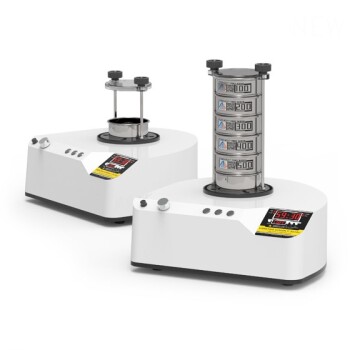
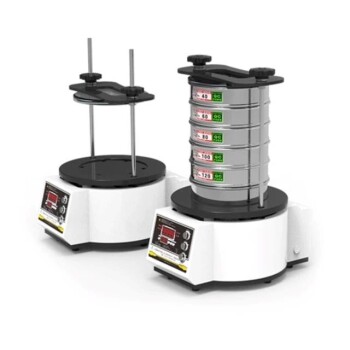
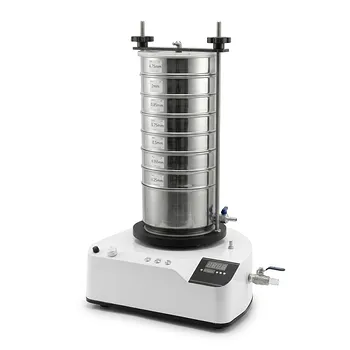
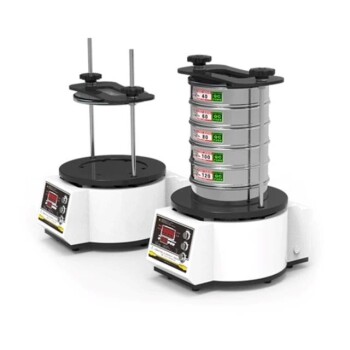
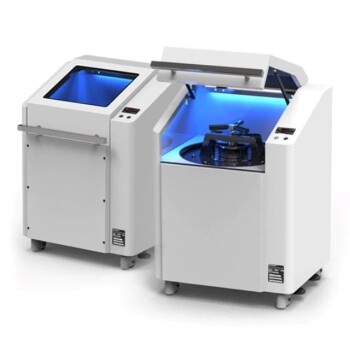
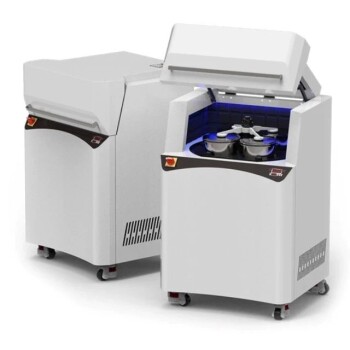
The primary function of an electronic vibrating sieve is the precise classification of raw materials. In the production of dolomite-based porous ceramic carriers, this device ensures that crushed aggregates, specifically dolomite and quartz sand, are filtered to a fine particle size of 300 to 400 mesh. Additionally, it processes pore-forming agents to meet a specific standard of 120 to 160 mesh.
Core Takeaway The vibrating sieve acts as the critical gatekeeper for material quality. By enforcing strict particle size limits, it ensures the uniformity of the ceramic's microstructure, which is the defining factor for both consistent porosity and the mechanical strength of the final product.
The Critical Role of Particle Classification
The electronic vibrating sieve transforms raw, crushed material into a usable, standardized feedstock. This process is not merely about separation; it is about establishing the physical parameters that define the ceramic carrier's performance.
Segregating Aggregates
The structural body of the ceramic carrier relies on dolomite and quartz sand. The sieve processes these crushed aggregates to ensure they pass through a 300 to 400 mesh screen.
This high level of fineness allows for a dense, cohesive packing of particles during the forming stage.
Filtering Pore-Forming Agents
Distinct from the structural aggregates, the pore-forming agents require a different size specification. The sieve filters these agents to a range of 120 to 160 mesh.
This specific range is calculated to create the necessary voids within the ceramic matrix without compromising the structure's overall integrity.
Impact on Ceramic Properties
The precision achieved during the sieving process directly correlates to the physical characteristics of the finished porous ceramic carrier.
Ensuring Microstructural Uniformity
When raw materials vary in size, the internal structure of the ceramic becomes chaotic. The sieve eliminates distinct variances, ensuring a homogeneous distribution of materials throughout the mixture.
Stabilizing Porosity
The consistency of the porosity is dictated by the uniformity of the pore-forming agents. By strictly filtering these agents to 120 to 160 mesh, the sieve ensures that the resulting pores are predictable in size and distribution.
Enhancing Mechanical Strength
A uniform microstructure is inherently stronger. By removing oversized particles and ensuring consistent aggregate sizing, the sieve helps maximize the ultimate mechanical strength of the ceramic carrier.
Understanding the Trade-offs
While electronic vibrating sieving is essential for quality, it introduces specific processing constraints that must be managed.
Throughput vs. Precision
Achieving a fineness of 300 to 400 mesh requires significant energy and time. Increasing the throughput speed often risks allowing oversized particles to pass or clogging the mesh, which immediately degrades the uniformity of the final product.
Material Segregation Risks
If the sieve is not calibrated correctly, it may inadvertently separate materials based on density rather than just size. This can lead to a batch where the ratio of dolomite to quartz is inconsistent, affecting the chemical stability of the carrier.
Ensuring Quality in Ceramic Preparation
To leverage the electronic vibrating sieve effectively, you must align your processing parameters with your specific material goals.
- If your primary focus is Structural Strength: Ensure your dolomite and quartz aggregates are strictly sieving to the 300 to 400 mesh range to maximize particle packing density.
- If your primary focus is Pore Consistency: rigorously monitor the filtration of pore-forming agents to the 120 to 160 mesh range to guarantee a uniform void structure.
Precision at the sieving stage is the single most effective way to guarantee the reliability of your final ceramic product.
Summary Table:
| Component | Material Type | Target Mesh Size | Role in Ceramic Carrier |
|---|---|---|---|
| Aggregates | Dolomite & Quartz Sand | 300 - 400 Mesh | Establishes structural body and packing density |
| Pore-Formers | Pore-forming agents | 120 - 160 Mesh | Creates predictable voids and consistent porosity |
| Sieve Function | Electronic Vibrating | Precise Classification | Ensures microstructural uniformity and strength |
Elevate Your Material Research with KINTEK Precision
Consistency in particle size is the foundation of high-performance ceramics. KINTEK specializes in advanced laboratory equipment and consumables, offering professional sieving equipment designed to meet the rigorous mesh requirements of your research.
Beyond classification, our comprehensive portfolio supports every stage of your workflow—from crushing and milling systems to high-temperature furnaces (muffle, vacuum, CVD) for sintering, and hydraulic presses for carrier forming. We also provide specialized PTFE products, ceramics, and crucibles to maintain material purity.
Ready to achieve superior microstructural uniformity? Contact our technical experts today to find the perfect equipment solution for your laboratory.
References
- Yongjun Li, Wenjing Zhao. Mechanical properties and flow characteristics of dolomite-based porous supports for catalysts using different pore-forming agents. DOI: 10.15376/biores.17.4.6679-6691
This article is also based on technical information from Kintek Solution Knowledge Base .
Related Products
- Three-dimensional electromagnetic sieving instrument
- Vibratory Sieve Shaker Machine Dry Three-Dimensional Vibrating Sieve
- Laboratory Test Sieves and Vibratory Sieve Shaker Machine
- Laboratory Vibratory Sieve Shaker Machine Slap Vibrating Sieve
- Laboratory Vibratory Sieve Shaker Machine for Dry and Wet Three-Dimensional Sieving
People Also Ask
- Why is sieving equipment essential for the classification of processed bio-activated carbon? Optimize Performance
- What are the limitations of sieving? Understanding the Constraints of Particle Size Analysis
- What are advantages and disadvantages of sieving method? A Guide to Reliable & Cost-Effective Particle Sizing
- How is sieving important? The Critical Role of Particle Size Analysis in Quality Control
- What is sieving and how does it work? A Guide to Accurate Particle Size Analysis