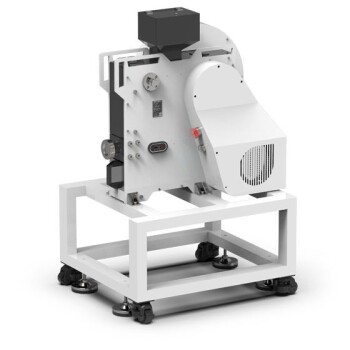
The primary function of laboratory crushing and sieving systems in this context is to mechanically reduce raw sandstone rock into a standardized, ultra-fine powder, typically targeting a particle size of -200 mesh (approximately 75μm).
By transforming the physical state of the ore, these systems prepare the sample for subsequent chemical or biological extraction. This precise size reduction is not merely about making the sample smaller; it is about altering the material's properties to ensure the uranium can be effectively accessed and dissolved by leaching agents.
Core Takeaway The ultimate goal of crushing and sieving sandstone uranium ore is mineral liberation. By breaking the rock matrix down to the micron level, you expose the uranium trapped inside, maximizing the surface area available for leaching agents and directly dictating the efficiency of the extraction process.
The Mechanics of Ore Preparation
Precision Size Reduction
The system transforms raw, irregular sandstone chunks into a consistent, fine powder.
According to standard protocols, the target output is extremely fine, often reaching -200 mesh. This equates to a particle size of approximately 75μm, which is critical for laboratory-scale analysis and experimentation.
The Role of Sieving
While crushing reduces the size, sieving acts as the quality control mechanism.
It ensures that only particles meeting the specific size criteria proceed to the next stage. This standardization guarantees that experimental results are due to the chemistry of the leaching process, not inconsistencies in particle size.
Breaking Physical Encapsulation
Releasing Trapped Minerals
In its raw state, uranium is physically encapsulated within the sandstone host rock.
If the rock is not crushed sufficiently, the uranium minerals remain "locked" inside the matrix. The crushing system effectively breaks this physical encapsulation, freeing the uranium minerals from the surrounding waste rock.
Enabling Chemical Contact
Once the encapsulation is broken, the uranium becomes accessible to external fluids.
This exposure allows the leaching agent (whether chemical or biological) to make full contact with the uranium minerals. Without this step, the solvent would simply wash over the rock surface without accessing the valuable material inside.
Increasing Reaction Efficiency
Maximizing Specific Surface Area
Reducing the particle size significantly increases the specific surface area of the sample.
Much like in biomass processing or catalyst preparation, a larger surface area provides more "active sites" for reactions to occur. In the context of uranium, this increased area enables faster and more complete dissolution of the mineral.
Improving Leaching Yields
The direct result of increased surface area and mineral liberation is higher efficiency.
By ensuring the leaching agent can penetrate the material and contact the uranium, the system significantly improves uranium leaching efficiency. This ensures that the data derived from laboratory experiments accurately reflects the potential yield of the ore.
Understanding the Trade-offs
The Importance of Uniformity
Achieving a specific size range is as important as the reduction itself.
Just as catalyst preparation requires specific sizes to prevent pressure drops and diffusion limitations, uranium samples require uniformity to ensure consistent reaction kinetics. Irregular particle sizes can lead to erratic leaching rates, skewing experimental data.
The Risk of Improper Sizing
If the grinding is too coarse, the uranium remains encapsulated, leading to artificially low recovery rates.
Conversely, while not explicitly detailed in the primary text, uncontrolled crushing without sieving can create inconsistent gradients. The sieving component is vital to ensure the entire sample falls within the optimal -200 mesh range for accurate reproducibility.
Making the Right Choice for Your Goal
To maximize the utility of your laboratory crushing and sieving system, align your process with your specific experimental objectives:
- If your primary focus is maximizing extraction yield: Ensure your system consistently achieves the -200 mesh (75μm) threshold to fully liberate the uranium from the sandstone matrix.
- If your primary focus is kinetic data accuracy: Prioritize the sieving and classification stages to guarantee a narrow, uniform particle size distribution, eliminating variables caused by inconsistent surface areas.
Ultimately, the crushing and sieving system is not just a physical preparation tool, but the first critical step in defining the chemical success of your uranium recovery process.
Summary Table:
| Process Stage | Primary Action | Key Objective | Target Specification |
|---|---|---|---|
| Crushing | Mechanical Size Reduction | Breaking physical encapsulation | Irregular rock to powder |
| Sieving | Quality Control & Classification | Ensuring particle uniformity | -200 mesh (approx. 75μm) |
| Mineral Liberation | Matrix Disruption | Exposing trapped uranium minerals | High surface area for contact |
| Leaching Prep | Final Surface Optimization | Maximizing chemical reaction rates | Increased leaching yield |
Elevate Your Mineral Research with KINTEK Precision
Precision in particle size is the foundation of accurate uranium leaching data. KINTEK specializes in high-performance laboratory equipment designed for the rigorous demands of mining and material science.
Our advanced crushing and milling systems, sieving equipment, and hydraulic presses ensure your sandstone uranium samples achieve the perfect -200 mesh uniformity required for maximum mineral liberation. Beyond sample prep, we offer a comprehensive range of high-temperature furnaces, high-pressure reactors, and PTFE consumables to support your entire extraction workflow.
Ready to optimize your lab's extraction efficiency? Contact our technical experts today to find the perfect equipment solution for your research goals.
References
- Reda M. Attia, Nilly A. Kawady. Comparative evaluation of chemical and bio techniques for uranium leaching from low grade sandstone rock sample, Abu Thor, southwestern Sinai, Egypt. DOI: 10.1007/s10967-022-08621-6
This article is also based on technical information from Kintek Solution Knowledge Base .
Related Products
- Laboratory Jaw Crusher
- Laboratory Test Sieves and Sieving Machines
- Three-dimensional electromagnetic sieving instrument
- Laboratory Vibratory Sieve Shaker Machine for Dry and Wet Three-Dimensional Sieving
People Also Ask
- What role do laboratory crushers and standard sieves play in Datura stramonium pretreatment? Optimize Your HTL Yield
- What is a laboratory crusher? The First Step to Accurate Sample Analysis
- What is the primary function of a laboratory crusher? Optimize Biomass & Coal Co-Gasification Efficiency
- What is a jaw crusher for labs? The Essential First Step for Accurate Sample Analysis
- How does a jaw crusher contribute to the primary processing of slate waste? Optimize Your Size Reduction Workflow