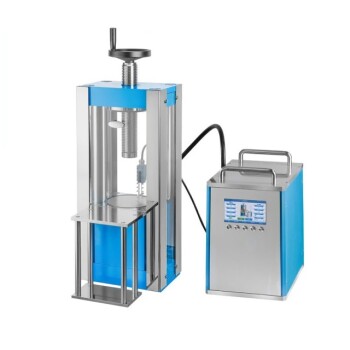
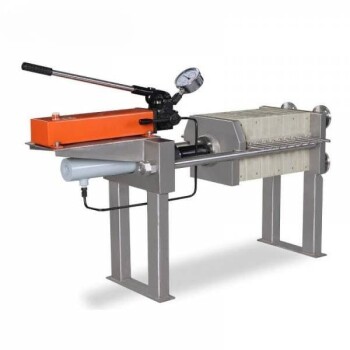
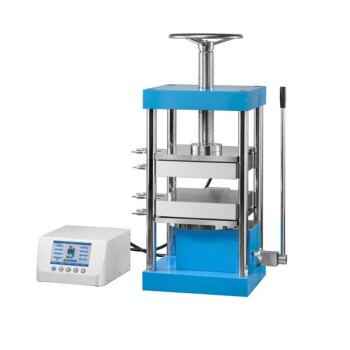
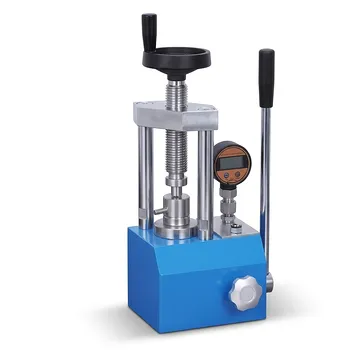
The primary function of laboratory hydraulic presses and mounting equipment in this context is to transform loose, powder-form leaching residue into solid, stable resin blocks. By compressing the mineral residue with mounting consumables, this equipment creates a unified matrix that can be subsequently ground and polished into thick sections for analysis.
The core objective of this preparation is to expose flat cross-sections of mineral particles. This physical transformation is the absolute prerequisite for Scanning Electron Microscopy (SEM) and automated mineral analysis, enabling researchers to quantify corrosion depth and internal mineral interactions.
The Role of Solidification in Analysis
Converting Powder to Solid Blocks
Leaching residues typically exist as loose powders, which are difficult to analyze individually under high-resolution microscopes.
Hydraulic presses, working with mounting consumables (typically resins), apply controlled pressure and heat to encapsulate these particles. This solidifies the loose material into a durable resin block.
Creating a Uniform Plane
Once the residue is mounted in a block, it undergoes grinding and polishing.
The mounting equipment ensures the sample is held rigidly during this abrasive process. This results in a perfectly flat surface where the internal cross-sections of the mineral particles are exposed, rather than just their outer surfaces.
Enabling Quantitative Mineralogy
Visualizing Internal Interactions
The specific value of this method for leaching residue is the ability to see inside the particle.
Because the press creates a dense, void-free mount, microscopes can image the interior of the mineral grains. This is critical for identifying corrosion depth—the extent to which the leaching agent has penetrated the mineral.
The Foundation for Automated Analysis
Modern quantitative research relies on automated mineral analysis systems.
These systems require high-quality, flat polished sections to function correctly. The hydraulic press ensures the sample has the necessary structural integrity to withstand polishing without plucking (particles falling out), ensuring accurate data regarding mineral liberation and association.
Understanding the Trade-offs
Sample Consistency vs. Throughput
While hydraulic mounting presses offer superior sample quality and edge retention, they are often slower than cold-mounting methods (mixing resin by hand).
You trade speed for structural fidelity. For leaching residues, where measuring precise corrosion layers is the goal, the superior gap-filling and edge retention of a hydraulic mounting press are usually required over faster methods.
Pressure Sensitivity
While supplementary data suggests hydraulic presses are excellent for densification (as seen in ceramic green bodies), excessive pressure during the mounting of leaching residues must be avoided.
If the pressure is too high, it may crush brittle leached rims or fragile porous structures. The equipment must allow for precise pressure control to simulate physical solidity without altering the geometric integrity of the residue particles.
Making the Right Choice for Your Goal
- If your primary focus is Quantitative Mineralogy: Prioritize a mounting press that offers high pressure control and superior edge retention to ensure accurate corrosion depth measurement.
- If your primary focus is High-Volume Screening: Consider if the high-fidelity finish of a hydraulic mount is necessary, or if faster, non-pressurized cold mounting will suffice for basic identification.
The quality of your data is directly proportional to the flatness and integrity of your prepared cross-section.
Summary Table:
| Feature | Function in Sample Preparation | Impact on Analysis |
|---|---|---|
| Resin Encapsulation | Converts loose powder into solid resin blocks | Enables grinding and polishing without sample loss |
| Controlled Pressure | Ensures a dense, void-free matrix | Preserves fragile mineral rims and internal structures |
| Surface Planarization | Creates a perfectly flat cross-section | Essential for SEM imaging and automated mineralogy |
| Structural Integrity | Prevents particle "plucking" during polishing | Ensures accurate quantification of corrosion depth |
Elevate Your Mineralogical Analysis with KINTEK Precision
Unlock the full potential of your SEM and automated mineral analysis with KINTEK’s specialized laboratory hydraulic presses and mounting systems. Whether you are quantifying corrosion depth in leaching residues or preparing high-density ceramic green bodies, our equipment delivers the structural fidelity and precise pressure control your research demands.
Why choose KINTEK?
- Advanced Sample Preparation: From pellet and isostatic presses to high-performance mounting consumables.
- Comprehensive Lab Solutions: We offer everything from high-temperature furnaces and crushing systems to ULT freezers and PTFE consumables.
- Tailored for Research: Perfect for battery research, metallurgy, and material science applications.
Ready to achieve perfectly polished sections and superior data accuracy? Contact KINTEK today to find the ideal equipment for your laboratory!
References
- Arevik Vardanyan, Narine Vardanyan. Extraction of Copper from Copper Concentrate by Indigenous Association of Iron-Oxidizing Bacteria. DOI: 10.3390/separations11040124
This article is also based on technical information from Kintek Solution Knowledge Base .
Related Products
- Laboratory Hydraulic Press Lab Pellet Press Machine for Glove Box
- Laboratory Hydraulic Press Split Electric Lab Pellet Press
- Automatic Laboratory Hydraulic Press for XRF & KBR Pellet Press
- Laboratory Hydraulic Press Lab Pellet Press for Button Battery
- Automatic Laboratory Hydraulic Pellet Press Machine for Lab Use
People Also Ask
- What is the function of a laboratory hydraulic press in W-Cu composites? Control Porosity and Material Ratio
- What is the role of a laboratory hydraulic press in the initial stages of Li6PS5Cl preparation? Key to Green Pellets
- What role does a laboratory hydraulic press play in triboelectric testing? Achieve Precision Alloy Sample Prep
- How can a laboratory hydraulic press be applied to chitosan for wastewater treatment? Optimize Pores & Strength
- How do a precision laboratory hydraulic press and specialized molds contribute to the fabrication of spherical ceramic samples? Achieving High-Density Material Precision