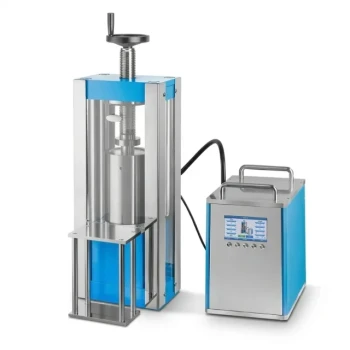
Knowledge universal laboratory press What is the function of a press machine? Harness Immense Force for Shaping and Assembly
Author avatar

Tech Team · Kintek Solution

Updated 2 months ago

What is the function of a press machine? Harness Immense Force for Shaping and Assembly


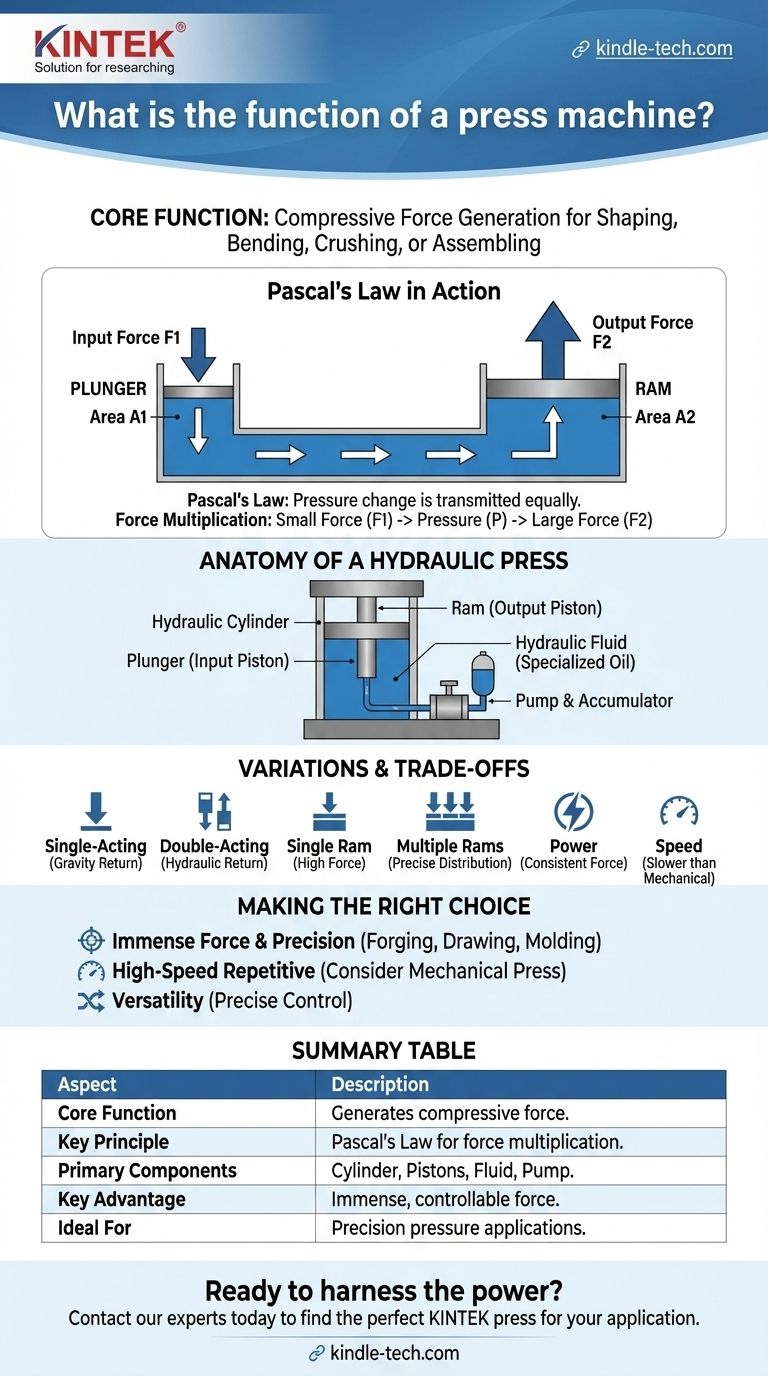
At its core, a press machine is designed to generate a significant compressive force to shape, bend, crush, or assemble materials. A hydraulic press, a common and powerful variant, achieves this by using a confined fluid to multiply a small initial effort into an immense output force. This is accomplished by leveraging a fundamental principle of fluid dynamics.

The primary function of a hydraulic press is not just to create force, but to achieve force multiplication. It masterfully exploits Pascal's Law, where a small force applied to a small area generates a pressure that, when distributed across a larger area, results in a proportionally larger output force.
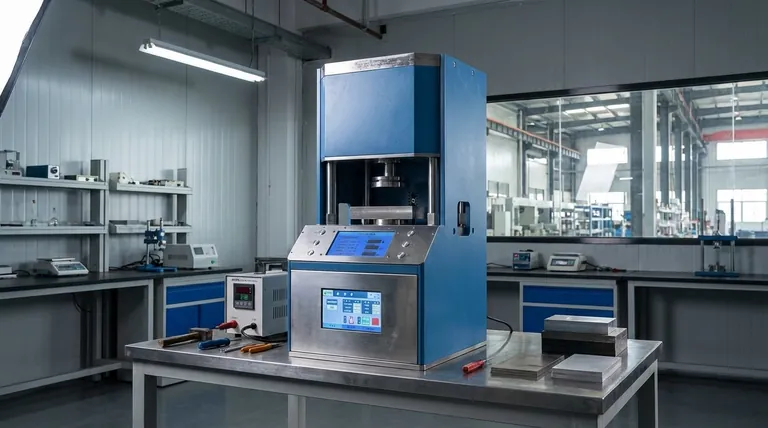
What is the function of a press machine? Harness Immense Force for Shaping and Assembly

The Core Principle: Pascal's Law in Action

To truly understand a hydraulic press, you must first understand the physics that makes it possible. The entire operation hinges on a single, elegant principle discovered in the 17th century.

What is Pascal's Law?

Pascal's Law states that a pressure change at any point in a confined, incompressible fluid is transmitted equally throughout the fluid.

Think of squeezing a sealed water bottle. The pressure you apply with your hand isn't just felt where your fingers are; it's distributed evenly to every interior surface of the bottle.

The Two-Piston System

A hydraulic press uses this principle with two interconnected cylinders, each with a piston, but of different sizes.

A small piston, often called the plunger, is where the initial, smaller force is applied. A much larger piston, called the ram, is where the massive output force is generated.

How Force is Multiplied

Because the two pistons exist in the same sealed hydraulic system, the pressure on the small plunger is the same as the pressure on the large ram.

Since Pressure = Force / Area, a small force on the small plunger's area creates the same pressure that acts on the large ram's area. To maintain that equal pressure, the force exerted by the large ram must be proportionally greater.

This mechanical advantage is what allows a press to turn a modest input from a pump into a force capable of shaping solid steel.

Anatomy of a Hydraulic Press

While the principle is simple, a functional press relies on several key components working in concert to deliver controlled power.

The Hydraulic Cylinder and Pistons

This is the heart of the machine. The cylinders contain the fluid, and the plunger (input piston) and ram (output piston) move within them to transfer and multiply the force.

The Hydraulic Fluid

The medium used to transfer the pressure is an incompressible fluid, most commonly a specialized oil. Its inability to be easily compressed is critical for the efficient transmission of pressure throughout the system.

The Pump and Accumulator

A pump provides the initial flow of hydraulic fluid, creating the pressure needed to move the plunger.

In many systems, a hydraulic accumulator acts like a rechargeable battery. It stores high-pressure fluid from the pump and can release it quickly when a strong, rapid thrust is required.

Understanding the Variations and Trade-offs

Not all hydraulic presses are identical. Their design is tailored to specific tasks, which introduces important trade-offs between control, speed, and complexity.

Single-Acting vs. Double-Acting

A single-acting cylinder uses hydraulic pressure to push the ram in one direction (usually down). The return stroke relies on gravity or springs.

A double-acting cylinder uses hydraulic power for both the extension and retraction strokes, offering greater control but at a higher complexity.

Single Ram vs. Multiple Rams

While a single large ram can deliver immense force, some presses use multiple smaller rams. This configuration allows for more precise control over the distribution of force across the workpiece.

Power vs. Speed

The defining characteristic of a hydraulic press is its ability to deliver a consistent, controllable force throughout its stroke. However, they are generally not as fast as mechanical presses, which excel at high-speed stamping operations.

Making the Right Choice for Your Goal

Understanding the function of a press allows you to select the right tool for the job. The hydraulic press is a master of controlled, powerful force.

  • If your primary focus is immense force and precision: A hydraulic press is the ideal choice for applications like forging, deep drawing, and molding, where consistent pressure is paramount.
  • If your primary focus is high-speed, repetitive production: You should evaluate if the cycle time of a hydraulic press meets your needs, as a mechanical press may be better suited for simple stamping.
  • If your primary focus is versatility: The ability to precisely control force, speed, and stroke length makes the hydraulic press one of the most adaptable forming tools available.

By understanding the principle of force multiplication, you can effectively leverage the immense power and control a press machine offers.

Summary Table:

Aspect Description
Core Function Generates compressive force to shape, bend, crush, or assemble materials.
Key Principle Pascal's Law: Force multiplication via hydraulic fluid pressure.
Primary Components Hydraulic cylinder, pistons (plunger & ram), hydraulic fluid, pump.
Key Advantage Delivers immense, controllable force throughout the stroke.
Ideal For Forging, deep drawing, molding, and applications requiring precise pressure control.

Ready to harness the power of a hydraulic press in your lab or production line? KINTEK specializes in high-performance lab equipment, including robust press machines designed for precision and durability. Whether you're in materials testing, sample preparation, or R&D, our solutions deliver the controlled force you need. Contact our experts today to find the perfect press for your specific application and achieve superior results!

Visual Guide
What is the function of a press machine? Harness Immense Force for Shaping and Assembly Visual Guide

Related Products

People Also Ask

Related Products

Automatic High Temperature Heated Hydraulic Press Machine with Heated Plates for Lab

Automatic High Temperature Heated Hydraulic Press Machine with Heated Plates for Lab

The High Temperature Hot Press is a machine specifically designed for pressing, sintering and processing materials in a high temperature environment. It is capable of operating in the range of hundreds of degrees Celsius to thousands of degrees Celsius for a variety of high temperature process requirements.

Automatic Laboratory Heat Press Machine

Automatic Laboratory Heat Press Machine

Precision automatic heat press machines for labs—ideal for material testing, composites, and R&D. Customizable, safe, and efficient. Contact KINTEK today!

30T 40T Split Automatic Heated Hydraulic Press Machine with Heated Plates for Laboratory Hot Press

30T 40T Split Automatic Heated Hydraulic Press Machine with Heated Plates for Laboratory Hot Press

Discover our split automatic heated lab press 30T/40T for precise sample preparation in material research, pharmacy, ceramics, and electronics industries. With a small footprint and heating up to 300°C, it's perfect for processing under vacuum environment.

Heated Hydraulic Press Machine with Heated Plates for Vacuum Box Laboratory Hot Press

Heated Hydraulic Press Machine with Heated Plates for Vacuum Box Laboratory Hot Press

Enhance your lab's precision with our lab press for vacuum box. Press pills and powders with ease and precision in a vacuum environment, reducing oxidation and improving consistency. Compact and easy to use with a digital pressure gauge.

Cold Isostatic Pressing Machine CIP for Small Workpiece Production 400Mpa

Cold Isostatic Pressing Machine CIP for Small Workpiece Production 400Mpa

Produce uniformly high-density materials with our Cold Isostatic Press. Ideal for compacting small workpieces in production settings. Widely used in powder metallurgy, ceramics, and biopharmaceutical fields for high-pressure sterilization and protein activation.

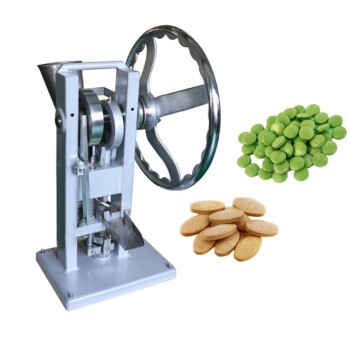
Single Punch Manual Tablet Press Machine TDP Tablet Punching Machine

Single Punch Manual Tablet Press Machine TDP Tablet Punching Machine

Single punch manual tablet punching machine can press various granular, crystal or powdery raw materials with good fluidity into disc-shaped, cylindrical, spherical, convex, concave and other various geometric shapes (such as square, triangle, ellipse, capsule shape, etc.), and can also press products with text and patterns.

Laboratory Hydraulic Press Lab Pellet Press Machine for Glove Box

Laboratory Hydraulic Press Lab Pellet Press Machine for Glove Box

Controlled environment lab press machine for glove box. Specialized equipment for material pressing and shaping with high precision digital pressure gauge.

Lab Scale Rotary Single Punch Tablet Press Machine TDP Tablet Punching Machine

Lab Scale Rotary Single Punch Tablet Press Machine TDP Tablet Punching Machine

This machine is a single-pressure automatic rotating, continuous tableting machine that compresses granular raw materials into various tablets. It is mainly used for tablet production in the pharmaceutical industry, and is also suitable for chemical, food, electronics and other industrial sectors.

Automatic Heated Hydraulic Press Machine with Heated Plates for Laboratory Hot Press

Automatic Heated Hydraulic Press Machine with Heated Plates for Laboratory Hot Press

The Automatic High Temperature Heat Press is a sophisticated hydraulic hot press designed for efficient temperature control and product quality processing.

Single Punch Electric Tablet Press Machine TDP Tablet Punching Machine

Single Punch Electric Tablet Press Machine TDP Tablet Punching Machine

The electric tablet punching machine is a laboratory equipment designed for pressing various granular and powdery raw materials into discs and other geometric shapes. It is commonly used in pharmaceutical, healthcare products, food, and other industries for small batch production and processing. The machine is compact, lightweight, and easy to operate, making it suitable for use in clinics, schools, laboratories, and research units.

Heated Hydraulic Press Machine with Heated Plates for Vacuum Box Laboratory Hot Press

Heated Hydraulic Press Machine with Heated Plates for Vacuum Box Laboratory Hot Press

The lab press for vacuum box is a specialized piece of equipment designed for laboratory use. Its main purpose is to press pills and powders according to specific requirements.

Automatic Laboratory Hydraulic Pellet Press Machine for Lab Use

Automatic Laboratory Hydraulic Pellet Press Machine for Lab Use

Experience efficient sample preparation with our Automatic Lab Press Machine. Ideal for material research, pharmacy, ceramics, and more. Features a compact size and hydraulic press functionality with heating plates. Available in various sizes.

Manual Heated Hydraulic Press Machine with Heated Plates for Laboratory Hot Press

Manual Heated Hydraulic Press Machine with Heated Plates for Laboratory Hot Press

The Manual Heat Press is a versatile piece of equipment suitable for a variety of applications, operated by a manual hydraulic system that applies controlled pressure and heat to the material placed on the piston.

Manual Cold Isostatic Pressing Machine CIP Pellet Press

Manual Cold Isostatic Pressing Machine CIP Pellet Press

Lab Manual Isostatic Press is a high-efficient equipment for sample preparation widely used in material research, pharmacy, ceramics, and electronic industries. It allows for precision control of the pressing process and can work in a vacuum environment.

Automatic Lab Cold Isostatic Press CIP Machine Cold Isostatic Pressing

Automatic Lab Cold Isostatic Press CIP Machine Cold Isostatic Pressing

Efficiently prepare samples with our Automatic Lab Cold Isostatic Press. Widely used in material research, pharmacy, and electronic industries. Provides greater flexibility and control compared to electric CIPs.

Electric Lab Cold Isostatic Press CIP Machine for Cold Isostatic Pressing

Electric Lab Cold Isostatic Press CIP Machine for Cold Isostatic Pressing

Produce dense, uniform parts with improved mechanical properties with our Electric Lab Cold Isostatic Press. Widely used in material research, pharmacy, and electronic industries. Efficient, compact, and vacuum-compatible.

Electric Split Lab Cold Isostatic Press CIP Machine for Cold Isostatic Pressing

Electric Split Lab Cold Isostatic Press CIP Machine for Cold Isostatic Pressing

Split cold isostatic presses are capable of providing higher pressures, making them suitable for testing applications that require high pressure levels.

Manual button battery sealing machine (digital display)

Manual button battery sealing machine (digital display)

The manual button battery sealing machine is a small device specially used for button battery packaging. It is easy to operate and suitable for laboratories and small batch production to ensure that the battery is firmly sealed and improve production efficiency.

kbr pellet press 2t

kbr pellet press 2t

Introducing the KINTEK KBR Press - a handheld laboratory hydraulic press designed for entry-level users.

Automatic Laboratory Hydraulic Press for XRF & KBR Pellet Press

Automatic Laboratory Hydraulic Press for XRF & KBR Pellet Press

Fast and easy xrf sample pellet preparation with KinTek Automatic Lab Pellet Press. Versatile and accurate results for X-ray fluorescence analysis.


Leave Your Message