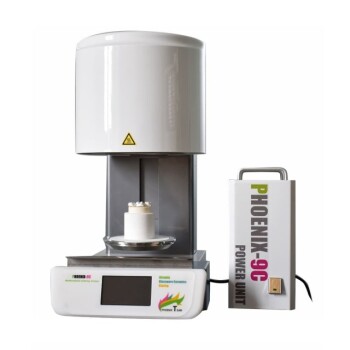
Knowledge What is the function of using an industrial muffle furnace with an argon gas flow? Ensure Pure Zn-Pb Alloy Production
Author avatar

Tech Team · Kintek Solution

Updated 1 day ago

What is the function of using an industrial muffle furnace with an argon gas flow? Ensure Pure Zn-Pb Alloy Production


The primary function of using an industrial muffle furnace with an argon gas flow is to couple precise thermal management with chemical isolation. The furnace generates the stable high temperatures required to fully liquefy the metals, often operating around 500°C for Zinc-Lead (Zn-Pb) alloys. Simultaneously, the argon gas flow displaces atmospheric oxygen to create an inert environment, preventing the molten metals from oxidizing and ensuring the integrity of the final alloy.

High-temperature processing of reactive metals like zinc and lead naturally invites contamination through oxidation. Introducing an argon atmosphere acts as a chemical shield, ensuring the resulting alloy maintains the exact purity and compositional accuracy required for high-quality production.

The Role of the Muffle Furnace

Achieving Complete Liquefaction

The fundamental purpose of the industrial muffle furnace is to provide a controlled heat source capable of exceeding the melting points of the constituent metals.

For Zn-Pb alloys, the furnace must maintain a stable environment, typically around 500°C. This ensures both the zinc and lead transition completely from solid to liquid states without temperature fluctuations that could lead to partial melting or segregation.

Ensuring Thermal Stability

Beyond simply reaching a target temperature, the muffle furnace design isolates the heating elements from the chamber.

This indirect heating method prevents localized hot spots. It creates a uniform thermal profile, which is critical for achieving a homogeneous mixture of the two distinct metals.

The Critical Function of Argon Gas

Creating an Inert Barrier

At 500°C, both zinc and lead become highly reactive to oxygen found in standard air.

The introduction of an argon gas flow serves to physically displace the air within the furnace chamber. Because argon is an inert noble gas, it does not react with the molten metals. It effectively blankets the melt, blocking oxygen from coming into contact with the liquid surface.

Preserving Alloy Composition

If oxidation were allowed to occur, a portion of your zinc and lead would convert into metal oxides (slag).

This reaction would alter the ratio of pure metal in the mix, deviating from your target formula. By preventing this reaction, the argon flow ensures that the mass of metal you input is the exact mass of metal present in the final alloy, guaranteeing compositional accuracy and high purity.

Understanding the Trade-offs

Operational Complexity vs. Purity

While using an argon atmosphere guarantees a cleaner alloy, it introduces complexity to the setup.

You must ensure the furnace is adequately sealed to maintain positive pressure and prevent oxygen ingress. Failing to monitor the flow rate can lead to incomplete coverage and wasted gas, compromising the protection without saving costs.

Cost Implications

Argon is a consumable resource that adds to the operational cost of the melting process compared to open-air melting.

However, this cost is generally offset by the reduction in material loss due to dross (oxide) formation. Open-air melting would result in a lower yield and a potentially brittle, impure product that may require expensive post-processing.

Making the Right Choice for Your Goal

To maximize the effectiveness of this setup, align your parameters with your specific quality requirements:

  • If your primary focus is Absolute Compositional Accuracy: Ensure a continuous, positive-pressure argon flow is established before the heating cycle begins to purge all oxygen prior to the metals reaching reactive temperatures.
  • If your primary focus is Process Efficiency: Calibrate the furnace temperature strictly to the 500°C range to minimize energy consumption while maintaining the argon flow at the minimum rate required to sustain the inert atmosphere.

By synchronizing thermal control with atmospheric protection, you transform a chaotic melting process into a precise chemical engineering operation.

Summary Table:

Feature Function in Zn-Pb Processing Benefit to Final Alloy
Muffle Furnace Stable 500°C uniform heating Complete liquefaction & homogeneous mixing
Argon Gas Flow Displaces oxygen (Inert blanket) Prevents oxidation and dross (slag) formation
Indirect Heating Isolates heating elements Prevents hot spots and thermal segregation
Positive Pressure Maintains chemical isolation Guarantees purity and exact mass ratios

Elevate Your Material Purity with KINTEK

Don't let oxidation compromise your alloy integrity. KINTEK specializes in advanced laboratory solutions, offering high-performance muffle furnaces, vacuum systems, and atmosphere-controlled furnaces designed for precision metallurgy.

Whether you are preparing Zn-Pb alloys or conducting complex battery research, our comprehensive range of high-temperature equipment, crushing and milling systems, and specialized crucibles ensures consistent, high-purity results.

Ready to optimize your thermal processing? Contact KINTEK today to discover how our expert-grade equipment can enhance your laboratory’s efficiency and production quality!

References

  1. Habiba Kherrab-Boukezzata, Slimane Boutarfaia. Electrochemical behavior of zinc anode in acidic zinc electrolyte -influence of lead as an impurity in zinc anodic dissolution. DOI: 10.4314/jfas.1142

This article is also based on technical information from Kintek Solution Knowledge Base .

Related Products

People Also Ask

Related Products

1700℃ Muffle Oven Furnace for Laboratory

1700℃ Muffle Oven Furnace for Laboratory

Get superior heat control with our 1700℃ Muffle Furnace. Equipped with intelligent temperature microprocessor, TFT touch screen controller & advanced insulation materials for precise heating up to 1700C. Order now!

1400℃ Muffle Oven Furnace for Laboratory

1400℃ Muffle Oven Furnace for Laboratory

Get precise high-temperature control up to 1500℃ with KT-14M Muffle furnace. Equipped with a smart touch screen controller and advanced insulation materials.

1800℃ Muffle Oven Furnace for Laboratory

1800℃ Muffle Oven Furnace for Laboratory

KT-18 muffle furnace with Japan Al2O3 polycrystalline fibe and Silicon Molybdenum heating element, up to 1900℃, PID temperature control and 7" smart touch screen. Compact design, low heat loss, and high energy efficiency. Safety interlock system and versatile functions.

1700℃ Controlled Atmosphere Furnace Nitrogen Inert Atmosphere Furnace

1700℃ Controlled Atmosphere Furnace Nitrogen Inert Atmosphere Furnace

KT-17A Controlled atmosphere furnace: 1700℃ heating, vacuum sealing technology, PID temperature control, and versatile TFT smart touch screen controller for laboratory and industrial use.

High Pressure Laboratory Vacuum Tube Furnace Quartz Tubular Furnace

High Pressure Laboratory Vacuum Tube Furnace Quartz Tubular Furnace

KT-PTF High Pressure Tube Furnace: Compact split tube furnace with strong positive pressure resistance. Working temp up to 1100°C and pressure up to 15Mpa. Also works under controller atmosphere or high vacuum.

1400℃ Controlled Atmosphere Furnace with Nitrogen and Inert Atmosphere

1400℃ Controlled Atmosphere Furnace with Nitrogen and Inert Atmosphere

Achieve precise heat treatment with KT-14A controlled atmosphere furnace. Vacuum sealed with a smart controller, it's ideal for lab and industrial use up to 1400℃.

1700℃ Laboratory High Temperature Tube Furnace with Alumina Tube

1700℃ Laboratory High Temperature Tube Furnace with Alumina Tube

Looking for a high-temperature tube furnace? Check out our 1700℃ Tube Furnace with Alumina Tube. Perfect for research and industrial applications up to 1700C.

Laboratory Muffle Oven Furnace Bottom Lifting Muffle Furnace

Laboratory Muffle Oven Furnace Bottom Lifting Muffle Furnace

Efficiently produce batches with excellent temperature uniformity using our Bottom Lifting Furnace. Features two electric lifting stages and advanced temperature control up to 1600℃.

1400℃ Laboratory High Temperature Tube Furnace with Alumina Tube

1400℃ Laboratory High Temperature Tube Furnace with Alumina Tube

Looking for a tube furnace for high-temperature applications? Our 1400℃ Tube Furnace with Alumina Tube is perfect for research and industrial use.

1200℃ Split Tube Furnace with Quartz Tube Laboratory Tubular Furnace

1200℃ Split Tube Furnace with Quartz Tube Laboratory Tubular Furnace

KT-TF12 split tube furnace: high-purity insulation, embedded heating wire coils, and max. 1200C. Widely used for new materials and chemical vapour deposition.

1200℃ Controlled Atmosphere Furnace Nitrogen Inert Atmosphere Furnace

1200℃ Controlled Atmosphere Furnace Nitrogen Inert Atmosphere Furnace

Discover our KT-12A Pro Controlled atmosphere furnace - high precision, heavy duty vacuum chamber, versatile smart touch screen controller, and excellent temperature uniformity up to 1200C. Ideal for both laboratory and industrial application.

Ultra-High Temperature Graphite Vacuum Graphitization Furnace

Ultra-High Temperature Graphite Vacuum Graphitization Furnace

The ultra-high temperature graphitization furnace utilizes medium frequency induction heating in a vacuum or inert gas environment. The induction coil generates an alternating magnetic field, inducing eddy currents in the graphite crucible, which heats up and radiates heat to the workpiece, bringing it to the desired temperature. This furnace is primarily used for graphitization and sintering of carbon materials, carbon fiber materials, and other composite materials.

Vacuum Heat Treat and Molybdenum Wire Sintering Furnace for Vacuum Sintering

Vacuum Heat Treat and Molybdenum Wire Sintering Furnace for Vacuum Sintering

A vacuum molybdenum wire sintering furnace is a vertical or bedroom structure, which is suitable for withdrawal, brazing, sintering and degassing of metal materials under high vacuum and high temperature conditions. It is also suitable for dehydroxylation treatment of quartz materials.

Vertical High Temperature Graphite Vacuum Graphitization Furnace

Vertical High Temperature Graphite Vacuum Graphitization Furnace

Vertical high temperature graphitization furnace for carbonization and graphitization of carbon materials up to 3100℃.Suitable for shaped graphitization of carbon fiber filaments and other materials sintered in a carbon environment.Applications in metallurgy, electronics, and aerospace for producing high-quality graphite products like electrodes and crucibles.

Mesh belt controlled atmosphere furnace

Mesh belt controlled atmosphere furnace

Discover our KT-MB mesh belt sintering furnace - perfect for high-temperature sintering of electronic components & glass insulators. Available for open air or controlled atmosphere environments.

Horizontal High Temperature Graphite Vacuum Graphitization Furnace

Horizontal High Temperature Graphite Vacuum Graphitization Furnace

Horizontal Graphitization Furnace: This type of furnace is designed with the heating elements placed horizontally, allowing for uniform heating of the sample. It's well-suited for graphitizing large or bulky samples that require precise temperature control and uniformity.

Multi-zone Laboratory Tube Furnace

Multi-zone Laboratory Tube Furnace

Experience precise, efficient thermal testing with our Multi Zone Tube Furnace. Independent heating zones and temperature sensors allow for controlled high-temperature gradient heating fields. Order now for advanced thermal analysis!

Laboratory Rapid Thermal Processing (RTP) Quartz Tube Furnace

Laboratory Rapid Thermal Processing (RTP) Quartz Tube Furnace

Get lightning-fast heating with our RTP Rapid Heating Tube Furnace. Designed for precise, high-speed heating and cooling with convenient sliding rail and TFT touch screen controller. Order now for ideal thermal processing!

Controlled Nitrogen Inert Hydrogen Atmosphere Furnace

Controlled Nitrogen Inert Hydrogen Atmosphere Furnace

KT-AH Hydrogen atmosphere furnace - induction gas furnace for sintering/annealing with built-in safety features, dual housing design, and energy-saving efficiency. Ideal for lab and industrial use.

2200 ℃ Tungsten Vacuum Heat Treat and Sintering Furnace

2200 ℃ Tungsten Vacuum Heat Treat and Sintering Furnace

Experience the ultimate refractory metal furnace with our Tungsten vacuum furnace. Capable of reaching 2200℃, perfect for sintering advanced ceramics and refractory metals. Order now for high-quality results.


Leave Your Message