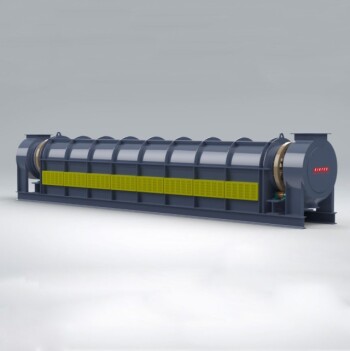
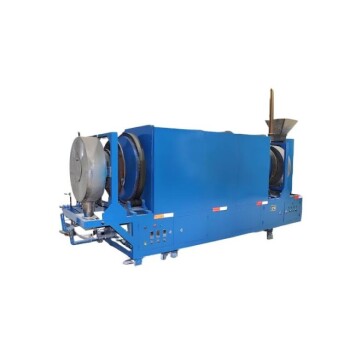
The high-temperature electric firing kiln acts as the definitive transformative stage in manufacturing dense refractory bricks, turning loose aggregate into a unified structural element. Operating at a stable 1350°C, this kiln drives the essential liquid-phase sintering process that eliminates internal porosity and cements the brick's physical integrity.
The kiln is not simply a heating device; it is a reactor for chemical change. It provides the precise thermal environment required to grow the mullite phase, ensuring the final product possesses the refractoriness and compressive strength needed for industrial applications.
The Physicochemical Transformation
Triggering Liquid-Phase Sintering
The primary function of the kiln is to elevate the material to 1350°C. At this specific temperature threshold, the material undergoes liquid-phase sintering.
This mechanism causes the boundaries of loose particles to liquefy slightly. As they fuse, they bond the particles into a solid, cohesive structure that mere drying cannot achieve.
Promoting Mullite Phase Growth
Beyond simple bonding, the kiln facilitates specific mineralogical changes. The high temperature allows for the growth of the mullite phase within the brick's matrix.
The presence of mullite is critical for high-performance refractories. It directly contributes to the brick's ability to withstand load and thermal stress.
Critical Performance Outcomes
Eliminating Internal Porosity
A dense refractory brick must be free of voids to function correctly. The controlled heating process forces internal pores to close up as the material densifies.
By eliminating these pores, the kiln ensures the brick is not susceptible to infiltration by slag or gases during use.
Establishing Thermal and Mechanical Resilience
The final firing is what grants the brick its defining properties. The process locks in refractoriness (the ability to withstand heat without melting) and high compressive strength.
Additionally, this structural bonding provides the necessary thermal shock resistance, allowing the brick to survive rapid temperature changes without cracking.
Understanding the Trade-offs
The Cost of Stability
The effectiveness of this process relies entirely on a stable environment.
If the kiln fails to maintain a consistent 1350°C, the physicochemical reactions may be incomplete.
Risks of Improper Firing
Insufficient firing results in a "green" or under-fired brick that retains porosity and lacks strength.
Conversely, uncontrolled fluctuations can lead to structural defects. The process requires precise energy regulation, which often translates to higher operational costs compared to lower-temperature methods.
Making the Right Choice for Your Goal
To ensure your refractory bricks perform as intended, consider how the firing process aligns with your specific requirements.
- If your primary focus is mechanical strength: Ensure the kiln cycle is long enough to complete the liquid-phase sintering, fully bonding the particles for maximum load-bearing capacity.
- If your primary focus is thermal longevity: Prioritize the stability of the 1350°C soak time to maximize mullite growth, which is the key factor in thermal shock resistance.
The high-temperature kiln is the bridge between raw potential and industrial reliability; its precision defines the lifespan of your refractory lining.
Summary Table:
| Feature | Impact on Refractory Bricks | Importance for Industrial Use |
|---|---|---|
| 1350°C Thermal Stability | Triggers liquid-phase sintering | Ensures particle bonding and structural cohesion |
| Mullite Phase Growth | Enhances mineralogical matrix | Provides high refractoriness and load-bearing capacity |
| Porosity Elimination | Closes internal voids | Prevents infiltration by slag, gases, and chemicals |
| Structural Locking | Increases compressive strength | Guarantees mechanical resilience and thermal shock resistance |
Elevate Your Material Integrity with KINTEK Precision
Unlock the full potential of your refractory production with KINTEK’s advanced high-temperature furnaces. Whether you require stable 1350°C environments for liquid-phase sintering or specialized systems for mullite growth, our range of muffle, tube, and atmosphere furnaces delivers the thermal precision your lab or facility demands.
From crushing and milling systems to high-pressure reactors and PTFE consumables, KINTEK provides a comprehensive ecosystem for industrial research and manufacturing. Don't let inconsistent firing compromise your thermal longevity.
Contact KINTEK today to optimize your firing process and enhance your material performance.
References
- Isiaka Olajide Odewale, Suraj Jare Olagunju. Consequence of Variations in Al2O3.2SiO2.2H2O and Grog Percentages on the Properties of Dense Refractory Bricks. DOI: 10.36348/sjet.2021.v06i12.002
This article is also based on technical information from Kintek Solution Knowledge Base .
Related Products
- Electric Rotary Kiln Pyrolysis Furnace Plant Machine Calciner Small Rotary Kiln Rotating Furnace
- Electric Rotary Kiln Continuous Working Small Rotary Furnace Heating Pyrolysis Plant
- Electric Rotary Kiln Small Rotary Furnace Biomass Pyrolysis Plant
- Electric Rotary Kiln Small Rotary Furnace for Activated Carbon Regeneration
- High Temperature Muffle Oven Furnace for Laboratory Debinding and Pre Sintering
People Also Ask
- What is a rotary kiln electric furnace? Achieve Superior Uniform Heating for Your Materials
- What are the characteristics of the slipping, slumping, and rolling modes of bed motion? Optimize Your Rotary Process
- What are the advantages of rotary kiln furnace? Achieve Superior Uniformity & Efficiency
- What is the temperature of a rotating kiln? It Depends on Your Material and Process Goal
- What are the principles of a rotary kiln? Master the Mechanics of High-Temperature Processing