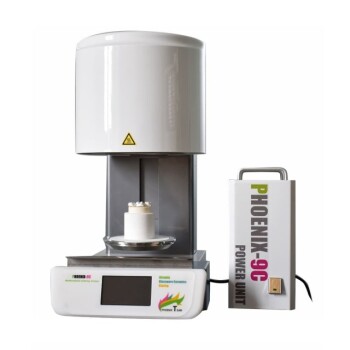
The sintering process is pivotal in modern manufacturing because it allows for the production of components that possess exceptional hardness, toughness, and high precision. It serves as a vital solution for creating intricate shapes and geometries that are often impossible or prohibitively expensive to achieve through traditional methods like machining or casting.
Sintering transforms compacted "green parts" into solid, high-performance components by heating them below their melting point. It creates a pathway to merge distinct material properties—such as toughness and abrasion resistance—while ensuring cost-effective, rapid mass production.
Achieving Superior Physical Properties
Enhancing Hardness and Durability
Sintering is essential for producing components that require extreme mechanical resilience. The process imparts great hardness and toughness to the final product, making it suitable for demanding industrial applications.
Precision and Repeatability
Consistency is a major challenge in large-scale manufacturing. Sintering enables rapid mass production while maintaining high precision and repeatability across thousands of units, ensuring that every part meets exact specifications.
Design Flexibility and Material Versatility
Creating Intricate Geometries
One of the most significant advantages of sintering is its ability to form complex shapes. These intricate geometries are often difficult or economically unfeasible to replicate using subtractive manufacturing methods like CNC machining.
Merging Distinct Material Characteristics
Sintering allows engineers to combine the beneficial properties of different materials into a single component. For example, a manufacturer can merge the toughness of one material with the abrasion resistance of another, creating a hybrid performance profile that a single alloy could not achieve.
Economic and Operational Benefits
Reducing Tooling Costs
For complex parts, traditional tooling can be a massive capital expense. Sintering offers lower-cost tooling alternatives, making it a financially viable option for projects requiring complicated part designs.
Environmental and Efficiency Gains
Beyond structure, sintering impacts the efficiency of the entire manufacturing line. Techniques like Hip (Hot Isostatic Pressing) sintering are noted for being environmentally friendly processes that remain cost-effective even during large-scale operations.
Understanding the Process Requirements
The Need for Optimization
Sintering is not a "set it and forget it" method; it requires an optimized process to guarantee the product achieves its intended physical properties. Failing to calibrate the process correctly can result in parts that do not meet performance standards.
Thermal Cycle Control
The process relies on a strict thermal cycle where the part is heated for a specific duration at a temperature below the melting point of the base metal. Precise control over these variables is critical to successfully transforming the compacted "green part" into a finished component.
Making the Right Choice for Your Manufacturing Goals
When evaluating whether sintering is the right solution for your production needs, consider your primary engineering objectives:
- If your primary focus is Durability: Leverage sintering to produce components with exceptional hardness and merged material properties, such as abrasion resistance combined with toughness.
- If your primary focus is Complex Design: Choose sintering to create intricate geometries and shapes that are difficult or impossible to achieve with standard machining.
- If your primary focus is Cost Efficiency: Utilize sintering to lower tooling costs for complex parts and enable rapid, repeatable mass production.
Sintering offers a unique intersection of design freedom, material performance, and economic efficiency for high-precision manufacturing.
Summary Table:
| Key Benefit | Description | Industrial Impact |
|---|---|---|
| Material Properties | Combines hardness, toughness, and abrasion resistance. | Superior component longevity. |
| Design Flexibility | Enables complex geometries impossible with machining. | Greater innovation in part design. |
| Cost Efficiency | Lowers tooling costs and enables rapid mass production. | Reduced CAPEX and higher ROI. |
| High Precision | Delivers consistent repeatability across large batches. | Reliable quality control for industry. |
Elevate Your Manufacturing with KINTEK Precision Solutions
Unlock the full potential of your materials with KINTEK’s advanced sintering and heat treatment technology. Whether you are producing intricate medical components or high-durability industrial parts, our comprehensive range of high-temperature muffle, vacuum, and rotary furnaces, alongside our specialized Hot Isostatic Pressing (HIP) systems and hydraulic pellet presses, ensures your "green parts" transform into high-performance products.
Why choose KINTEK?
- Expertise in Advanced Ceramics & Metals: From sintering furnaces to high-pressure reactors, we provide the tools needed to merge toughness with abrasion resistance.
- Comprehensive Lab Ecosystem: We supply everything from crushing and milling systems to crucibles and PTFE consumables to optimize your entire workflow.
- Precision Guaranteed: Achieve exact thermal cycles and repeatable results for your most demanding manufacturing goals.
Ready to optimize your production line and reduce tooling costs? Contact our experts today to find the perfect sintering solution!
Related Products
- Vacuum Heat Treat and Sintering Furnace with 9MPa Air Pressure
- Spark Plasma Sintering Furnace SPS Furnace
- Vacuum Heat Treat and Molybdenum Wire Sintering Furnace for Vacuum Sintering
- Small Vacuum Heat Treat and Tungsten Wire Sintering Furnace
- Dental Porcelain Zirconia Sintering Ceramic Vacuum Press Furnace
People Also Ask
- What is the process of pressure sintering? Achieve Superior Density and Strength for High-Performance Parts
- What is the effect of pressure during sintering? Achieve Higher Density and Finer Microstructures Faster
- Why must green bodies produced via binder jetting undergo treatment in a vacuum sintering furnace?
- What is a vacuum sintering furnace? Unlock Purity and Performance in Advanced Materials
- How does the vacuum environment impact sintering of diamond-copper composites? Protect Against Thermal Damage