Knowledge engineering ceramics What is the main disadvantage of ceramics? The Critical Challenge of Brittleness
Author avatar

Tech Team · Kintek Solution

Updated 2 months ago

What is the main disadvantage of ceramics? The Critical Challenge of Brittleness


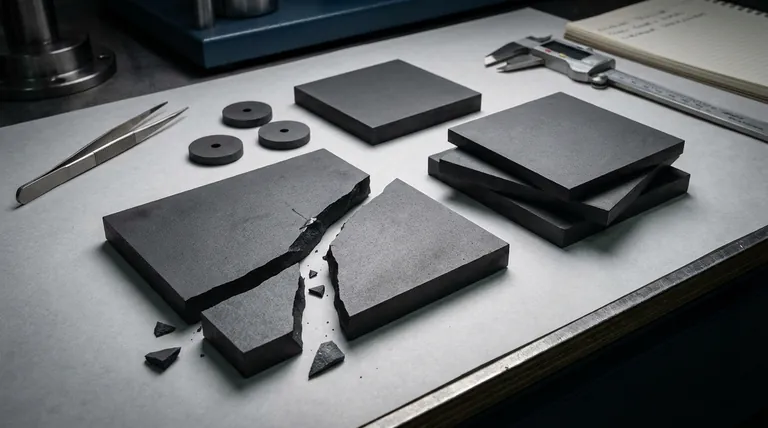
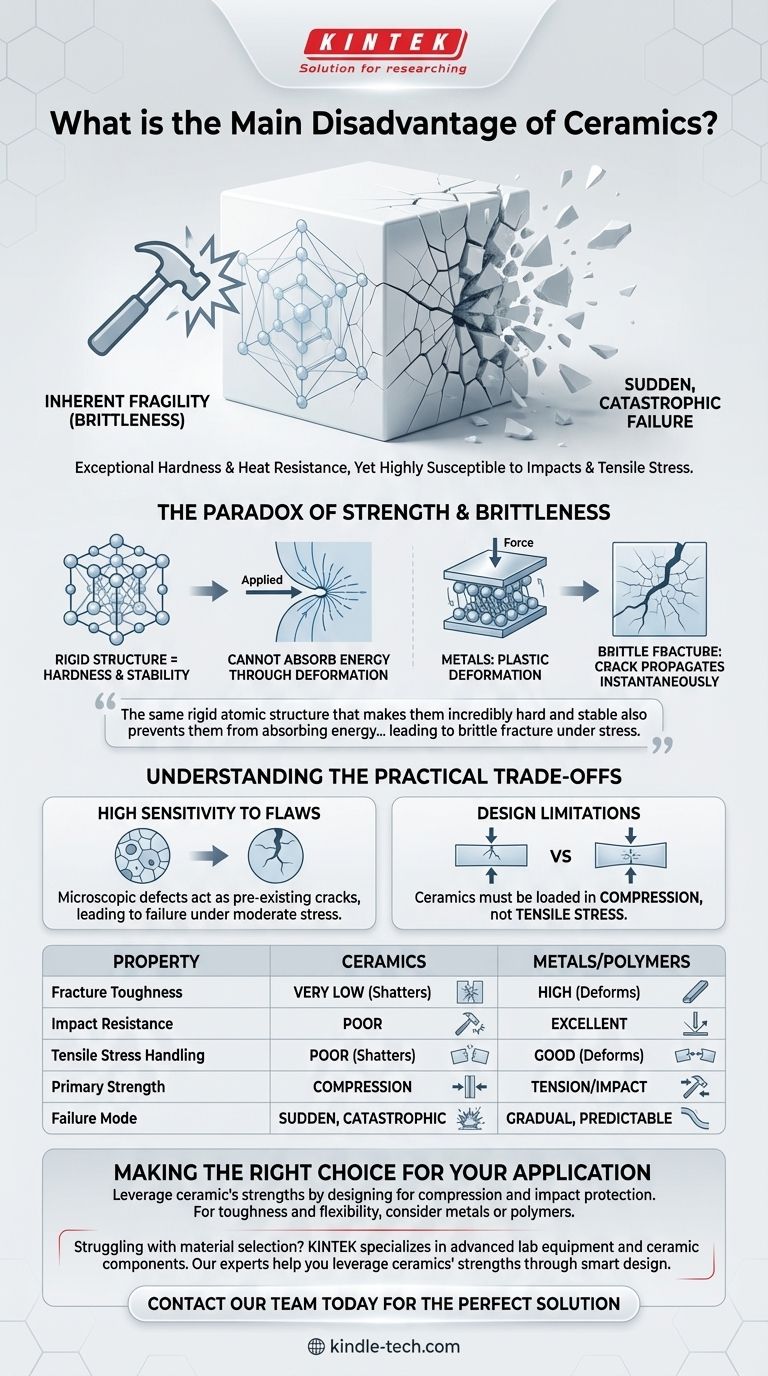
Without question, the single greatest disadvantage of most ceramic materials is their inherent fragility, or brittleness. While they possess exceptional hardness and resistance to heat and chemical attack, they are highly susceptible to catastrophic failure when subjected to sharp impacts or tensile stress. This means they can shatter suddenly without any prior warning or deformation.

The core issue with ceramics is a paradox: the same rigid atomic structure that makes them incredibly hard and stable also prevents them from absorbing energy through bending or deforming, leading to brittle fracture under stress.
What is the main disadvantage of ceramics? The Critical Challenge of Brittleness

The Paradox of Strength and Brittleness

Ceramics present a unique engineering challenge. Their most valued properties are directly linked to their most significant weakness. Understanding this relationship is crucial for using them effectively.

What Makes Ceramics So Hard?

The atoms in ceramic materials are held together by extremely strong and rigid ionic and covalent bonds.

This rigid crystalline structure is very difficult to disrupt. It is what gives ceramics their characteristic hardness, high compressive strength (resistance to being squeezed), and stability at high temperatures.

Why Does Hardness Lead to Brittleness?

When a force is applied to a metal, its atomic layers can slip past one another, allowing the material to deform and absorb energy. This is called plastic deformation.

Ceramics cannot do this. Their rigid bonds resist any slipping. Instead, when a force creates a tiny surface crack, all of that energy becomes concentrated at the tip of the crack. This intense stress breaks the bonds at the crack's tip, causing it to propagate almost instantaneously through the material, resulting in a sudden, complete fracture.

The Concept of Fracture Toughness

This property is measured as fracture toughness—a material's ability to resist the propagation of a crack.

Metals and polymers generally have high fracture toughness, while most traditional ceramics have very low fracture toughness. They simply cannot absorb much energy before failing.

Understanding the Practical Trade-offs

This fundamental brittleness has significant real-world consequences that must be managed in any application.

High Sensitivity to Flaws

The manufacturing process can introduce microscopic flaws, such as pores, grain boundaries, or tiny cracks, into the ceramic body.

These tiny, often invisible, defects act as pre-existing cracks. They become the starting points for catastrophic failure, even under moderate stress that a "perfect" component could easily withstand.

Challenges in Handling and Installation

The low fracture toughness of ceramics makes them extremely vulnerable during transportation and installation.

A dropped tool, an accidental collision, or even stress from bolting a ceramic part to a misaligned surface can be enough to initiate a crack and cause the entire component to fail.

Design Limitations

Engineers must design systems that specifically protect ceramic components from impact and tensile stress (pulling forces).

Ceramic parts are almost always designed to be loaded in compression (pushing forces), which works to close any potential cracks rather than pull them apart.

Making the Right Choice for Your Application

Ultimately, the choice to use a ceramic material depends entirely on whether you can leverage its strengths while mitigating its fundamental weakness.

  • If your primary focus is hardness, wear resistance, or high-temperature stability: Ceramics are an exceptional choice, provided you can design the component to exist primarily in a state of compression and protect it from impact.
  • If your primary focus is impact resistance, toughness, or the ability to bend without breaking: You must consider metals, polymers, or composite materials, as ceramics are fundamentally unsuited for these requirements.

Understanding the brittle nature of ceramics is the first step to harnessing their remarkable capabilities.

Summary Table:

Property Ceramics Metals/Polymers
Fracture Toughness Very Low High
Impact Resistance Poor Excellent
Tensile Stress Handling Poor (Shatters) Good (Deforms)
Primary Strength Compression Tension/Impact
Failure Mode Sudden, Catastrophic Gradual, Predictable

Struggling to choose the right material for your high-temperature or high-wear application? KINTEK specializes in advanced lab equipment and consumables, including ceramic components engineered for maximum performance. Our experts can help you leverage the strengths of ceramics while mitigating their brittleness through smart design and material selection. Contact our team today to find the perfect solution for your laboratory's unique challenges!

Visual Guide
What is the main disadvantage of ceramics? The Critical Challenge of Brittleness Visual Guide

Related Products

People Also Ask

Related Products

Silicon Carbide (SIC) Ceramic Sheet Wear-Resistant Engineering Advanced Fine Ceramics

Silicon Carbide (SIC) Ceramic Sheet Wear-Resistant Engineering Advanced Fine Ceramics

Silicon carbide (sic) ceramic sheet is composed of high-purity silicon carbide and ultra-fine powder, which is formed by vibration molding and high-temperature sintering.

Boron Nitride (BN) Ceramic Plate

Boron Nitride (BN) Ceramic Plate

Boron nitride (BN) ceramic plates do not use aluminum water to wet, and can provide comprehensive protection for the surface of materials that directly contact molten aluminum, magnesium, zinc alloys and their slag.

Silicon Carbide (SIC) Ceramic Plate for Engineering Advanced Fine Ceramics

Silicon Carbide (SIC) Ceramic Plate for Engineering Advanced Fine Ceramics

Silicon nitride (sic) ceramic is an inorganic material ceramic that does not shrink during sintering. It is a high-strength, low-density, high-temperature-resistant covalent bond compound.

Silicon Carbide (SIC) Ceramic Sheet Flat Corrugated Heat Sink for Engineering Advanced Fine Ceramics

Silicon Carbide (SIC) Ceramic Sheet Flat Corrugated Heat Sink for Engineering Advanced Fine Ceramics

Silicon carbide (sic) ceramic heat sink not only does not generate electromagnetic waves, but also can isolate electromagnetic waves and absorb part of electromagnetic waves.

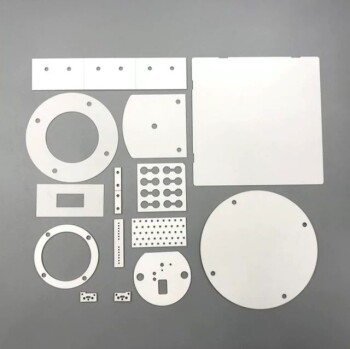
Custom-Made Alumina Zirconia Special-Shaped Ceramic Plates for Engineering Advanced Fine Ceramics Processing

Custom-Made Alumina Zirconia Special-Shaped Ceramic Plates for Engineering Advanced Fine Ceramics Processing

Alumina ceramics have good electrical conductivity, mechanical strength and high temperature resistance, while zirconia ceramics are known for their high strength and high toughness and are widely used.

Hexagonal Boron Nitride HBN Ceramic Ring

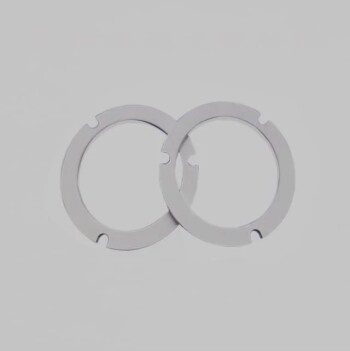
Hexagonal Boron Nitride HBN Ceramic Ring

Boron nitride ceramic (BN) rings are commonly used in high temperature applications such as furnace fixtures, heat exchangers and semiconductor processing.

Engineering Advanced Fine Ceramics Aluminium Oxide Al2O3 Ceramic Washer for Wear-Resistant Applications

Engineering Advanced Fine Ceramics Aluminium Oxide Al2O3 Ceramic Washer for Wear-Resistant Applications

Alumina wear-resistant ceramic washer are used for heat dissipation, which can replace aluminum heat sinks, with high temperature resistance and high thermal conductivity.

Alumina Al2O3 Ceramic Crucible Semicircle Boat with Lid for Engineering Advanced Fine Ceramics

Alumina Al2O3 Ceramic Crucible Semicircle Boat with Lid for Engineering Advanced Fine Ceramics

Crucibles are containers widely used for melting and processing various materials, and semicircular boat-shaped crucibles are suitable for special smelting and processing requirements. Their types and uses vary by material and shape.

Advanced Engineering Fine Ceramics Alumina Ceramic Saggar for Fine Corundum

Advanced Engineering Fine Ceramics Alumina Ceramic Saggar for Fine Corundum

Alumina sagger products have the characteristics of high temperature resistance, good thermal shock stability, small expansion coefficient, anti-stripping, and good anti-powdering performance.

Engineering Advanced Fine Ceramics Alumina Al2O3 Crucible With Lid Cylindrical Laboratory Crucible

Engineering Advanced Fine Ceramics Alumina Al2O3 Crucible With Lid Cylindrical Laboratory Crucible

Cylindrical Crucibles Cylindrical crucibles are one of the most common crucible shapes, suitable for melting and processing a wide variety of materials, and are easy to handle and clean.

Ceramic Evaporation Boat Set Alumina Crucible for Laboratory Use

Ceramic Evaporation Boat Set Alumina Crucible for Laboratory Use

It can be used for vapor deposition of various metals and alloys. Most metals can be evaporated completely without loss. Evaporation baskets are reusable.1

Engineering Advanced Fine Alumina Al2O3 Ceramic Crucible for Laboratory Muffle Furnace

Engineering Advanced Fine Alumina Al2O3 Ceramic Crucible for Laboratory Muffle Furnace

Alumina ceramic crucibles are used in some materials and metal melting tools, and flat-bottomed crucibles are suitable for melting and processing larger batches of materials with better stability and uniformity.

Engineering Advanced Fine Ceramics Alumina Crucibles (Al2O3) for Thermal Analysis TGA DTA

Engineering Advanced Fine Ceramics Alumina Crucibles (Al2O3) for Thermal Analysis TGA DTA

TGA/DTA thermal analysis vessels are made of aluminum oxide (corundum or aluminum oxide). It can withstand high temperature and is suitable for analyzing materials that require high temperature testing.

Aluminized Ceramic Evaporation Boat for Thin Film Deposition

Aluminized Ceramic Evaporation Boat for Thin Film Deposition

Vessel for depositing thin films; has an aluminum-coated ceramic body for improved thermal efficiency and chemical resistance. making it suitable for various applications.

Dental Porcelain Zirconia Sintering Ceramic Furnace Chairside with Transformer

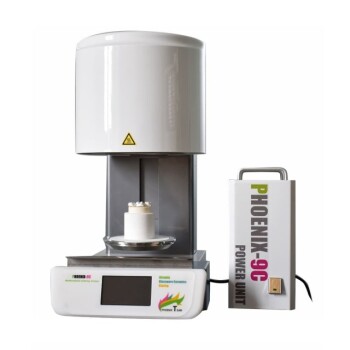
Dental Porcelain Zirconia Sintering Ceramic Furnace Chairside with Transformer

Experience top-notch sintering with Chairside Sintering Furnace with Transformer. Easy to operate, noise-free pallet, and automatic temperature calibration. Order now!

Dental Porcelain Zirconia Sintering Ceramic Vacuum Press Furnace

Dental Porcelain Zirconia Sintering Ceramic Vacuum Press Furnace

Get precise dental results with Dental Vacuum Press Furnace. Automatic temperature calibration, low noise tray, and touch screen operation. Order now!

Boron Nitride (BN) Crucible for Phosphorous Powder Sintered

Boron Nitride (BN) Crucible for Phosphorous Powder Sintered

Phosphorus powder sintered boron nitride (BN) crucible has a smooth surface, dense, pollution-free and long service life.

Vacuum Dental Porcelain Sintering Furnace

Vacuum Dental Porcelain Sintering Furnace

Get precise and reliable results with KinTek's Vacuum Porcelain Furnace. Suitable for all porcelain powders, it features hyperbolic ceramic furnace function, voice prompt, and automatic temperature calibration.

High Temperature Muffle Oven Furnace for Laboratory Debinding and Pre Sintering

High Temperature Muffle Oven Furnace for Laboratory Debinding and Pre Sintering

KT-MD High temperature debinding and pre-sintering furnace for ceramic materials with various molding processes. Ideal for electronic components such as MLCC and NFC.

Cylindrical Press Mold with Scale for Lab

Cylindrical Press Mold with Scale for Lab

Discover precision with our Cylindrical Press Mold. Ideal for high-pressure applications, it molds various shapes and sizes, ensuring stability and uniformity. Perfect for lab use.


Leave Your Message