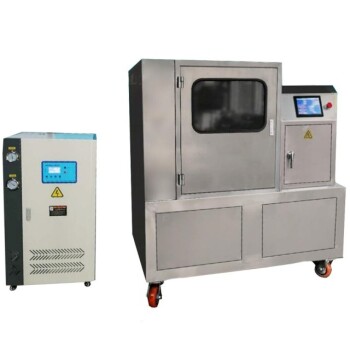
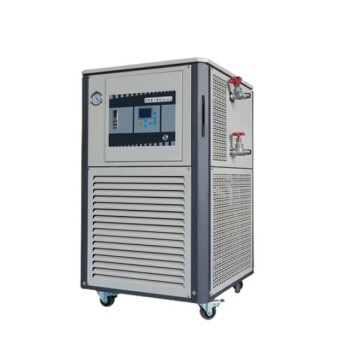
Rapid cooling systems typically employ water injection mechanisms to drastically reduce the temperature of FeCrAl alloys. This process is engineered to mimic the emergency cooling protocols required immediately following an industrial accident, abruptly shifting the material's environment from critical to stable conditions.
Core Takeaway The fundamental goal of these experiments is to validate the "self-healing" nature of the alloy's protective film. The rapid cooling process forces the surface oxide to transition from an accident-induced alumina (Al2O3) structure back to a standard chromium oxide (Cr2O3) layer, proving the material's reversibility.
The Mechanics of the Simulation
Simulating Emergency Scenarios
The primary mechanism used in these quenching experiments is a water injection system.
This setup is designed to replicate the sudden thermal shock and environmental shift that occurs during emergency cooling procedures in industrial settings.
Environmental Fluctuation
The experiment does not just lower temperature; it fundamentally alters the chemical environment surrounding the alloy.
By rapidly introducing water, the system simulates the transition from a high-temperature accident environment to a cooler, recovery phase.
Impact on the Oxide Layer
The Accident State (Alumina)
Prior to cooling, the FeCrAl alloy exists in a simulated accident condition.
In this high-stress state, the protective layer on the alloy's surface is composed primarily of alumina (Al2O3).
The Normal State (Chromium Oxide)
The target outcome of the quenching process is to return the surface to its baseline condition.
Under normal operating parameters, the protective film should consist of chromium oxide (Cr2O3).
The Phase Transition
The rapid cooling mechanism acts as the catalyst for this chemical shift.
It demonstrates the material's ability to switch its protective oxide composition in response to the changing temperature and environmental conditions.
Validating Material Resilience
Testing Reversibility
The crucial metric in these experiments is reversibility.
Researchers use the cooling system to verify that the oxide formation is not permanent and can revert to its standard state once accident conditions subside.
Verifying Self-Healing
This process serves as a proof-of-concept for the alloy's self-healing capabilities.
It confirms that the protective film can regenerate and adapt, maintaining integrity even after enduring extreme fluctuations.
Understanding the Constraints
Simulation vs. Reality
While water injection effectively mimics thermal shock, it is a controlled approximation of a chaotic event.
The experiment focuses specifically on the chemical reversibility of the oxide layer, isolating this variable from other potential accident factors like mechanical debris or radiation.
The Limits of Repair
The experiment is a pass/fail test for the material's surface chemistry.
If the transition from Al2O3 back to Cr2O3 is incomplete or slow, it indicates a failure in the alloy's self-healing mechanism, signaling potential vulnerabilities in real-world safety scenarios.
Interpreting the Experimental Data
To effectively utilize the results of FeCrAl quenching experiments, focus on the specific behavior of the oxide layer.
- If your primary focus is Material Safety: Look for a complete and rapid transition to chromium oxide (Cr2O3), as this confirms the alloy can recover its standard protective layer after an accident.
- If your primary focus is Accident Modeling: Analyze the alumina (Al2O3) stability prior to cooling to understand how the material holds up during the peak of the simulated crisis.
Successful rapid cooling demonstrates not just thermal resistance, but the chemical adaptability required for long-term reliability.
Summary Table:
| Feature | Accident Condition | Post-Quenching State |
|---|---|---|
| Dominant Oxide Layer | Alumina (Al2O3) | Chromium Oxide (Cr2O3) |
| Environmental Phase | High-Temperature Stress | Recovery & Stable Phase |
| Cooling Mechanism | N/A | Rapid Water Injection |
| Material Goal | Resistance to Failure | Chemical Reversibility |
| Primary Metric | Structural Integrity | Self-Healing Capability |
Precision is critical when simulating extreme industrial environments. KINTEK provides advanced high-temperature furnaces, high-pressure reactors, and rapid cooling solutions designed to test the resilience of your advanced materials. Whether you are researching FeCrAl alloys or developing next-generation energy systems, our comprehensive range of laboratory equipment—including vacuum furnaces, autoclaves, and crushing systems—ensures your data is accurate and reproducible. Contact KINTEK today to equip your lab with the industry-leading tools needed for reliable material science and accident simulation research.
References
- Vipul Gupta, Raúl B. Rebak. Utilizing FeCrAl Oxidation Resistance Properties in Water, Air and Steam for Accident Tolerant Fuel Cladding. DOI: 10.1149/08502.0003ecst
This article is also based on technical information from Kintek Solution Knowledge Base .
Related Products
- Multifunctional Electrolytic Electrochemical Cell Water Bath Single Layer Double Layer
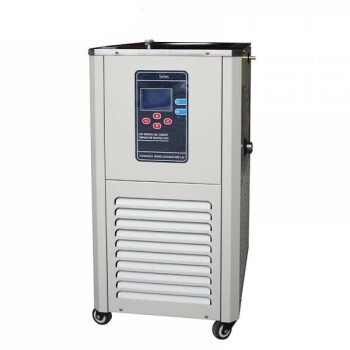
- 50L Heating Chilling Circulator Cooling Water Bath Circulator for High and Low Temperature Constant Temperature Reaction
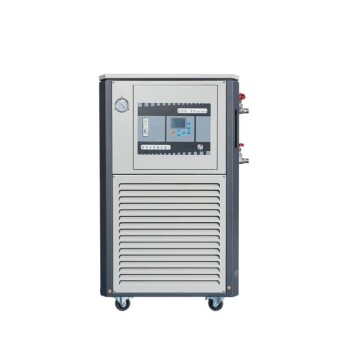
- 5L Heating Chilling Circulator Cooling Water Bath Circulator for High and Low Temperature Constant Temperature Reaction
- 10L Chilling Circulator Cooling Water Bath Low Temperature Constant Temperature Reaction Bath
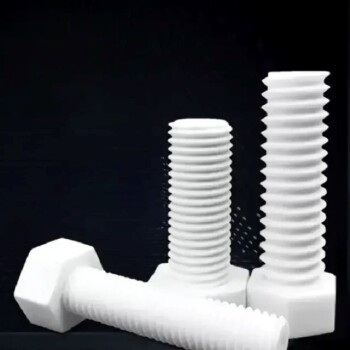
- High Quality Alumina Ceramic Screw for Engineering Advanced Fine Ceramics with High Temperature Resistance and Insulation
People Also Ask
- What does the routine maintenance of a double-layer water-bath electrolytic cell involve? A Guide to Ensuring Precision and Longevity
- When is professional repair required for a double-layer water-bath electrolytic cell? Protect Your Lab's Precision and Safety
- What are the key features of a double-layer water-bath electrolytic cell? Achieve Precise Temperature Control for Your Experiments
- What are the procedures for after using a double-layer water-bath electrolytic cell? Ensure Equipment Longevity and Data Accuracy
- What is the typical experimental system used with a double-layer water-bath electrolytic cell? Achieve Precise Electrochemical Control