Knowledge thermal elements What is the melting point of tungsten in a vacuum? The Real Limit is Sublimation, Not Melting
Author avatar

Tech Team · Kintek Solution

Updated 2 months ago

What is the melting point of tungsten in a vacuum? The Real Limit is Sublimation, Not Melting


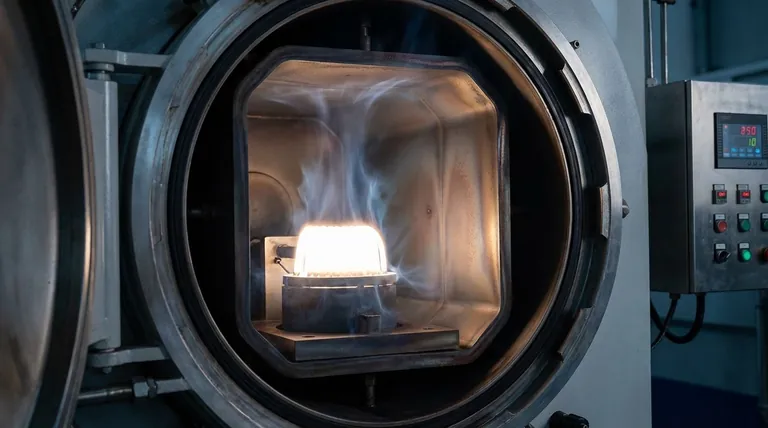
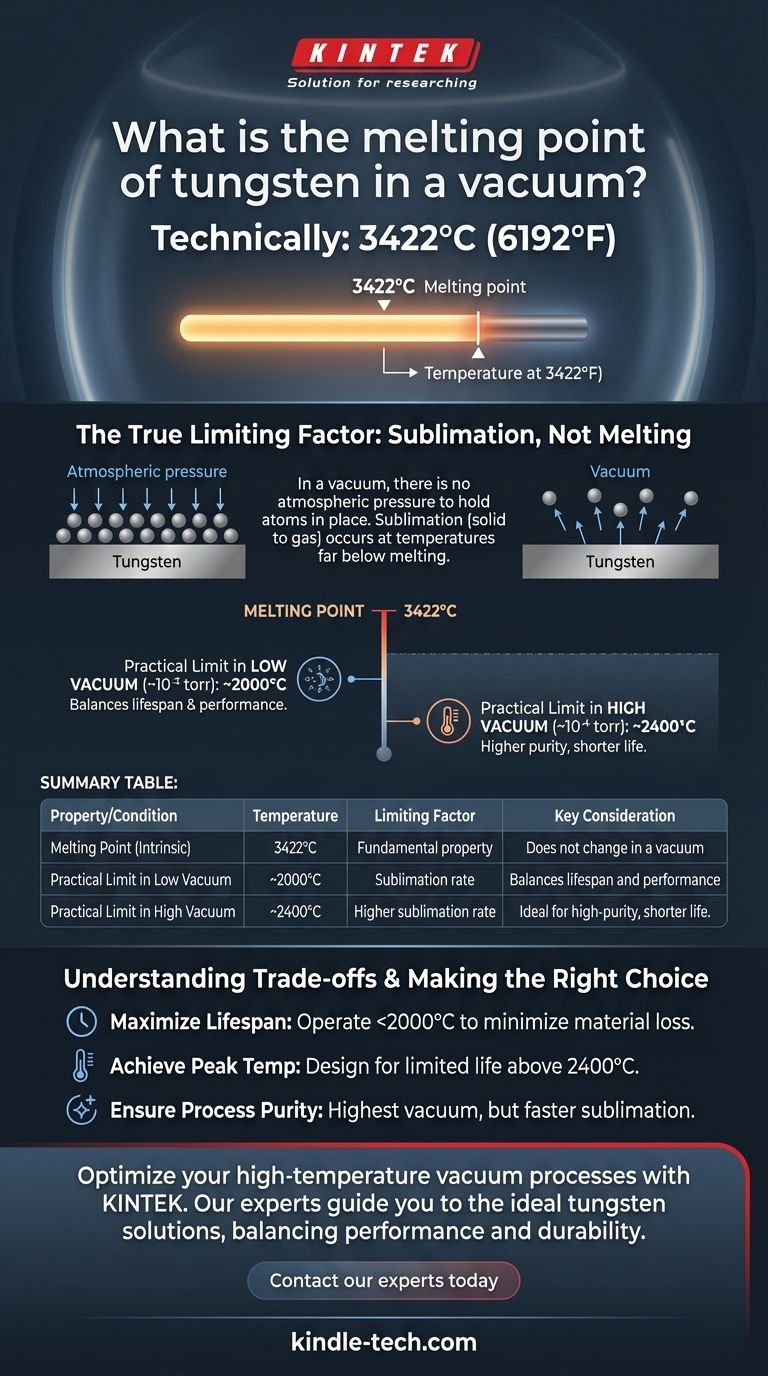
Technically, the melting point of tungsten is 3422°C (6192°F), and this fundamental physical property does not change in a vacuum. However, this value is often misleading in practical applications, as the true limiting factor for tungsten at high temperatures in a vacuum is not melting, but evaporation.

The core issue isn't whether tungsten will melt, but at what temperature it begins to sublimate—turning directly from a solid into a gas. This sublimation process occurs at temperatures far below the actual melting point and dictates tungsten's maximum usable temperature in a vacuum environment.
What is the melting point of tungsten in a vacuum? The Real Limit is Sublimation, Not Melting

Melting Point vs. Usable Temperature

Understanding the distinction between a material's melting point and its practical operating temperature is critical for any high-temperature vacuum application.

An Intrinsic Property

The melting point of a pure metal is an intrinsic physical property. It is the specific temperature at which the material transitions from a solid to a liquid state. For tungsten, this is an exceptionally high 3422°C.

The Role of Atmospheric Pressure

Under normal atmospheric pressure, air molecules constantly bombard the surface of the metal. This pressure helps to "hold in" the tungsten atoms, making it more difficult for them to escape the solid structure.

The Critical Factor in a Vacuum: Sublimation

When you remove the atmospheric pressure by creating a vacuum, the behavior of the material at high temperatures changes dramatically.

What is Sublimation?

Sublimation is the process where a substance transitions directly from a solid to a gas, bypassing the liquid phase entirely. Think of it as a form of evaporation for solids.

Why Vacuum Accelerates Sublimation

In a vacuum, there is virtually no external pressure holding the tungsten atoms in place. As the tungsten is heated, its atoms vibrate more energetically until they have enough energy to break free from the surface and enter the vacuum as a gas.

Practical Temperature Limits

This sublimation is why the maximum practical operating temperature of tungsten in a vacuum is significantly lower than its melting point. The rate of material loss due to sublimation increases with both temperature and the quality of the vacuum (lower pressure).

For example, established engineering limits show that tungsten's usable temperature is often capped to control the rate of this material loss. It can be used up to 2000°C in a low vacuum (10⁻² torr) and around 2400°C in a high vacuum (10⁻⁴ torr) before the rate of evaporation becomes problematic for most components.

Understanding the Trade-offs

Operating tungsten in a vacuum involves a constant balance between temperature, component lifespan, and process purity.

Temperature vs. Material Longevity

Every increase in temperature exponentially increases the rate of sublimation. Pushing a tungsten heating element closer to its limit means it will degrade faster, requiring more frequent and costly replacement.

Vacuum Level and Performance

A stronger vacuum (lower pressure) is often desired for process purity, as it minimizes contamination from residual air. However, this environment also makes it easier for tungsten atoms to sublimate, which can increase the rate of material loss.

Making the Right Choice for Your Goal

Your application's primary goal determines the ideal operating parameters for tungsten components.

  • If your primary focus is maximizing component lifespan: Operate at conservative temperatures, staying well below the 2000°C threshold to minimize material loss from sublimation.
  • If your primary focus is achieving the highest possible process temperature: Design for a limited component life, accepting that operating above 2400°C will cause rapid degradation.
  • If your primary focus is process purity: Utilize the highest vacuum you can achieve, but be mindful that this will accelerate tungsten sublimation, which could itself become a source of contamination.

Ultimately, managing tungsten in a vacuum is a careful balancing act governed by the physics of sublimation, not melting.

Summary Table:

Property / Condition Temperature / Limiting Factor Key Consideration
Melting Point (Intrinsic) 3422°C (6192°F) Fundamental property; does not change in a vacuum.
Practical Limit in Low Vacuum (~10⁻² torr) ~2000°C Sublimation rate becomes significant; balances lifespan and performance.
Practical Limit in High Vacuum (~10⁻⁴ torr) ~2400°C Higher sublimation rate; ideal for high-purity processes but shorter component life.

Optimize your high-temperature vacuum processes with KINTEK.

Choosing the right parameters for tungsten components is critical for the success and longevity of your equipment. Whether your priority is maximizing component lifespan, achieving peak temperatures, or ensuring ultimate process purity, KINTEK's expertise in lab equipment and consumables can guide you.

Our specialists can help you select the ideal tungsten-based solutions for your specific vacuum furnace or high-temperature application, ensuring you get the performance and durability you need.

Contact our experts today to discuss your application and find the perfect balance for your lab's needs.

Visual Guide
What is the melting point of tungsten in a vacuum? The Real Limit is Sublimation, Not Melting Visual Guide

Related Products

People Also Ask

Related Products

2200 ℃ Tungsten Vacuum Heat Treat and Sintering Furnace

2200 ℃ Tungsten Vacuum Heat Treat and Sintering Furnace

Experience the ultimate refractory metal furnace with our Tungsten vacuum furnace. Capable of reaching 2200℃, perfect for sintering advanced ceramics and refractory metals. Order now for high-quality results.

Small Vacuum Heat Treat and Tungsten Wire Sintering Furnace

Small Vacuum Heat Treat and Tungsten Wire Sintering Furnace

The small vacuum tungsten wire sintering furnace is a compact experimental vacuum furnace specially designed for universities and scientific research institutes. The furnace features a CNC welded shell and vacuum piping to ensure leak-free operation. Quick-connect electrical connections facilitate relocation and debugging, and the standard electrical control cabinet is safe and convenient to operate.

Molybdenum Tungsten Tantalum Special Shape Evaporation Boat

Molybdenum Tungsten Tantalum Special Shape Evaporation Boat

Tungsten Evaporation Boat is ideal for vacuum coating industry and sintering furnace or vacuum annealing. we offers tungsten evaporation boats that are designed to be durable and robust, with long operating lifetimes and to ensure consistent smooth and even spreading of the molten metals.

Molybdenum Vacuum Heat Treat Furnace

Molybdenum Vacuum Heat Treat Furnace

Discover the benefits of a high-configuration molybdenum vacuum furnace with heat shield insulation. Ideal for high-purity, vacuum environments like sapphire crystal growth and heat treatment.

Vacuum Heat Treat and Molybdenum Wire Sintering Furnace for Vacuum Sintering

Vacuum Heat Treat and Molybdenum Wire Sintering Furnace for Vacuum Sintering

A vacuum molybdenum wire sintering furnace is a vertical or bedroom structure, which is suitable for withdrawal, brazing, sintering and degassing of metal materials under high vacuum and high temperature conditions. It is also suitable for dehydroxylation treatment of quartz materials.

600T Vacuum Induction Hot Press Furnace for Heat Treat and Sintering

600T Vacuum Induction Hot Press Furnace for Heat Treat and Sintering

Discover the 600T Vacuum Induction Hot Press Furnace, designed for high-temperature sintering experiments in vacuum or protected atmospheres. Its precise temperature and pressure control, adjustable working pressure, and advanced safety features make it ideal for nonmetal materials, carbon composites, ceramics, and metal powders.

Ultra-High Temperature Graphite Vacuum Graphitization Furnace

Ultra-High Temperature Graphite Vacuum Graphitization Furnace

The ultra-high temperature graphitization furnace utilizes medium frequency induction heating in a vacuum or inert gas environment. The induction coil generates an alternating magnetic field, inducing eddy currents in the graphite crucible, which heats up and radiates heat to the workpiece, bringing it to the desired temperature. This furnace is primarily used for graphitization and sintering of carbon materials, carbon fiber materials, and other composite materials.

Graphite Vacuum Furnace IGBT Experimental Graphitization Furnace

Graphite Vacuum Furnace IGBT Experimental Graphitization Furnace

IGBT experimental graphitization furnace, a tailored solution for universities and research institutions, with high heating efficiency, user-friendliness, and precise temperature control.

Vacuum Heat Treat Sintering Brazing Furnace

Vacuum Heat Treat Sintering Brazing Furnace

A vacuum brazing furnace is a type of industrial furnace used for brazing, a metalworking process that joins two pieces of metal using a filler metal that melts at a lower temperature than the base metals. Vacuum brazing furnaces are typically used for high-quality applications where a strong, clean joint is required.

Vacuum Heat Treat and Pressure Sintering Furnace for High Temperature Applications

Vacuum Heat Treat and Pressure Sintering Furnace for High Temperature Applications

Vacuum pressure sintering furnaces are designed for high temperature hot pressing applications in metal and ceramic sintering. Its advanced features ensure precise temperature control, reliable pressure maintenance, and a robust design for seamless operation.

2200 ℃ Graphite Vacuum Heat Treat Furnace

2200 ℃ Graphite Vacuum Heat Treat Furnace

Discover the power of the KT-VG Graphite Vacuum Furnace - with a maximum working temperature of 2200℃, it's perfect for vacuum sintering of various materials. Learn more now.

Graphite Vacuum Furnace Bottom Discharge Graphitization Furnace for Carbon Materials

Graphite Vacuum Furnace Bottom Discharge Graphitization Furnace for Carbon Materials

Bottom-out graphitization furnace for carbon materials, ultra-high temperature furnace up to 3100°C, suitable for graphitization and sintering of carbon rods and carbon blocks. Vertical design, bottom discharging, convenient feeding and discharging, high temperature uniformity, low energy consumption, good stability, hydraulic lifting system, convenient loading and unloading.

Vertical High Temperature Graphite Vacuum Graphitization Furnace

Vertical High Temperature Graphite Vacuum Graphitization Furnace

Vertical high temperature graphitization furnace for carbonization and graphitization of carbon materials up to 3100℃.Suitable for shaped graphitization of carbon fiber filaments and other materials sintered in a carbon environment.Applications in metallurgy, electronics, and aerospace for producing high-quality graphite products like electrodes and crucibles.

Vacuum Arc Induction Melting Furnace

Vacuum Arc Induction Melting Furnace

Discover the power of Vacuum Arc Furnace for melting active & refractory metals. High-speed, remarkable degassing effect, and free of contamination. Learn more now!

Large Vertical Graphite Vacuum Graphitization Furnace

Large Vertical Graphite Vacuum Graphitization Furnace

A large vertical high-temperature graphitization furnace is a type of industrial furnace used for the graphitization of carbon materials, such as carbon fiber and carbon black. It is a high-temperature furnace that can reach temperatures of up to 3100°C.

Vacuum Heat Treat Furnace and Levitation Induction Melting Furnace

Vacuum Heat Treat Furnace and Levitation Induction Melting Furnace

Experience precise melting with our Vacuum Levitation Melting Furnace. Ideal for high melting point metals or alloys, with advanced technology for effective smelting. Order now for high-quality results.

Vacuum Hot Press Furnace Heated Vacuum Press Machine Tube Furnace

Vacuum Hot Press Furnace Heated Vacuum Press Machine Tube Furnace

Reduce forming pressure & shorten sintering time with Vacuum Tube Hot Press Furnace for high-density, fine-grain materials. Ideal for refractory metals.

Vacuum Heat Treat Furnace with Ceramic Fiber Liner

Vacuum Heat Treat Furnace with Ceramic Fiber Liner

Vacuum furnace with polycrystalline ceramic fiber insulation liner for excellent heat insulation and uniform temperature field. Choose from 1200℃ or 1700℃ max. working temperature with high vacuum performance and precise temperature control.

Horizontal High Temperature Graphite Vacuum Graphitization Furnace

Horizontal High Temperature Graphite Vacuum Graphitization Furnace

Horizontal Graphitization Furnace: This type of furnace is designed with the heating elements placed horizontally, allowing for uniform heating of the sample. It's well-suited for graphitizing large or bulky samples that require precise temperature control and uniformity.

Vacuum Dental Porcelain Sintering Furnace

Vacuum Dental Porcelain Sintering Furnace

Get precise and reliable results with KinTek's Vacuum Porcelain Furnace. Suitable for all porcelain powders, it features hyperbolic ceramic furnace function, voice prompt, and automatic temperature calibration.


Leave Your Message