Knowledge What is the minimum melting-temperature for brazing material? The 450°C Threshold Explained
Author avatar

Tech Team · Kintek Solution

Updated 6 days ago

What is the minimum melting-temperature for brazing material? The 450°C Threshold Explained


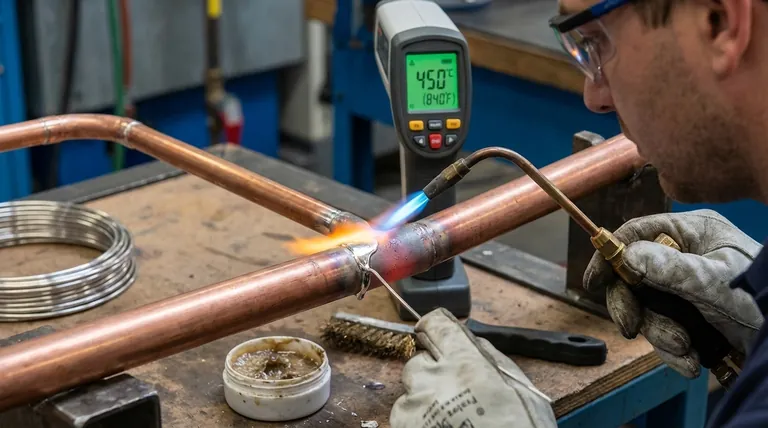
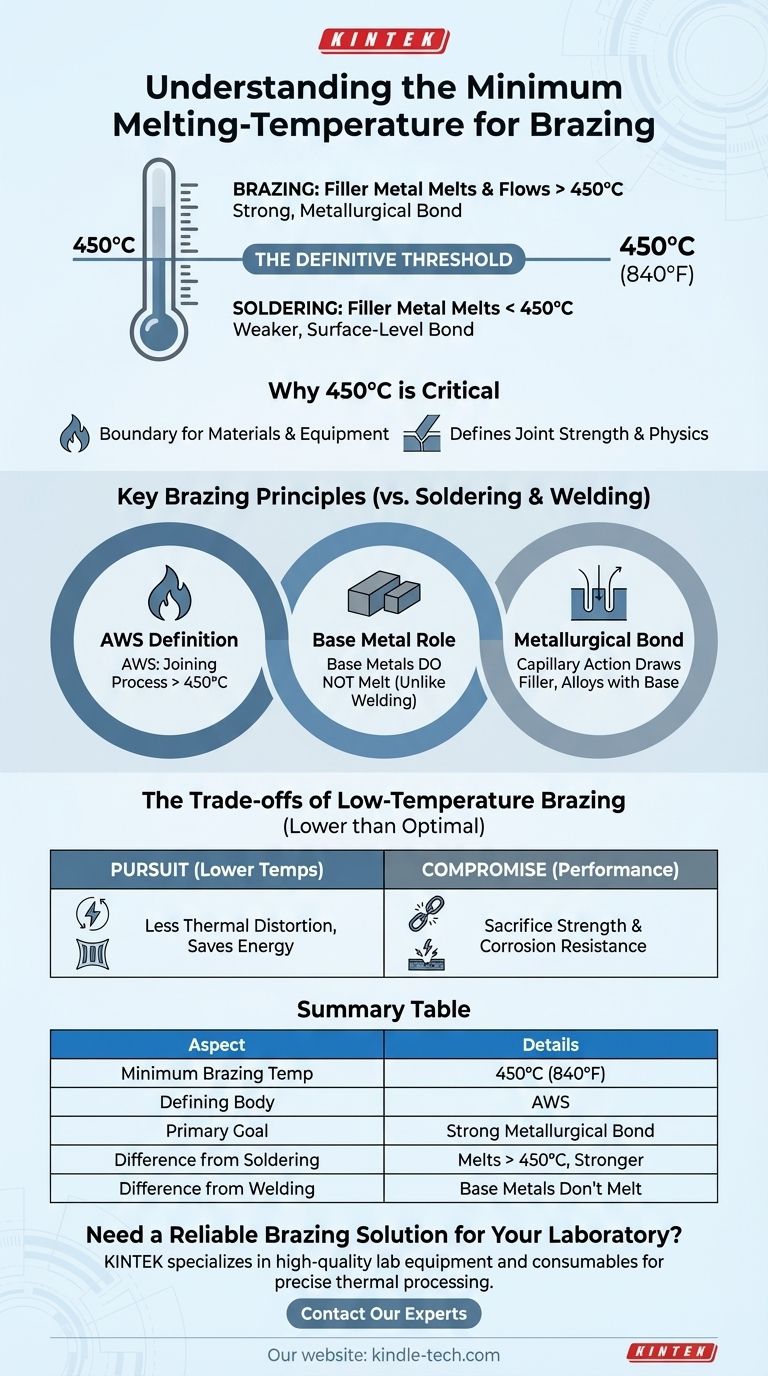
The definitive minimum melting temperature for a filler material to be classified for brazing is 450°C (840°F). This temperature is the internationally recognized dividing line that separates brazing from the lower-temperature process of soldering. For a process to be considered brazing, the filler metal must melt and flow above this point, but always below the melting point of the base metals being joined.

The core principle is not just the temperature itself, but what it represents. The 450°C (840°F) threshold distinguishes brazing—a process that creates a strong, metallurgically-bonded joint via capillary action—from soldering, which typically results in a weaker, surface-level bond.
What is the minimum melting-temperature for brazing material? The 450°C Threshold Explained

Why 450°C is the Critical Threshold

Understanding this specific temperature reveals the fundamental physics that defines the entire joining process. It's the boundary condition that dictates the materials, equipment, and resulting strength of the final assembly.

Defining Brazing vs. Soldering

The American Welding Society (AWS) formally defines brazing as a group of joining processes that use a filler metal with a liquidus (melting) temperature above 450°C (840°F).

Conversely, any similar process using a filler metal that melts below this temperature is defined as soldering. This distinction is crucial for material selection and engineering specifications.

The Role of the Base Metal

A key principle of brazing is that the base metals being joined do not melt. The process relies on heating a joint to a temperature high enough to melt the filler alloy, but low enough to keep the parent parts—such as steel, copper, or brass—solid.

This is the primary difference between brazing and welding, where the base metals are melted and fused together.

How the Metallurgical Bond Forms

The heat used in brazing (above 450°C) is sufficient to create a strong metallurgical bond between the filler and base metals.

At these temperatures, the liquid filler metal is drawn into the tight-fitting joint by capillary action. It then alloys with a thin layer of the base metal, creating a permanent bond upon cooling that is often stronger than the filler metal itself.

The Trade-offs of Low-Temperature Brazing

While 450°C is the minimum, there is a constant engineering drive to develop alloys that work at the lowest possible temperatures within the brazing range. This pursuit, however, involves significant compromises.

The Pursuit of Lower Temperatures

Operating at lower temperatures reduces the risk of thermal distortion in the base parts, saves energy, and can speed up production cycles. This makes the development of effective, low-temperature brazing alloys a highly desirable goal.

The Compromise in Performance

As noted in laboratory research, many experimental low-temperature brazing alloys have not yet met industrial requirements.

These specialized alloys often sacrifice critical properties like corrosion resistance and mechanical strength to achieve a lower melting point. This makes them unsuitable for many demanding applications.

The Importance of Flux

Flux is a chemical compound used to clean and protect the base metals from oxidation during heating, which is essential for proper filler metal flow.

The flux must have a melting and activation range that is compatible with the filler metal. For example, some common fluxes activate around 565°C (1049°F), meaning they are only suitable for brazing alloys that melt at or above that temperature.

Making the Right Choice for Your Application

Your choice of joining process depends entirely on the required strength, operating conditions, and material properties of the final assembly.

  • If your primary focus is maximum joint strength and high-temperature performance: Brazing is the correct choice, using alloys that operate well above the 450°C minimum.
  • If your primary focus is joining heat-sensitive components or minimizing thermal distortion: Soldering, which operates below the 450°C threshold, is the appropriate process.
  • If you are exploring specialized, low-heat applications: Be aware that experimental low-temperature brazing alloys require careful validation of their mechanical and chemical properties before industrial use.

Understanding this fundamental temperature threshold is the first step toward selecting a reliable and effective joining strategy for your project.

Summary Table:

Key Aspect Details
Minimum Brazing Temperature 450°C (840°F)
Defining Body American Welding Society (AWS)
Primary Goal Create a metallurgical bond via capillary action
Key Difference from Soldering Filler metal melts above 450°C, creating stronger joints
Key Difference from Welding Base metals do not melt; only the filler metal does

Need a Reliable Brazing Solution for Your Laboratory?

Choosing the right brazing materials and equipment is critical for achieving strong, durable joints in your research or production. KINTEK specializes in providing high-quality lab equipment and consumables tailored to your precise thermal processing needs.

Contact our experts today to discuss how our solutions can help you optimize your brazing processes, ensure consistent results, and enhance the integrity of your assemblies.

Visual Guide
What is the minimum melting-temperature for brazing material? The 450°C Threshold Explained Visual Guide

Related Products

People Also Ask

Related Products

Electrode Polishing Material for Electrochemical Experiments

Electrode Polishing Material for Electrochemical Experiments

Looking for a way to polish your electrodes for electrochemical experiments? Our polishing materials are here to help! Follow our easy instructions for best results.

Laboratory Disc Rotary Mixer for Efficient Sample Mixing and Homogenization

Laboratory Disc Rotary Mixer for Efficient Sample Mixing and Homogenization

Efficient Laboratory Disc Rotary Mixer for Precise Sample Mixing, Versatile for Various Applications, DC Motor and Microcomputer Control, Adjustable Speed and Angle.

Custom PTFE Teflon Parts Manufacturer for PTFE Containers

Custom PTFE Teflon Parts Manufacturer for PTFE Containers

PTFE container is a container with excellent corrosion resistance and chemical inertness.

Conductive Carbon Cloth Carbon Paper Carbon Felt for Electrodes and Batteries

Conductive Carbon Cloth Carbon Paper Carbon Felt for Electrodes and Batteries

Conductive carbon cloth, paper, and felt for electrochemical experiments. High-quality materials for reliable and accurate results. Order now for customization options.

High Shear Homogenizer for Pharmaceutical and Cosmetic Applications

High Shear Homogenizer for Pharmaceutical and Cosmetic Applications

Enhance lab efficiency with our high-speed Laboratory Emulsifier Homogenizer for precise, stable sample processing. Ideal for pharmaceuticals & cosmetics.

Thermally Evaporated Tungsten Wire for High Temperature Applications

Thermally Evaporated Tungsten Wire for High Temperature Applications

It has a high melting point, thermal and electrical conductivity, and corrosion resistance. It is a valuable material for high temperature, vacuum and other industries.

Conductive Boron Nitride BN Ceramics Composite for Advanced Applications

Conductive Boron Nitride BN Ceramics Composite for Advanced Applications

Due to the characteristics of boron nitride itself, the dielectric constant and dielectric loss are very small, so it is an ideal electrical insulating material.

Laboratory Vibratory Sieve Shaker Machine Slap Vibrating Sieve

Laboratory Vibratory Sieve Shaker Machine Slap Vibrating Sieve

KT-T200TAP is a slapping and oscillating sieving instrument for laboratory desktop use, with 300 rpm horizontal circular motion and 300 vertical slapping motions to simulate manual sieving to help sample particles pass through better.

High Energy Vibratory Laboratory Ball Mill Grinding Mill Single Tank Type

High Energy Vibratory Laboratory Ball Mill Grinding Mill Single Tank Type

High-energy vibration ball mill is a small desktop laboratory grinding instrument.It can be ball-milled or mixed with different particle sizes and materials by dry and wet methods.

Custom PTFE Teflon Parts Manufacturer for PTFE Ball Valve Seat

Custom PTFE Teflon Parts Manufacturer for PTFE Ball Valve Seat

Seats and inserts are vital components in the valve industry. As a key component, polytetrafluoroethylene is usually selected as the raw material.

Metallographic Specimen Mounting Machine for Laboratory Materials and Analysis

Metallographic Specimen Mounting Machine for Laboratory Materials and Analysis

Precision metallographic mounting machines for labs—automated, versatile, and efficient. Ideal for sample prep in research and quality control. Contact KINTEK today!

Precision Machined Zirconia Ceramic Ball for Engineering Advanced Fine Ceramics

Precision Machined Zirconia Ceramic Ball for Engineering Advanced Fine Ceramics

zirconia ceramic ball have the characteristics of high strength, high hardness, PPM wear level, high fracture toughness, good wear resistance, and high specific gravity.

Laboratory CVD Boron Doped Diamond Materials

Laboratory CVD Boron Doped Diamond Materials

CVD boron-doped diamond: A versatile material enabling tailored electrical conductivity, optical transparency, and exceptional thermal properties for applications in electronics, optics, sensing, and quantum technologies.

1700℃ Laboratory Quartz Tube Furnace with Alumina Tube Tubular Furnace

1700℃ Laboratory Quartz Tube Furnace with Alumina Tube Tubular Furnace

Looking for a high-temperature tube furnace? Check out our 1700℃ Tube Furnace with Alumina Tube. Perfect for research and industrial applications up to 1700C.

Laboratory Hydraulic Press Lab Pellet Press for Button Battery

Laboratory Hydraulic Press Lab Pellet Press for Button Battery

Efficiently prepare samples with our 2T Button Battery Press. Ideal for material research labs and small-scale production. Small footprint, lightweight, and vacuum-compatible.

Custom-Made Alumina Zirconia Special-Shaped Ceramic Plates for Engineering Advanced Fine Ceramics Processing

Custom-Made Alumina Zirconia Special-Shaped Ceramic Plates for Engineering Advanced Fine Ceramics Processing

Alumina ceramics have good electrical conductivity, mechanical strength and high temperature resistance, while zirconia ceramics are known for their high strength and high toughness and are widely used.

Custom PTFE Teflon Parts Manufacturer for Culture Dish and Evaporation Dish

Custom PTFE Teflon Parts Manufacturer for Culture Dish and Evaporation Dish

The PTFE culture dish evaporating dish is a versatile laboratory tool known for its chemical resistance and high-temperature stability. PTFE, a fluoropolymer, offers exceptional non-stick properties and durability, making it ideal for various applications in research and industry, including filtration, pyrolysis, and membrane technology.

Vacuum Hot Press Furnace Machine for Lamination and Heating

Vacuum Hot Press Furnace Machine for Lamination and Heating

Experience clean and precise lamination with Vacuum Lamination Press. Perfect for wafer bonding, thin-film transformations, and LCP lamination. Order now!

Graphite Vacuum Continuous Graphitization Furnace

Graphite Vacuum Continuous Graphitization Furnace

High-temperature graphitization furnace is a professional equipment for graphitization treatment of carbon materials. It is a key equipment for the production of high-quality graphite products. It has high temperature, high efficiency and uniform heating. It is suitable for various high-temperature treatments and graphitization treatments. It is widely used in metallurgy, electronics, aerospace, etc. industry.

Lab-Scale Vacuum Induction Melting Furnace

Lab-Scale Vacuum Induction Melting Furnace

Get precise alloy composition with our Vacuum Induction Melting Furnace. Ideal for aerospace, nuclear energy, and electronic industries. Order now for effective smelting and casting of metals and alloys.


Leave Your Message