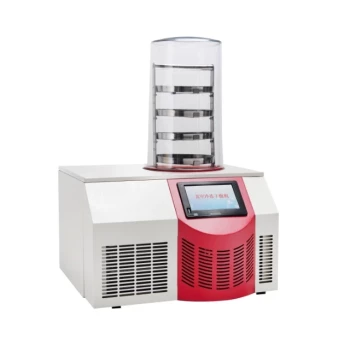
The operating mechanism of a vacuum drying oven relies on the physical principle that reducing ambient pressure lowers the boiling point of liquids. By creating a vacuum within the chamber, residual solvents—such as water, ethanol, or DMF—can be vaporized and removed at significantly lower temperatures than would be possible at atmospheric pressure. This mechanism is effective for drying heat-sensitive nanomaterials without subjecting them to damaging thermal stress.
Vacuum drying facilitates the efficient removal of trapped solvents from porous nanomaterials by manipulating pressure rather than relying solely on high heat. This preserves the structural integrity of delicate frameworks, prevents oxidation, and avoids the pore collapse often associated with standard thermal drying.
The Core Mechanism: Pressure Reduction
Lowering Boiling Points
The fundamental driver of a vacuum drying oven is the relationship between pressure and vaporization. By engaging a vacuum pump, the oven reduces the internal chamber pressure.
This reduction causes the boiling points of solvents trapped within the material to drop drastically. Consequently, solvents evaporate quickly even at low, gentle temperatures.
Deep Solvent Extraction
In the context of nanomaterials, solvents are often trapped deep within complex structures.
For materials like Metal-Organic Frameworks (MOFs) or silica-based nanomaterials, this mechanism allows for the extraction of solvents trapped within micropores. The vacuum environment "pulls" these volatiles out more effectively than surface heating alone.
Preserving Nanostructural Integrity
Preventing Framework Collapse
Nanomaterials often possess delicate pore structures that are vital to their function. High-temperature drying can induce thermal stress, leading to the collapse of these frameworks or the blockage of micropores.
By operating at lower temperatures, vacuum drying protects these sensitive structures. It ensures that the porosity and surface area—key attributes of nanomaterials—remain intact during the post-treatment phase.
Preventing Oxidation
For certain polymers, such as Polyaniline (PANI) nanotubes, exposure to heat and oxygen can be destructive.
Standard ovens circulate hot air, which promotes oxidation. A vacuum oven removes the air (and oxygen) from the chamber, creating an inert environment that prevents thermal degradation and preserves the microscopic morphology of the nanotubes.
Pre-Sintering Stabilization
For nanopowders destined for high-temperature sintering, such as Y3+:CaF2, thorough drying is a critical pretreatment step.
Vacuum drying effectively removes physically adsorbed water and residual solvents. If left behind, these impurities would vaporize explosively during sintering, causing internal pores or cracks in the final ceramic.
Comparison with Standard Convection Ovens
Thermal Stress Differences
Standard drying ovens operate by circulating heated air (convection) to achieve uniformity, often requiring temperatures up to 300°C to be effective.
While effective for sterilizing equipment, this high-heat approach is often too aggressive for nanomaterials. Vacuum ovens achieve drying at much lower temperatures (e.g., around 80°C or lower), mitigating the risk of material degradation.
Airflow vs. Static Vacuum
Standard ovens rely on fans to circulate air.
In contrast, vacuum ovens rely on pressure differentials. This is advantageous for fine nanopowders, as it avoids the potential for blowing or displacing light powder samples, ensuring the material remains contained and uncontaminated.
Making the Right Choice for Your Goal
- If your primary focus is preserving porosity: Use vacuum drying to remove solvents from MOFs or silica without collapsing the delicate pore framework.
- If your primary focus is chemical stability: Rely on the vacuum environment to dry oxidation-sensitive polymers like PANI without degrading their molecular structure.
- If your primary focus is sintering preparation: Ensure all adsorbed water is removed via vacuum drying to prevent cracking or defect formation during the final heating stage.
By decoupling drying efficiency from high temperature, vacuum drying serves as a critical preservation step, ensuring the synthesized nanostructure survives post-treatment to perform as designed.
Summary Table:
| Feature | Vacuum Drying Oven Mechanism | Impact on Nanomaterials |
|---|---|---|
| Driving Force | Lowered ambient pressure | Reduced boiling point of trapped solvents |
| Temperature | Low, gentle heat (e.g., < 80°C) | Prevents thermal stress and framework collapse |
| Environment | Oxygen-depleted vacuum | Eliminates oxidation and chemical degradation |
| Airflow | Static (no fans/convection) | Prevents displacement of fine nanopowders |
| Key Outcome | Deep solvent extraction | Preserves high surface area and porosity |
Elevate Your Nanotechnology Research with KINTEK Precision
Preserving the delicate architecture of MOFs, nanotubes, and nanopowders requires the precise environmental control that only high-quality vacuum drying can provide. KINTEK specializes in advanced laboratory equipment, offering high-performance vacuum ovens, specialized high-temperature furnaces, and cooling solutions designed to protect your most sensitive materials.
Whether you are preparing ceramics for sintering or stabilizing oxidation-sensitive polymers, our technical experts are ready to help you find the perfect system for your workflow.
Contact KINTEK Today for a Professional Consultation to ensure your nanomaterials maintain their structural integrity from synthesis to final application.
References
- Felicia Bucura, Marius Constantinescu. Selectivity of MOFs and Silica Nanoparticles in CO2 Capture from Flue Gases. DOI: 10.3390/nano13192637
This article is also based on technical information from Kintek Solution Knowledge Base .
Related Products
- 56L Vertical Laboratory Vacuum Drying Oven
- 23L Laboratory Vacuum Drying Oven
- Laboratory Scientific Electric Heating Blast Drying Oven
- Benchtop Laboratory Vacuum Freeze Dryer
- Dental Porcelain Zirconia Sintering Ceramic Vacuum Press Furnace
People Also Ask
- Why is a laboratory vacuum drying oven recommended for rice straw residues? Protect Your Biomass Integrity
- What role does a laboratory vacuum drying oven play in the preparation of modified multi-walled carbon nanotubes?
- What is the importance of using a laboratory vacuum drying oven? Preserving Slow-Release Microcapsule Integrity
- Why is a Laboratory Vacuum Drying Oven recommended for PBAT microspheres? Protect Sensitive Polymer Integrity
- What role does a laboratory vacuum drying oven play in processing nanoparticle powder samples? Protect Sample Integrity