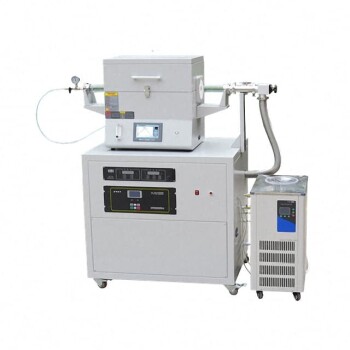
The primary function of a Chemical Vapor Deposition (CVD) system in this specific application is to provide a precisely controlled high-temperature environment necessary for the pyrolysis of gaseous hydrocarbons.
By maintaining a reaction temperature of 1550 °C and strictly managing the gas flow field, the system facilitates the catalyst-free decomposition of precursors like propylene. This process is not merely about depositing carbon; it is engineered to grow a specific hierarchical micro-nano structure on the substrate, which is the defining characteristic that renders the material superhydrophobic.
Core Insight The CVD system does not simply coat a surface; it acts as a structural reactor. By controlling the thermal decomposition of propylene without catalysts, it forces carbon to nucleate and grow into a complex, rough surface texture. This hierarchical architecture—rather than the chemical composition alone—is what generates the superhydrophobic (water-repelling) capability of Low-Density Isotropic Pyrolytic Carbon.
The Mechanics of LDIP Synthesis
Controlled High-Temperature Pyrolysis
The fundamental role of the CVD system is to act as a thermal engine for chemical transformation. It must sustain a stable temperature of 1550 °C.
At this specific thermal threshold, gaseous hydrocarbons (such as propylene) undergo pyrolysis. The system ensures this decomposition happens consistently, allowing carbon atoms to separate from the hydrogen without the need for external catalysts.
Management of Gas Flow Fields
Beyond temperature, the CVD system regulates the dynamics of the gas within the chamber. This includes the introduction of the precursor vapor and its transport to the substrate.
Proper management of this flow field is critical. It ensures that the reactants reach the surface uniformly, allowing for consistent nucleation and growth of the solid phase across the entire deposition area.
Creation of Micro-Nano Structures
The ultimate goal of this specific CVD setup is structural engineering at a microscopic level. The process is tuned to produce hierarchical micro-nano structures.
This roughness is not a defect; it is a design feature. These complex physical structures trap air and reduce the contact area for water droplets, directly resulting in the material's superhydrophobic performance.
Advantages of the CVD Approach
Bottom-Up Molecular Growth
CVD is a "bottom-up" technology. It builds the film atom by atom via chemical reactions on the surface.
This allows for the creation of high-purity, dense films. Because the coating grows from the surface outward, the adhesion and structural integrity of the LDIP are typically superior to coatings applied via physical means.
Non-Line-of-Sight Deposition
Unlike Physical Vapor Deposition (PVD), CVD relies on gas diffusion rather than line-of-sight spraying.
This gives the system high "throwing power." It can effectively coat complex geometries, deep recesses, and irregular shapes, ensuring the superhydrophobic property is uniform even on non-flat components.
Understanding the Trade-offs
Thermal and Energy Demands
The requirement for 1550 °C is significant. This high-temperature regime demands robust equipment capable of handling extreme thermal stress and consumes considerable energy compared to lower-temperature deposition methods.
Process Complexity
While the concept is simple, the execution is complex. The "catalyst-free" nature of this specific LDIP synthesis means the process relies entirely on thermal energy and gas dynamics.
If the temperature fluctuates or the gas flow becomes turbulent, the specific micro-nano structure may fail to form correctly. This would result in standard pyrolytic carbon, which lacks the desired superhydrophobic properties.
Strategic Application for Material Design
To effectively utilize CVD for Low-Density Isotropic Pyrolytic Carbon, you must prioritize process control over speed.
- If your primary focus is Superhydrophobicity: Prioritize the precision of the gas flow and the stability of the 1550 °C temperature to ensure the formation of the hierarchical micro-nano structure.
- If your primary focus is Purity: Leverage the catalyst-free nature of this high-temperature process to eliminate the risk of metallic contamination in the final carbon coating.
- If your primary focus is Complex Geometry: Rely on CVD’s high throwing power to coat irregular parts, but ensure your reactor design avoids "dead zones" where gas flow might stagnate.
Success in this process depends on viewing the CVD system not just as a heater, but as a tool for sculpting surface topography at the molecular level.
Summary Table:
| Feature | Role in LDIP Synthesis |
|---|---|
| Operating Temperature | 1550 °C (High-temperature pyrolysis) |
| Precursor Gas | Propylene (Catalyst-free decomposition) |
| Key Outcome | Hierarchical micro-nano structural growth |
| Surface Property | Superhydrophobicity (Water-repelling) |
| Process Benefit | High throwing power for complex geometries |
Elevate Your Material Research with KINTEK
Unlock the full potential of Chemical Vapor Deposition (CVD) for your high-performance material synthesis. At KINTEK, we specialize in providing researchers and industrial manufacturers with precision-engineered CVD and PECVD systems capable of handling extreme thermal demands like the 1550°C required for LDIP.
Our extensive portfolio includes:
- Advanced Furnaces: Muffle, tube, rotary, and atmosphere-controlled systems.
- Reaction Vessels: High-temperature high-pressure reactors and autoclaves.
- Material Processing: Crushing, milling, and hydraulic presses (pellet, hot, isostatic).
- Lab Essentials: Specialized electrolytic cells, electrodes, and durable ceramics/crucibles.
Whether you are sculpting micro-nano surface textures or developing high-purity carbon films, KINTEK provides the reliability and technical support your lab deserves. Contact us today to find the perfect equipment solution for your research!
References
- Ruixuan Tan, Bo Liu. A new approach to fabricate superhydrophobic and antibacterial low density isotropic pyrocarbon by using catalyst free chemical vapor deposition. DOI: 10.1016/j.carbon.2019.01.041
This article is also based on technical information from Kintek Solution Knowledge Base .
Related Products
- Chemical Vapor Deposition CVD Equipment System Chamber Slide PECVD Tube Furnace with Liquid Gasifier PECVD Machine
- Customer Made Versatile CVD Tube Furnace Chemical Vapor Deposition Chamber System Equipment
- HFCVD Machine System Equipment for Drawing Die Nano-Diamond Coating
- Split Chamber CVD Tube Furnace with Vacuum Station Chemical Vapor Deposition System Equipment Machine
- Multi Heating Zones CVD Tube Furnace Machine Chemical Vapor Deposition Chamber System Equipment
People Also Ask
- What are the advantages of chemical vapor deposition? Achieve Superior Thin Films for Your Lab
- What types of substrates are used in CVD to facilitate graphene films? Optimize Graphene Growth with the Right Catalyst
- What is the chemical vapor deposition growth process? Build Superior Thin Films from the Atom Up
- How expensive is chemical vapor deposition? Understanding the True Cost of High-Performance Coating
- Why is Chemical Vapor Deposition (CVD) equipment uniquely suited for constructing hierarchical superhydrophobic structures?